
Angel Shark
The Angel Shark (Squatina squatina) is one of the world’s most unusual sharks. Although its broad, flattened body resembles a ray, it is a true shark that belongs to its own unique order, Squatiniformes. Rather than constantly swimming through the open ocean like a great white or mako shark, the Angel Shark spends much of its life resting on the seafloor, hidden beneath sand or fine gravel as it waits for prey to pass nearby.
For centuries, Angel Sharks were common throughout the northeastern Atlantic Ocean and the Mediterranean Sea. Today, however, they are among the most threatened sharks on Earth. Heavy fishing pressure and accidental capture in bottom-trawl fisheries have caused populations to disappear from much of their historic range. The species is now listed as Critically Endangered, making its conservation one of Europe’s highest marine conservation priorities.
Angel Sharks are generally harmless to people. They are masters of camouflage, relying on patience rather than speed to capture fish, crustaceans, and other small marine animals. Their remarkable body shape, specialized hunting strategy, and dramatic conservation story make them one of the ocean’s most fascinating shark species.
What Is an Angel Shark?
The Angel Shark is a species of bottom-dwelling shark belonging to the family Squatinidae, a group commonly known as the angel sharks. Unlike most sharks, which have streamlined bodies designed for constant swimming, Angel Sharks have evolved a flattened shape that allows them to lie motionless on the seafloor.
Although they look similar to rays, Angel Sharks can be distinguished by several important features. Their gill slits are located on the sides of the head rather than underneath the body, their powerful tail remains distinctly shark-like, and their pectoral fins are not fused to the head as they are in true rays. These characteristics reveal their evolutionary relationship with other sharks despite their unusual appearance.
Angel Sharks are highly specialized ambush predators that depend on camouflage instead of pursuit. They bury themselves beneath sand with only their eyes and breathing openings exposed, remaining nearly invisible until prey comes within striking distance.
Physical Appearance
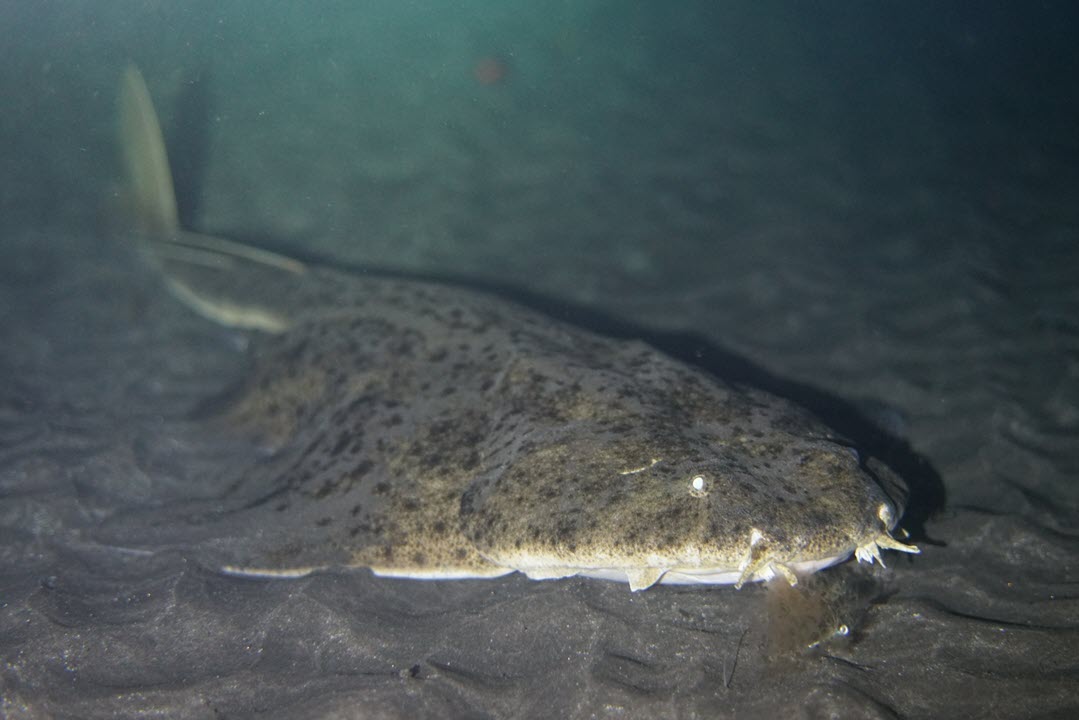
The Angel Shark has one of the most distinctive body shapes of any shark. Adults are commonly around 1.5 meters (5 feet) long, although large females can reach about 2.4 meters (8 feet).Their bodies are broad and flattened, giving them an appearance that closely resembles a ray when viewed from above.
Their large pectoral fins spread outward like wings, while the pelvic fins form a wide platform that helps stabilize the shark as it rests on the seabed. Unlike rays, however, the tail remains muscular and clearly shark-like, ending in a well-developed caudal fin used for short bursts of swimming.
The head is wide and rounded, with relatively small eyes positioned on top to provide a clear view of approaching prey. Just behind the eyes are large spiracles, openings that allow water to pass over the gills while the shark is buried beneath the sand. This adaptation enables the Angel Shark to breathe without drawing sediment into its gills.
Its coloration varies from light sandy brown to grayish brown, often covered with scattered dark spots, pale markings, or irregular patterns that closely resemble the surrounding seafloor. This natural camouflage helps conceal the shark from both prey and predators.
Perhaps the most striking feature is its mouth. Although normally hidden beneath the head, the jaws can extend forward rapidly when prey approaches, allowing the Angel Shark to seize fish before they have time to escape.
Evolution
Angel Sharks belong to a distinctive lineage of sharks that became highly specialized for life on the seafloor. Their lineage diverged from other sharks tens of millions of years ago, eventually evolving into a highly specialized family adapted for life on the seafloor.
While many shark groups evolved streamlined bodies for active swimming, Angel Sharks followed a different evolutionary path. Natural selection favored individuals that could remain hidden on sandy bottoms while waiting for prey instead of chasing it. Over time, their bodies became flatter, their pectoral fins expanded, and their camouflage improved, producing the unique appearance seen today.
Although they resemble rays, Angel Sharks and rays evolved their flattened body shapes independently. This is an example of convergent evolution, where unrelated groups develop similar features because they occupy similar ecological roles rather than because they share a recent common ancestor.
Fossil evidence shows that angel sharks have retained this successful body design for millions of years, making them one of the more recognizable examples of evolutionary specialization among sharks.
Traits and Adaptations
Angel Sharks possess a number of specialized adaptations that allow them to thrive as bottom-dwelling predators.
Their flattened body reduces their profile against the seafloor while their enlarged pectoral fins help stabilize them on soft sediments. Large spiracles behind the eyes allow the shark to breathe while buried beneath sand without drawing sediment through the gills.
Their eyes are positioned on top of the head, giving them an excellent view of the surrounding area while most of the body remains concealed. Like other sharks, Angel Sharks also possess the lateral line, a sensory system that detects tiny vibrations in the water, helping them locate nearby animals even when visibility is poor.
Another remarkable adaptation is the Ampullae of Lorenzini, specialized organs that detect weak electrical fields produced by the muscles and nervous systems of living animals. This allows Angel Sharks to locate prey hidden beneath sand or approaching in darkness.
Powerful jaw muscles and rapidly extending jaws complete their hunting equipment. Once prey comes within range, the strike is both explosive and highly accurate.
Together, these adaptations make Angel Sharks exceptionally effective ambush predators despite their relatively slow, sedentary lifestyle.
Where Angel Sharks Live
Historically, the Angel Shark was widely distributed throughout the northeastern Atlantic Ocean, from southern Norway and the British Isles southward to northwestern Africa. It was also common throughout much of the Mediterranean Sea.
Today, however, its range has become much smaller due to severe population declines. The Canary Islands remain one of the species’ most important strongholds, while populations elsewhere in its former European range have declined severely.
Angel Sharks prefer shallow coastal habitats with sandy or muddy bottoms where they can bury themselves for camouflage. They are commonly found in:
- Sandy bays
- Coastal shelves
- Seagrass meadows
- Estuaries
- Muddy seabeds
- Areas with mixed sand and gravel
Most Angel Sharks live at depths ranging from about 5 to 150 meters (16 to 490 feet), although they occasionally occur deeper.
These habitats provide both abundant prey and the soft sediments needed for their ambush hunting lifestyle. Unfortunately, they also overlap with areas heavily used by commercial fishing, placing Angel Sharks at continued risk throughout much of their remaining range.
What Angel Sharks Eat
Angel Sharks are carnivorous predators that feed primarily on animals living close to the seafloor. Rather than searching continuously for food, they conserve energy by remaining hidden until prey comes within range.
Their diet varies depending on location and age but commonly includes:
- Small bony fish
- Flatfish
- Skates and small rays
- Squid
- Crabs
- Shrimp
- Other crustaceans
Young Angel Sharks generally consume smaller prey such as shrimp and small fish before gradually shifting to larger fish and cephalopods as they mature.
This feeding strategy allows Angel Sharks to occupy an important ecological role by helping regulate populations of bottom-dwelling marine animals.
How Angel Sharks Hunt
Unlike fast-swimming sharks that chase their prey across the open ocean, Angel Sharks rely on stealth, patience, and surprise. They are classic ambush predators, spending much of the day partially buried beneath the sand with only their eyes and spiracles visible above the surface. Their mottled coloration blends almost perfectly with the seafloor, making them nearly impossible for passing fish to detect.
Angel Sharks usually become more active at night when many bottom-dwelling fish begin feeding. Instead of searching constantly for food, they wait motionless until prey swims within range. When the moment is right, the shark launches upward with remarkable speed, extending its jaws forward and creating a powerful suction that pulls the prey into its mouth.
This entire attack often lasts only a fraction of a second.
Their hunting strategy conserves energy while allowing them to capture surprisingly fast prey. Because they depend on camouflage rather than speed, Angel Sharks can remain successful hunters even though they spend long periods resting on the seafloor.
Why Angel Sharks Are Important
Angel Sharks are part of the ocean’s food chains and food webs. A food chain is a simple path showing how one animal provides food for another. A food web is made up of many food chains connected together. Angel Sharks eat fish, rays, crustaceans, and other animals, while young Angel Sharks may be eaten by larger marine predators. This makes the Angel Shark one of many links connecting animals throughout the ocean ecosystem.
Reproduction and Life Cycle
Angel Sharks reproduce through ovoviviparity, in which embryos develop inside the mother’s body and are nourished by yolk rather than a placenta.
Gestation varies among populations. It has been reported at about 8 to 10 months in some areas and around 6 months in the Canary Islands. Females give birth to live young, with litters generally ranging from 7 to 25 pups.
Newborn Angel Sharks measure approximately 24 to 30 centimeters (9 to 12 inches) long and are independent from birth.
Angel Sharks grow slowly and do not reach sexual maturity for several years, which means populations often recover slowly after declines. Even if adult mortality is reduced, rebuilding populations can take decades because relatively few young survive to adulthood.
Angel Shark Conservation
The Angel Shark is classified as Critically Endangered by the International Union for Conservation of Nature (IUCN), making it one of the world’s most threatened shark species.
Its greatest threat is accidental capture in commercial fishing gear, particularly bottom-trawl nets that are dragged across the seafloor. Because Angel Sharks spend much of their lives resting on sandy bottoms, they are especially vulnerable to this type of fishing.
Other major threats include:
- Habitat degradation from coastal development.
- Disturbance of important nursery areas.
- Pollution affecting coastal ecosystems.
- Slow population recovery due to delayed maturity and relatively low reproductive rates.
Despite these challenges, conservation efforts are beginning to show promise.
Several countries have introduced legal protections that prohibit intentionally catching Angel Sharks, while marine protected areas help safeguard important habitats. Scientists continue to monitor surviving populations using underwater surveys, acoustic tagging, and photographic identification.
The Canary Islands have become an international center for Angel Shark conservation, bringing together researchers, conservation organizations, government agencies, divers, and local communities to protect one of the species’ last remaining strongholds.
People can also help by supporting sustainable seafood choices, respecting marine protected areas, reporting Angel Shark sightings to conservation organizations, and learning more about threatened marine wildlife.
| Common Name | Angel Shark, Angelshark |
| Other Common Names | European Angel Shark, Monkfish (historical name in parts of Europe and the United Kingdom) |
| Scientific Name | Squatina squatina |
| Family | Squatinidae |
| Order | Squatiniformes |
| Conservation Status | Critically Endangered (IUCN Red List) |
Interesting Angel Shark Facts
Angel Sharks are unlike almost any other shark species. Their unique appearance and hunting strategy have fascinated scientists for centuries.
- Angel Sharks are among the flattest sharks in the world.
- They are often mistaken for rays because of their broad, wing-like pectoral fins.
- Unlike rays, Angel Sharks have gill slits on the sides of the head.
- They spend much of the day partially buried beneath sand or sediment.
- Their eyes are positioned on top of the head, allowing them to watch for prey while remaining hidden.
- Angel Sharks can move upward from the seafloor in a fraction of a second to capture prey.
- They become more active at night.
- Their mottled brown coloration provides excellent camouflage against sandy seabeds.
- Fossils show that angel sharks have existed for millions of years with relatively little change in body design.
- Most Angel Shark populations have disappeared from large parts of their former range.
- The Canary Islands are one of the few remaining strongholds for the European Angel Shark.
- Because they spend so much time resting on the bottom, Angel Sharks are especially vulnerable to bottom-trawl fishing.
SHARK MENU
Angel Shark Research & Quotes
Modern research has greatly improved our understanding of Angel Shark biology, habitat use, and conservation needs. Scientists now use acoustic transmitters and satellite technology to study seasonal movements, while underwater photography allows researchers to identify individual sharks by their unique spot patterns without disturbing them.
Genetic studies are helping researchers understand how isolated populations are connected, providing valuable information for future conservation planning. Other projects focus on identifying nursery habitats where young Angel Sharks develop, allowing these important areas to receive additional protection.
The Angel Shark serves as a reminder that even species that have survived for millions of years can decline rapidly without effective conservation.
Near disappearance of the Angelshark Squatina squatina over half a century of observations.
This 2019 study examines the dramatic decline of the Angelshark (Squatina...
The distribution, ecology and predicted habitat use of the Critically Endangered angelshark (Squatina squatina) in coastal waters of Wales and the central Irish Sea
This 2022 study investigates the distribution, ecology, and habitat use of the...
Common Angelshark (Squatina squatina) 5-Year Review: Summary and Evaluation
The Common Angelshark (Squatina squatina) 5-Year Review: Summary and...
Single Species Action Plan for the Angelshark (Squatina squatina) in the Mediterranean Sea
The Single Species Action Plan for the Angelshark (Squatina squatina) in the...
Angel Sharks in Culture
Although Angel Sharks are not as widely recognized in folklore as great white sharks or hammerheads, they have long been known by coastal communities throughout Europe and North Africa.
Historically, they were commonly called monkfish in parts of the United Kingdom and Europe because of their broad, flattened appearance. This older name can cause confusion today because the modern commercial fish known as monkfish actually belongs to an entirely different group of fishes called anglerfish.
In recent decades, the Angel Shark has become an important symbol of marine conservation in the Canary Islands, where one of the last healthy populations survives. Educational programs, scientific research, and citizen science projects have helped raise awareness of the species and its fragile future.