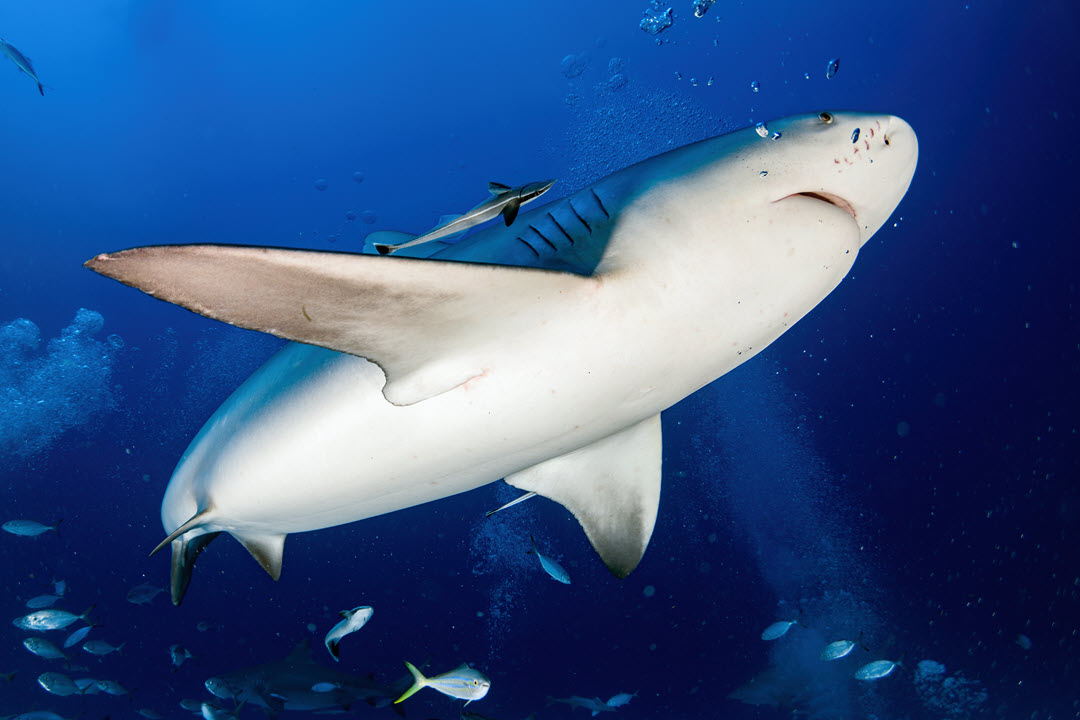
Bull Shark
Bull sharks are powerful sharks with an amazing ability—they can live in both salt water and fresh water.
Most sharks live only in the ocean. Bull sharks can swim from coastal waters into rivers, sometimes traveling hundreds of miles inland. Their ability to live in different kinds of water makes them one of the most unusual sharks in the world.
What Is a Bull Shark?
The bull shark is a large shark found in warm coastal waters around the world. Its scientific name is Carcharhinus leucas.
Bull sharks belong to a group called requiem sharks. This group also includes blue sharks, blacktip sharks, and several other species.
Most adult bull sharks are around 7 to 8 feet long, although some grow larger. Females usually grow larger than males.
Bull sharks get their name from their broad, heavy bodies and short, blunt snouts.
What Do Bull Sharks Look Like?
Bull sharks have thick, powerful bodies. Their snouts are short, wide, and rounded.
They are usually gray on top and much lighter underneath. This coloring helps them blend into the water when seen from above or below.
Bull sharks have a large triangular dorsal fin on their backs. Their strong tails help propel them through the water.
Their teeth are sharp and designed for catching and cutting prey.
What Is the History of Bull Sharks?
Bull sharks belong to the requiem shark family, a large group of sharks found throughout the world’s oceans.
Sharks have lived on Earth for hundreds of millions of years. Over time, different sharks developed features that helped them survive in different habitats.
Bull sharks developed an unusual ability to control the amount of salt and water inside their bodies. This allows them to move between salt water and fresh water.
Scientists study living sharks, fossils, and DNA to learn how bull sharks and other sharks are related.
Where Do Bull Sharks Live?
Bull sharks live in warm coastal waters around the world. They are commonly found near beaches, bays, lagoons, estuaries, and river mouths.
Unlike most sharks, bull sharks can also swim into freshwater rivers and lakes. They have traveled thousands of miles up some large rivers.
Young bull sharks often spend time in shallow bays, estuaries, and rivers. These areas can serve as nurseries, where young sharks can grow.
Bull Shark Behavior
Bull sharks often swim through shallow coastal waters searching for food. They can also travel between ocean and freshwater habitats.
They may spend long periods in rivers and estuaries before returning to the ocean.
Bull sharks often swim slowly while searching for food, but they can move quickly when chasing prey.
What Do Bull Sharks Eat?
Bull sharks are predators that eat many different kinds of animals.
Fish make up much of their diet. They also eat rays, smaller sharks, crabs, shrimp, squid, and sometimes sea turtles.
What they eat depends on their size, location, and which animals are available.
How Do Bull Sharks Hunt?
Bull sharks are powerful hunters.
They often cruise through shallow water looking for prey. When they find an animal they can catch, they can use a quick burst of speed to attack.
Their strong jaws and sharp teeth allow them to catch and eat many different kinds of prey.
Like other sharks, bull sharks have excellent senses that help them detect animals in the water.
Reproduction and Life Cycle
Bull sharks give birth to live young called pups.
The pups develop inside their mother’s body. As they grow, they receive nourishment through a connection called a yolk-sac placenta.
A female can give birth to between 1 and 13 pups. The pups are about 2 to 3 feet long when they are born.
Young bull sharks often grow up in shallow coastal areas and river mouths. These nursery habitats provide places to find food and can help young sharks avoid some larger predators.
Traits
- Bull sharks can live in fresh water. They are one of the few sharks able to spend long periods in rivers and other freshwater habitats.
- They can move between fresh and salt water. Their bodies can control salt and water in ways that most sharks cannot.
- Young bull sharks use nursery areas. Estuaries, lagoons, and river mouths provide important habitat for growing pups.
- They are powerful predators. Bull sharks eat fish, rays, smaller sharks, and many other animals.
- They have a wide range. Bull sharks live in warm coastal waters in many parts of the world.
Why Bull Sharks Are Important
Bull sharks are predators in coastal, estuary, and river ecosystems.
By hunting other animals, bull sharks are part of the food webs that connect animals within an ecosystem.
Bull sharks are especially interesting to scientists because they can move between ocean and freshwater habitats. Studying them helps scientists understand how sharks can survive in very different kinds of water.
Why Bull Sharks Should Be Protected
Scientists have listed bull sharks as Vulnerable, which means they face a high risk of extinction in the wild.
Bull sharks are caught in fishing gear both on purpose and by accident. Because they often live close to shore, they can also be affected by changes to coastal habitats.
Young bull sharks depend on shallow coastal waters, estuaries, and river mouths as nursery areas. Protecting these places can help young sharks survive and grow.
Protecting bull sharks means carefully managing fishing and protecting the coastal and freshwater habitats they need.
READING LEVEL: Grades 4-5 & Above
Shark Pages Menu
Words to Know
Coastal Waters — ocean waters near the shore
Ecosystem — living things and their environment working together
Estuary — a place where fresh water from a river mixes with salt water from the ocean
Fresh Water — water with very little salt, such as water in rivers and lakes
Habitat — the place where an animal lives
Nursery — an area where young animals live and grow
Predator — an animal that hunts and eats other animals
Prey — an animal that is hunted and eaten by another animal
Pup — a baby shark
Requiem Shark — a shark from a large family that includes bull sharks, blue sharks, and many other species
Vulnerable — a conservation status for a species that faces a high risk of extinction in the wild
Yolk-sac Placenta — a connection that provides nourishment to a developing shark pup inside its mother