
Mako Shark
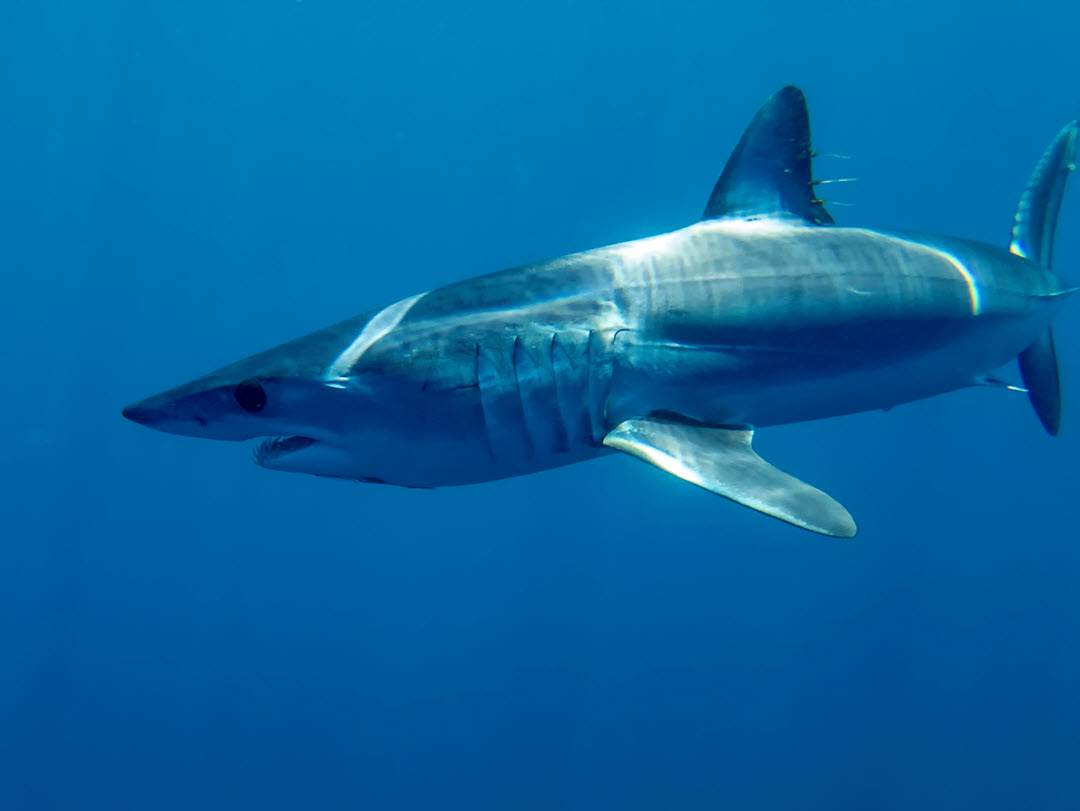
Image: Shortfin Mako Shark
Mako sharks are built for speed. Their streamlined bodies and powerful tails make them some of the fastest sharks in the ocean.
There are two species of mako shark: the shortfin mako and the longfin mako. The shortfin mako is better known and is famous for its speed, powerful swimming, and ability to leap from the water.
What Is a Mako Shark?
Mako sharks are large sharks that live in the open ocean. They belong to a group called mackerel sharks, which also includes great white sharks.
The two species are the shortfin mako and the longfin mako. Shortfin makos are found in warm and mild oceans around the world. Longfin makos are less commonly seen and are not as well studied.
Adult shortfin makos are often around 6 to 10 feet long, although some grow larger.
The name mako comes from the Māori language of New Zealand and refers to a shark or shark tooth.
What Do Mako Sharks Look Like?
Mako sharks have long, streamlined bodies that help them move quickly through the water.
They have pointed snouts, large eyes, and strong crescent-shaped tails. Their fins are shaped to help them swim efficiently through the open ocean.
Shortfin makos are usually deep blue or bluish-gray on top and white underneath. This coloring helps them blend into the ocean.
Their mouths contain rows of long, narrow, pointed teeth. Some of these teeth can still be seen when the shark’s mouth is closed.
What Is the History of Mako Sharks?
Mako sharks belong to the mackerel shark family. Great white sharks and porbeagle sharks are also members of this family.
Sharks have lived in Earth’s oceans for hundreds of millions of years. Over time, different sharks developed features that helped them survive in different habitats.
Mako sharks are well suited for life in the open ocean. Their streamlined bodies, powerful muscles, and strong tails help them travel and chase fast-moving prey.
Scientists study living sharks, fossils, and DNA to learn about the history of mako sharks and how different sharks are related.
Where Do Mako Sharks Live?
Shortfin mako sharks live in warm and mild ocean waters around the world.
They usually live in the open ocean, although they can sometimes be found closer to shore. They travel through large areas of ocean in search of food and suitable water temperatures.
Shortfin makos can make long journeys. Some individuals travel thousands of miles across the ocean.
Longfin makos also live in warm oceans, but scientists know less about their movements and behavior.
Mako Shark Behavior
Mako sharks are strong, active swimmers. Shortfin makos can travel long distances and move quickly when chasing prey.
They are also known for leaping out of the water. A mako may jump several feet above the ocean surface.
Like some other mackerel sharks, makos can keep parts of their bodies warmer than the surrounding water. This helps their muscles and other organs work well while they swim and hunt.
What Do Mako Sharks Eat?
Mako sharks are predators that eat fast-moving ocean animals.
Shortfin makos eat many kinds of fish, including tuna, mackerel, and other large fish. They also eat squid and sometimes other sharks.
Larger makos can catch bigger prey, including swordfish.
What a mako eats depends on its size and which animals are available in its habitat.
How Do Mako Sharks Hunt?
Mako sharks use speed and powerful swimming to catch prey in the open ocean.
Their streamlined bodies reduce resistance as they move through the water. Strong muscles and a powerful tail help them accelerate quickly when chasing prey.
Their sharp teeth help them grab and hold slippery fish and squid.
Like other sharks, makos have highly developed senses that help them locate animals in the water.
Reproduction and Life Cycle
Mako sharks give birth to live young called pups.
The pups develop inside their mother’s body before they are born. They first receive food from yolk. Later, developing pups also eat unfertilized eggs produced by their mother.
Shortfin makos usually give birth to several pups at a time. The pups are already more than 2 feet long when they are born.
Mako sharks grow slowly and take years to become old enough to reproduce. This can make it difficult for their populations to recover when too many sharks are lost.
Traits
- Makos are built for speed. Their streamlined bodies and powerful tails help them chase fast-moving prey.
- Shortfin makos can leap from the water. These powerful sharks sometimes jump several feet above the ocean surface.
- They can keep parts of their bodies warm. This helps their muscles and other organs work well in cooler ocean water.
- They travel long distances. Shortfin makos can cross large areas of the open ocean.
- They have long, pointed teeth. Their teeth help them catch slippery, fast-moving prey.
Why Mako Sharks Are Important
Mako sharks are predators in open-ocean ecosystems.
They hunt fish, squid, and other animals and are part of the food webs that connect ocean life.
Makos are also important to scientists. Studying their swimming, migrations, body temperature, and behavior helps scientists learn more about how large sharks survive in the open ocean.
Why Mako Sharks Should Be Protected
Scientists have listed both shortfin and longfin mako sharks as Endangered, which means they face a very high risk of extinction in the wild.
Mako sharks are caught by commercial fishing boats. Some are caught on purpose, while others are accidentally caught on fishing lines meant for tuna, swordfish, and other animals. Accidental capture is called bycatch.
Mako sharks grow slowly and take years to become old enough to reproduce. This means populations may take a long time to recover when many sharks are caught.
Protecting mako sharks means carefully managing fishing and reducing the number of sharks accidentally caught in fishing gear.
READING LEVEL: Grades 4-5 & Above
Shark Pages Menu
Words to Know
Bycatch — an animal caught accidentally while people are fishing for something else
Endangered — a conservation status for a species that faces a very high risk of extinction in the wild
Habitat — the place where an animal lives
Longfin Mako — one of the two species of mako shark
Mackerel Shark — a shark from a group that includes mako sharks and great white sharks
Migration — the movement of an animal from one area to another
Open Ocean — ocean water far from the coast and ocean floor
Predator — an animal that hunts and eats other animals
Prey — an animal that is hunted and eaten by another animal
Pup — a baby shark
Shortfin Mako — the best-known of the two species of mako shark
Streamlined — having a smooth shape that helps an animal move easily through water
Shortfin Mako Shark