Tiger Shark
The tiger shark is one of the largest sharks in the ocean.
It gets its name from the dark stripes along its body. The stripes are easiest to see on young tiger sharks. They often fade as the sharks grow older.
Tiger sharks are strong swimmers and skilled hunters. They eat many different kinds of food and can live in many parts of the ocean.
What Is a Tiger Shark?
A tiger shark is a large shark that lives in warm oceans around the world. Its scientific name is Galeocerdo cuvier.
Tiger sharks belong to a large family of sharks called requiem sharks. Bull sharks, blue sharks, and many other sharks belong to this family too.
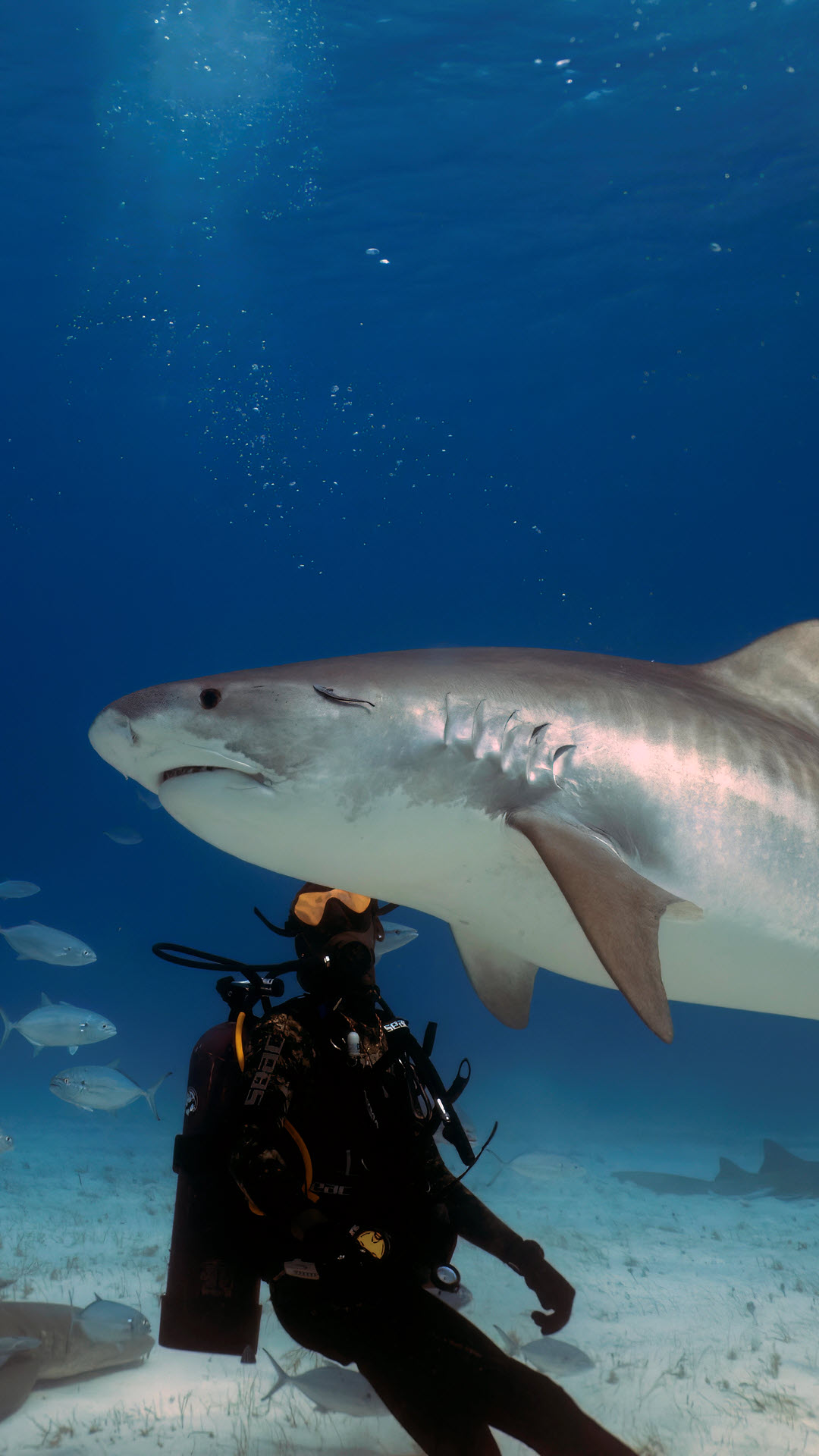
Adult tiger sharks are often about 10 to 14 feet long. Some can grow even larger. Females usually grow larger than males.
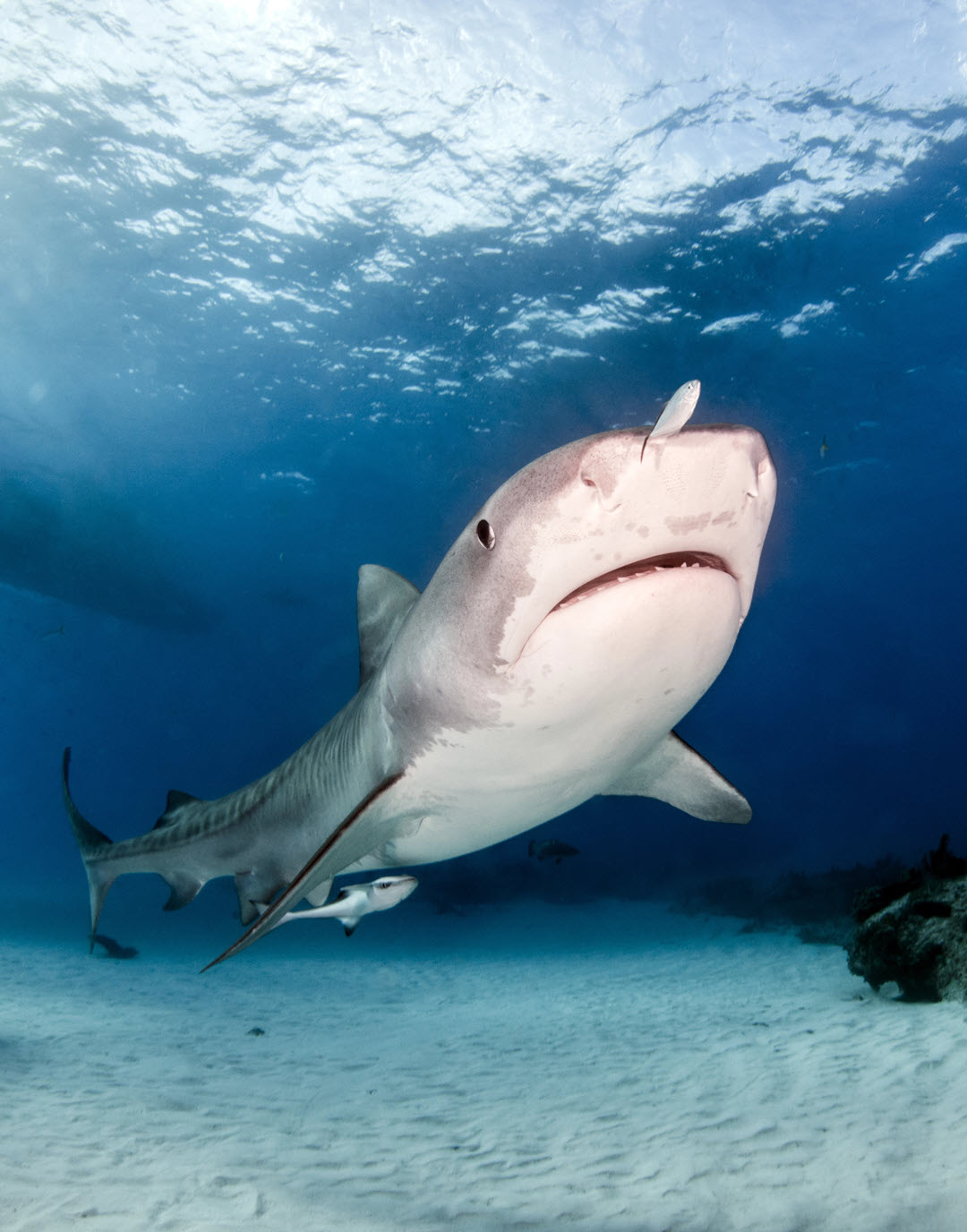
The tiger shark gets its name from the dark stripes and spots on its body. Young tiger sharks have the strongest markings. As they get older, the markings often become harder to see.
What Do Tiger Sharks Look Like?
Tiger sharks have large, strong bodies. Their heads are broad and their snouts are short and blunt.
Their backs can be gray, blue-gray, or greenish-gray. Their undersides are much lighter.
Young tiger sharks have dark spots and stripes along their backs and sides. This pattern makes them easy to recognize.
Tiger sharks also have very unusual teeth. The teeth are curved and have sharp, saw-like edges called serrations. These teeth help tiger sharks cut through tough food.
The upper part of a tiger shark’s tail is long and powerful. The tail pushes the shark through the water as it swims.
History of Tiger Sharks
Sharks have lived in Earth’s oceans for hundreds of millions of years. They were here long before the first dinosaurs appeared.
Tiger sharks are part of this long shark history. Scientists have found fossil teeth from tiger sharks and their ancient relatives.
Teeth are especially important for studying ancient sharks. A shark’s skeleton is made mostly of cartilage, which usually does not fossilize as well as hard bone. Teeth are harder, so they are more likely to survive as fossils.
These fossil teeth give scientists clues about sharks that lived millions of years ago.
Where Do Tiger Sharks Live?
Tiger sharks live in warm waters around the world. They can be found in the Atlantic, Pacific, and Indian Oceans.
They live in many different places. Tiger sharks may swim near beaches, around islands and coral reefs, in bays, or far out in the open ocean.
They do not always stay in one place. Some tiger sharks travel long distances during the year.
Tiger sharks can also swim at different depths. They may be close to the surface at one time and much deeper at another.
Tiger Shark Behavior
Tiger sharks usually travel alone. They may swim over large areas while looking for food.
In some places, tiger sharks are more active at night. They may move into shallow water to look for food and then return to deeper water.
Tiger sharks have powerful senses. They can smell food in the water and feel movements and vibrations around them.
They can even detect tiny electrical signals made by other animals using a special sense organ.
What Do Tiger Sharks Eat?
Tiger sharks eat many different kinds of animals.
Their food can include fish, rays, sea turtles, seabirds, squid, crabs, and other sea animals. Large tiger sharks may also eat marine mammals.
A tiger shark’s diet can change as it grows. It also depends on what kinds of food are available where the shark lives.
How Do Tiger Sharks Hunt?
Tiger sharks often swim slowly while looking for food. Their strong senses help them find animals even when the water is dark or cloudy.
When a tiger shark finds food, it uses its powerful jaws and sharp teeth to bite it.
Its curved teeth have saw-like edges that can cut through tough food. They can even cut through the hard shells of sea turtles.
Reproduction and Life Cycle
Tiger sharks give birth to live young called pups.
The pups grow inside their mother’s body before they are born. They first get food from yolk and later receive additional nourishment from their mother.
A mother tiger shark can give birth to many pups at one time. Newborn tiger sharks are usually about 2 to 3 feet long.
Young tiger sharks have dark spots and stripes. Their markings usually become lighter as they grow.
Tiger sharks grow slowly. It takes several years for a young tiger shark to become an adult.
Traits and Abilities
Young tiger sharks really have stripes. Their dark stripes and spots are much easier to see than the markings on most adults. These markings gave the tiger shark its name.
Tiger sharks eat many kinds of food. Fish, rays, sea turtles, seabirds, squid, and crabs can all be part of their diet.
Their teeth are built for cutting. Tiger shark teeth are curved and have sharp, saw-like edges. This helps them cut through tough food.
They can travel a long way. Tiger sharks may move between coastal waters and the open ocean. Some travel hundreds or even thousands of miles.
They have an amazing electrical sense. Tiger sharks can detect tiny electrical signals made by other animals. This can help them find food that is difficult to see.
Why Are Tiger Sharks Important?
Tiger sharks are important predators in the ocean.
They eat many different kinds of animals. This makes them an important part of the ocean communities where they live.
Tiger sharks can also change the way other animals behave. Some animals may move away or avoid certain places when a large tiger shark is nearby.
Scientists study tiger sharks to learn where they travel, what they eat, and how large ocean predators affect other animals.
Learning about tiger sharks can help us better understand how ocean habitats work.
Why Should Tiger Sharks Be Protected?
Tiger sharks are listed as Near Threatened on the IUCN Red List.
One of the biggest dangers to tiger sharks is fishing. Some are caught on purpose. Others are caught by accident while people are fishing for different animals. This accidental capture is called bycatch.
Tiger sharks grow slowly and take years to become adults. This means their populations may take a long time to recover if too many sharks are killed.
People can help protect tiger sharks by managing fishing carefully, reducing bycatch, and protecting important shark habitats.
Tiger sharks have an important place in the ocean. Protecting them also helps protect the ocean habitats and animals that are connected to them.
READING LEVEL: Grades 4-5 & Above
Shark Pages
Words to Know
Bycatch — an animal caught by accident while people are fishing for something else
Cartilage — the strong, flexible material that makes up a shark’s skeleton instead of bone
Coastal Waters — ocean waters near the coast
Crustacean — an animal with a hard outer covering and jointed legs, such as a crab or shrimp
Fossil — the remains or signs of a living thing from long ago that have been preserved
Habitat — the place where an animal lives
Migration — the movement of animals from one place to another, often at certain times of the year
Near Threatened — a conservation category for a species that may be at risk of becoming threatened in the future
Open Ocean — the large area of ocean away from the coast
Predator — an animal that hunts and eats other animals
Pup — a baby shark
Requiem Shark — a shark from a large family that includes tiger sharks, bull sharks, blue sharks, and many other sharks
Serrations — small, sharp points along an edge, like the teeth of a saw
Tropical — describing warm parts of the world near the equator
Yolk — stored food that feeds a young animal while it develops before birth or hatching