Shark Frontier

A WildE Planet Eco-Learning Lab. Explore the world of sharks - their habitats, evolution, biology, and conservation.

The World of Sharks

Sharks are among the oldest animals on Earth. They have patrolled the world’s oceans for more than 400 million years, surviving multiple mass extinctions and evolving into an incredible variety of forms. There are more than 500 living shark species, ranging from tiny deep-sea species only a few inches long to the enormous whale shark, the largest fish in the world.

Although sharks are often portrayed as dangerous predators, the vast majority pose little or no threat to people. Instead, they play a vital role in maintaining healthy marine ecosystems. By helping regulate populations of fish and other marine animals, sharks contribute to balanced food webs that support the health of oceans around the globe.

Sharks can be found in nearly every marine environment, from shallow coral reefs and coastal estuaries to the deep ocean and even icy polar waters. Their remarkable diversity, specialized adaptations, and long evolutionary history have made them one of the most fascinating groups of animals on the planet.

diver and shark

Interesting Facts

Sharks possess many unique characteristics that have helped them survive for hundreds of millions of years. While different species have evolved to fill many ecological roles, they all share remarkable adaptations for life in the water.

Some sharks are active hunters, while others slowly filter tiny plankton from the ocean. Their diversity is one of the reasons they are so important to marine ecosystems.

  • Sharks appeared more than 400 million years ago, before dinosaurs evolved.
  • More than 500 living species have been identified.
  • The whale shark is the largest fish in the world, growing over 40 feet (12 meters) long.
  • The dwarf lanternshark is one of the smallest sharks, measuring only about 8 inches (20 centimeters).
  • Sharks continually replace lost teeth throughout their lives.
  • Some sharks can detect tiny electrical signals produced by other animals.
  • The Greenland shark may live for more than 250 years, making it one of the longest-lived vertebrates.
  • Not all sharks are predators—whale sharks and basking sharks feed mainly on plankton.
  • Some sharks lay eggs, while others give birth to live young.
  • Shark skin has inspired designs for advanced swimsuits and surfaces that reduce drag in water.
  • Sharks have survived multiple mass extinctions.
  • Most shark species have never been involved in attacks on humans.

2025 Shark Update

Research and conservation efforts continued to improve our understanding of sharks during 2025. Important developments included:

  • Continued use of satellite tagging to map long-distance migrations of whale sharks, great white sharks, tiger sharks, and other species.
  • Expanded use of environmental DNA (eDNA) to detect rare and elusive shark species without capturing them.
  • Ongoing refinement of population estimates for threatened species using genetic analysis and artificial intelligence.
  • Additional marine protected areas and fisheries management measures in several regions aimed at reducing shark mortality.
  • Continued discovery and scientific description of lesser-known deep-sea shark species.
  • Growing use of drones, autonomous underwater vehicles, and AI-assisted image recognition to monitor shark populations and habitats.

Together, these advances are helping scientists better understand shark populations while providing governments and conservation organizations with improved tools for protecting threatened species.

sharking looking at camera

What Is a Shark?

A shark is a cartilaginous fish, meaning its skeleton is made primarily of flexible cartilage rather than bone. Sharks belong to the class Chondrichthyes, which also includes rays, skates, and chimaeras. They are distinguished by multiple gill slits, replaceable teeth, rough skin covered with tiny tooth-like scales called dermal denticles, and highly developed senses that help them locate prey.

Unlike most bony fish, sharks continually replace their teeth throughout their lives. Some species may grow tens of thousands of teeth over a lifetime. Their streamlined bodies, powerful tails, and efficient swimming abilities have helped them become successful predators in nearly every marine habitat.

A big shark - great white shark swimming

Evolution

The ancestors of modern sharks first appeared more than 400 million years ago during the Devonian Period. Early shark-like fishes differed greatly from today’s species, but over millions of years sharks diversified into many forms that occupied different ecological roles.

Some prehistoric sharks became famous for their unusual anatomy. Cladoselache was among the earliest well-known sharks, while Helicoprion possessed a distinctive spiral tooth whorl. Edestus had curved jaws lined with serrated teeth, and Cretoxyrhina was a fast-swimming predator that lived alongside dinosaurs. The giant Megalodon, which lived between about 23 and 3.6 million years ago, was one of the largest predators ever to inhabit Earth’s oceans.

Modern sharks represent only the latest branch of a long evolutionary history. Despite many changes over time, the basic shark body plan has remained remarkably successful.

Edestus Prehistoric Shark

Physical Appearance

Although sharks vary tremendously in size and shape, they share several common features. Most have streamlined bodies, paired pectoral fins for steering, one or two dorsal fins for stability, and powerful tails that provide propulsion through the water. Their skin is covered with tiny, backward-facing dermal denticles that reduce drag and protect the body.

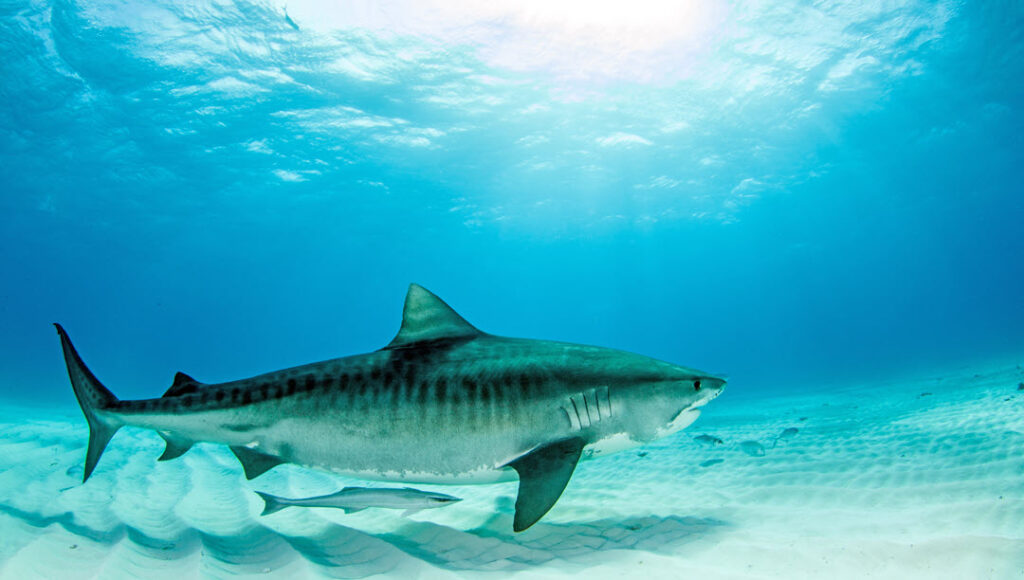
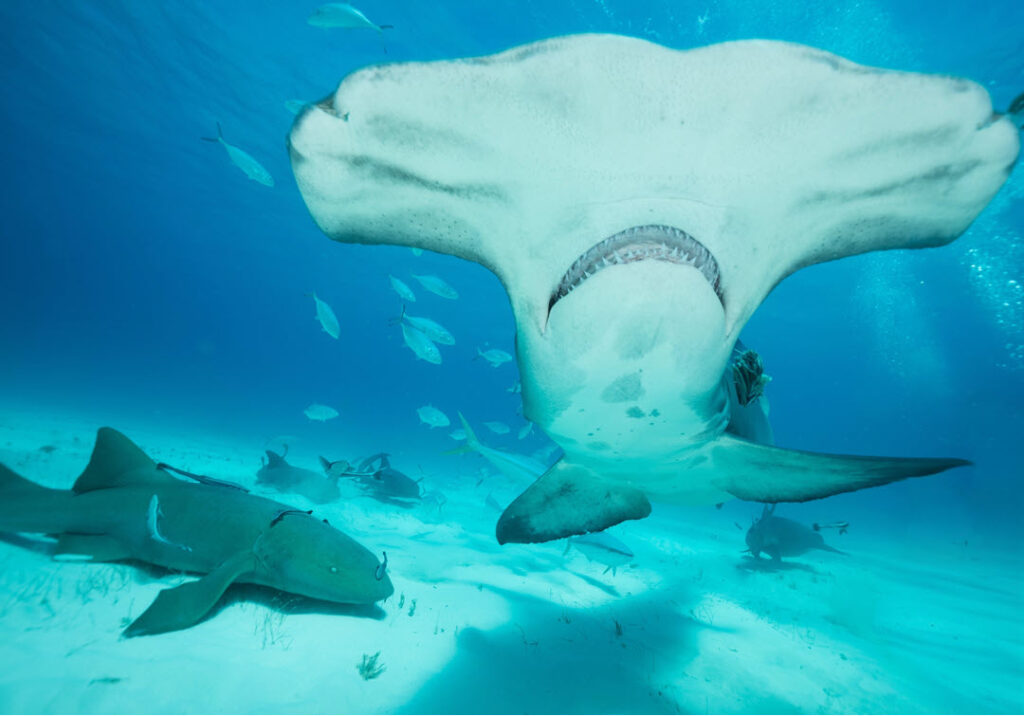
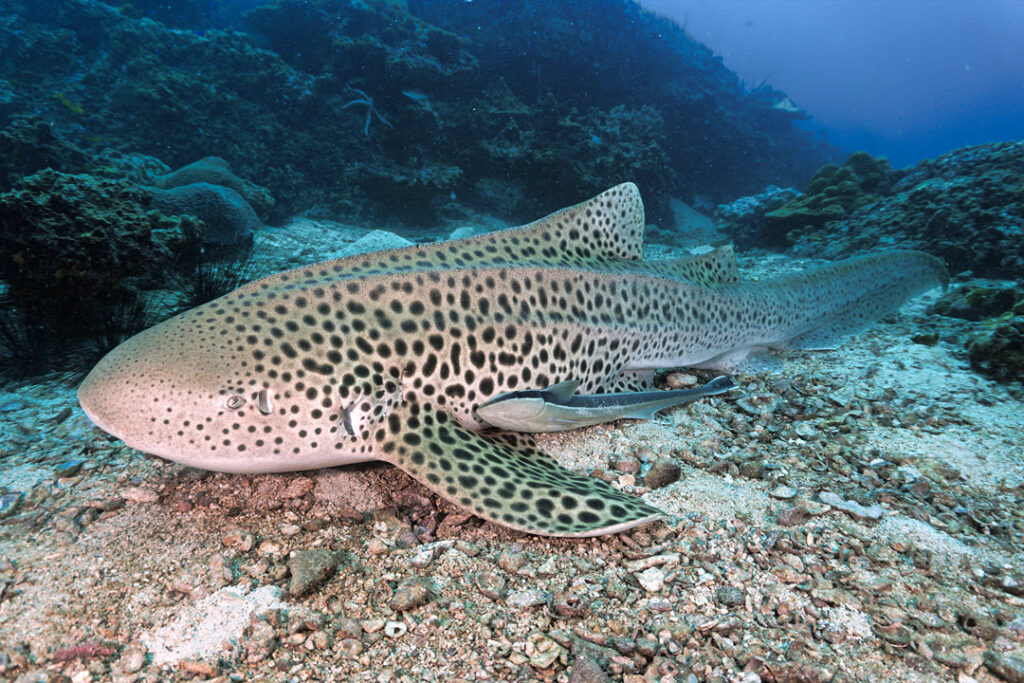
Body shape reflects lifestyle. Great white sharks have torpedo-shaped bodies built for speed, while hammerhead sharks have broad, flattened heads that improve sensory perception. Carpet sharks such as wobbegongs have flattened bodies and camouflage patterns that help them ambush prey on the seafloor. The whale shark’s enormous mouth allows it to filter-feed on plankton, while the goblin shark’s protrusible jaws help capture prey in the deep sea.

Coloration also varies widely. Many sharks display darker upper surfaces and lighter undersides, a pattern known as countershading that provides camouflage from both above and below.

What Sharks Eat

Sharks occupy many feeding roles within marine ecosystems. Some species hunt fish, squid, rays, seals, and other marine mammals, while others specialize in crustaceans, mollusks, or bottom-dwelling animals.

Three of the largest sharks—the whale shark, basking shark, and megamouth shark—are gentle filter feeders that consume tiny plankton and small fish rather than large prey.

Common food sources include:

  • Fish
  • Squid
  • Octopus
  • Crustaceans
  • Mollusks
  • Marine mammals (some species)
  • Plankton (filter-feeding sharks)
shark food sources

How Sharks Hunt

Sharks use a combination of highly developed senses to locate prey. Their excellent sense of smell can detect tiny traces of chemicals in the water, while their lateral line system senses vibrations produced by nearby animals. Specialized organs called the Ampullae of Lorenzini allow sharks to detect weak electrical fields generated by the muscles and nerves of living prey.

Different species use different hunting strategies. Great white sharks often attack from below with bursts of speed, while wobbegongs rely on camouflage to ambush unsuspecting fish. Thresher sharks use their long tails to stun schools of fish, and hammerhead sharks use their broad heads to help locate prey hidden beneath the sand.

group of sharks

Reproduction and Life Cycle

Sharks reproduce through internal fertilization. Depending on the species, females may lay eggs, retain eggs until they hatch inside the body, or give birth to fully developed live young.

Compared with many fish, sharks generally mature slowly and produce relatively few offspring. This slow reproductive rate makes many species especially vulnerable to population declines because they cannot quickly replace lost individuals.

Young sharks are independent from birth in most species and receive little or no parental care. Many coastal areas, shallow bays, and mangrove habitats serve as nursery grounds where juvenile sharks can grow while avoiding larger predators.

Biology: Traits and Adaptations

Sharks possess a remarkable collection of biological adaptations that have contributed to their long evolutionary success. Their lightweight cartilage skeleton provides flexibility while reducing body weight, and their replaceable teeth ensure they always have effective tools for feeding.

Their sensory systems are among the most advanced in the animal kingdom. Excellent hearing, keen eyesight, an acute sense of smell, the vibration-sensitive lateral line, and the electrical detection abilities of the Ampullae of Lorenzini work together to help sharks locate prey even in dark or murky water.

Efficient swimming is supported by powerful muscles, streamlined bodies, and dermal denticles that reduce drag. Many species also possess large, oil-rich livers that help provide buoyancy in the absence of a swim bladder.

Together, these adaptations have allowed sharks to occupy an extraordinary range of marine habitats and remain among the ocean’s most successful predators.

Sharks in Culture

For thousands of years, sharks have captured the human imagination. Different cultures have viewed them as symbols of strength, protection, danger, wisdom, and survival. While modern movies often portray sharks as fearsome predators, many traditional cultures have held far more balanced and respectful views. In Hawaiian culture, sharks are sometimes regarded as ‘aumākua, or family guardian spirits that protect and guide their descendants. Certain sharks were believed to watch over families and warn them of danger. They were also associated with deities such as Kamohoalii the shark god and Ka’ahupahau, the shark goddes. Respect for these guardian sharks remains an important part of Hawaiian tradition. Many Polynesian cultures also viewed sharks as powerful spiritual beings associated with courage, navigation, and the ocean. Some Pacific Island stories describe sharks helping travelers or serving as protectors of fishermen. In Māori tradition, sharks appear in legends and oral histories as symbols of strength and endurance. Some species were respected as powerful ocean animals closely connected with the sea. Sharks have also appeared in famous paintings, like The Gulf Stream, by Winslow Homer (1899).   In Western culture, sharks have become symbols of power, mystery, and danger. Peter Benchley’s 1974 novel Jaws and the 1975 film adaptation introduced millions of people to the great white shark, dramatically increasing public fascination. Although the story helped popularize sharks, it also created misconceptions about their behavior that scientists continue to correct today. Today, sharks appear in documentaries, aquariums, educational programs, sports logos, conservation campaigns, artwork, and photography. As public understanding grows, they are increasingly recognized not only as predators but also as essential members of healthy ocean ecosystems.

Conservation

Sharks face greater threats today than at almost any time in their long evolutionary history. Although they have survived for more than 400 million years, many species are declining because of human activities.

The greatest threat is overfishing. Sharks are caught intentionally for their meat, fins, cartilage, liver oil, and other products. Many are also caught accidentally as bycatch in commercial fishing operations targeting other species. Because most sharks grow slowly, mature late, and produce relatively few young, populations often recover very slowly after declines.

Habitat loss is another growing concern. Coastal development, pollution, destruction of coral reefs, and the loss of mangrove forests can reduce important nursery areas where young sharks grow and develop.

Climate change is also affecting sharks by altering ocean temperatures, changing prey distributions, damaging coral reef ecosystems, and increasing ocean acidification. These environmental changes may force some species to shift their ranges while making survival more difficult for others.

Conservation efforts are expanding around the world and include:

  • Establishing marine protected areas.
  • Regulating commercial shark fisheries.
  • Banning or restricting shark finning in many countries.
  • Supporting scientific research and population monitoring.
  • Protecting important breeding and nursery habitats.
  • Promoting sustainable seafood practices.
  • Educating the public about the ecological importance of sharks.

Individuals can also help by supporting sustainable fisheries, reducing plastic pollution, participating in beach and coastal cleanups, and supporting organizations that protect marine ecosystems.

Protecting sharks benefits far more than a single group of animals. Healthy shark populations help maintain balanced marine food webs that support the overall health of the world’s oceans

Research & Quotes

“Sharks play an important role in the ecosystem by maintaining the species below them in food chain and serving as a indicator of ocean health. Sharks are one of the most important groups of predators of the planet and having over a broad distribution of habitats in every ocean.” – Ahilan, B. & Vinoliya, Crosslin & M., Alwinpeter & Pavinkumar, P.. (2021). ECOLOGICAL IMPORTANCE OF SHARKS. JOURNAL OF AQUACULTURE IN THE TROPICS. 36. 31-38. 10.32381/JAT.2021.36.1-4.4. 


“Sharks are beautiful animals, and if you’re lucky enough to see lots of them, that means that you’re in a healthy ocean. You should be afraid if you are in the ocean and don’t see sharks!” – Marine biologist Dr. Sylvia Earle.

whale shark swimming

Menu

Mailing List

Sign up to receive WildE Planet content in your inbox, including new articles and downloads.

We don’t spam! Read our privacy policy for more info.