
Shark Classification
Scientists classify sharks using a hierarchy that begins with the animal kingdom and becomes increasingly specific, ending with individual species. The easiest way to understand shark classification is by looking at the major shark groups (orders and families). This guide uses those common groups while also including the scientific classification for each section.
How Classification Works
Scientists have identified millions of different species on Earth. To make sense of all that diversity, they sort living things into a system of groups. It starts broad and gets more specific. This system is called classification.
Think of classification like a set of boxes inside bigger boxes. The biggest box holds every living thing on the planet. Inside that box are smaller boxes for animals, plants, fungi, and other major groups. Inside the animal box are even smaller boxes. Each one narrows things down further, until you reach a box that holds just one single species.
Each level of this system is called a rank. Moving from broadest to most specific, the main ranks are Domain, Kingdom, Phylum, Class, Order, Family, Genus, and Species. Every animal on Earth, including every shark, fits somewhere in this system.
Scientists group animals this way because it reflects real relationships. Animals in the same group usually share body features. More importantly, they often share a common ancestor further back in their evolutionary history. Classification isn’t just a filing system — it’s a map of how life on Earth is related.
How Sharks Are Classified
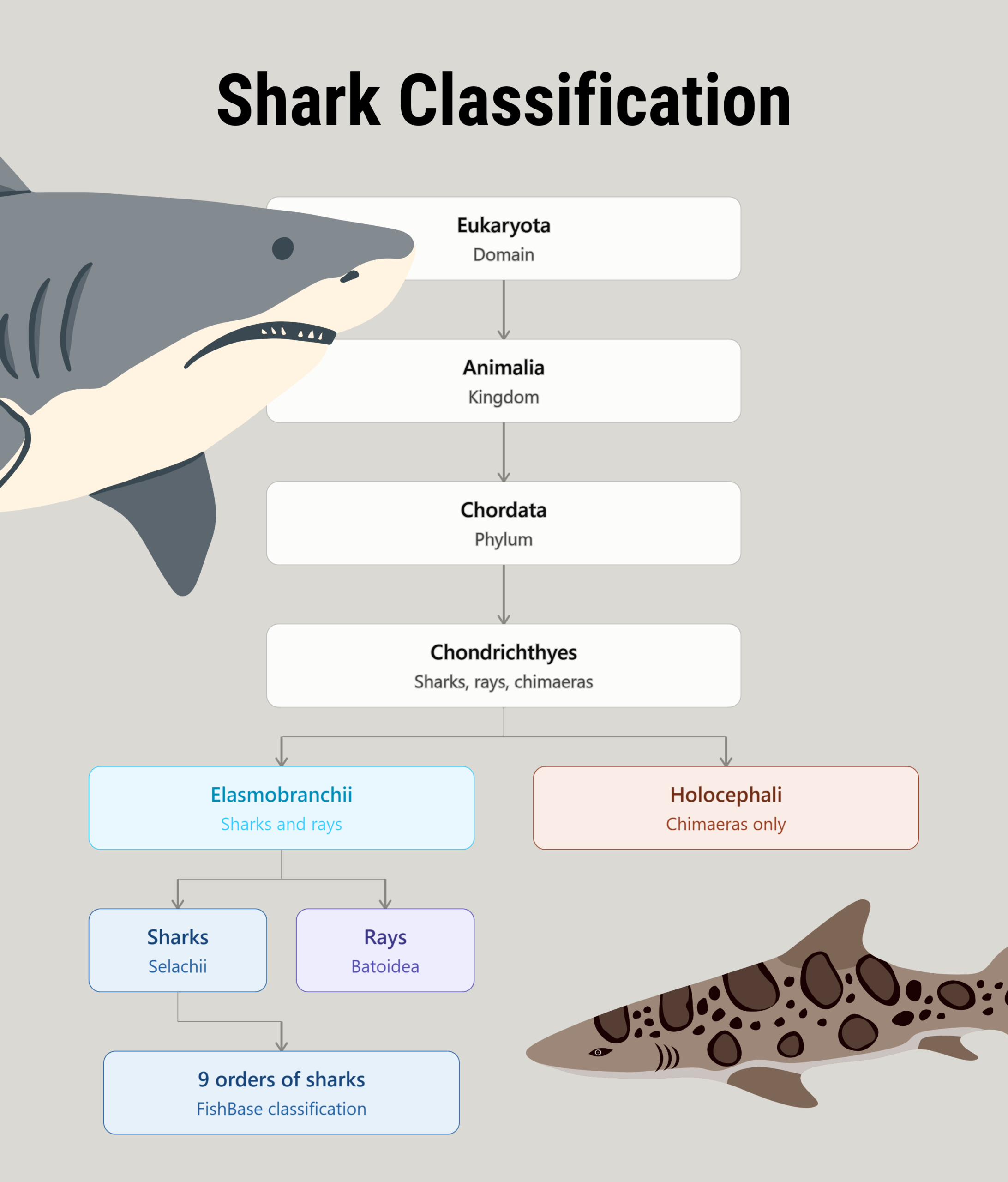
Sharks fit into this same system. Starting from the broadest rank and working down, here’s where sharks belong.
Domain: Eukaryota
At the broadest level, sharks belong to Eukaryota. This domain includes every living thing made of complex cells with a nucleus. This includes animals, plants, fungi, and many other organisms. It’s essentially everything except bacteria and a few other simple single-celled life forms.
Kingdom: Animalia
Within Eukaryota, sharks belong to the kingdom Animalia, the kingdom that includes all animals. Animals are generally able to move. They get their energy by eating other organisms rather than making their own food the way plants do.
Phylum: Chordata
Sharks belong to the phylum Chordata. At some point in their life, every animal in this phylum has a supportive rod running along its back. This rod is called a notochord. In sharks and most other vertebrates, this develops into a backbone.
Class: Chondrichthyes
Within Chordata, sharks belong to the class Chondrichthyes, commonly known as the cartilaginous fish. Unlike most fish, animals in this class have skeletons made of cartilage instead of bone. Cartilage is lighter and more flexible than bone, though it can still become partly hardened in places. Chondrichthyes includes sharks, rays, skates, and chimaeras.
Subclass: Elasmobranchii and Holocephali
Chondrichthyes splits into two subclasses. Elasmobranchii includes sharks and rays. Holocephali includes only chimaeras, an unusual group of deep-sea fish. They’re sometimes called ghost sharks, even though they aren’t true sharks.
Selachii and Batoidea
Within Elasmobranchii, animals split into two further groups. Sharks belong to the group Selachii. Rays, skates, and sawfish belong to the group Batoidea. Sharks and rays are close relatives, but they’re distinct groups with different body plans. Rays are generally flattened, with their gill slits on the underside of the body. Sharks keep the more typical torpedo-shaped body and side-facing gill slits.
Orders: 9 Orders of Sharks
Sharks themselves are divided into 9 living orders, based on FishBase classification. Each order groups together sharks that share a similar body plan and set of features. These orders include everything from fast-swimming open-ocean predators to flattened, bottom-dwelling ambush hunters. The 9 shark orders are:
- Ground Sharks (Carcharhiniformes) — the largest and most diverse order, including requiem sharks, hammerhead sharks, and catsharks
- Mackerel Sharks (Lamniformes) — including great white sharks, mako sharks, basking sharks, and thresher sharks
- Carpet Sharks (Orectolobiformes) — including nurse sharks, whale sharks, wobbegongs, and zebra sharks
- Dogfish Sharks (Squaliformes) — mostly deep-water sharks, including lanternsharks and sleeper sharks
- Bullhead Sharks (Heterodontiformes) — small, bottom-dwelling sharks with blunt heads, like the Port Jackson shark
- Cow & Frilled Sharks (Hexanchiformes) — an ancient lineage with extra gill slits, including the frilled shark
- Angel Sharks (Squatiniformes) — flattened, ray-like ambush predators that bury in the seafloor
- Sawsharks (Pristiophoriformes) — sharks with a long, saw-like snout used to detect and strike prey
- Bramble Sharks (Echinorhiniformes) — a small order of deep-water sharks with thorny, spine-covered skin
From there, each order divides further into families, then genera, and finally individual species. These are the same species you’ll find described on this site’s shark pages, each with its own scientific name made up of its genus and species.
More About Shark Families, Genera, and Species
If you look up how many shark families, genera, or species exist, you’ll find different sources giving different numbers.
One widely cited scientific checklist, published in 2016, organized sharks into 9 orders. It counted 34 living families, 105 genera, and 509 species. Many other sources report shark species numbers above 500, with some recent counts reaching past 540. Estimates of the number of shark families can range even more widely. Some sources cite as few as 14, while others cite 30 or more, depending on which classification system they follow.
Why the Numbers Don’t Match
One reason why the numbers don’t always match is that taxonomists don’t all use the same reference system. You will find major databases like FishBase, the IUCN Red List, and the World Register of Marine Species (WoRMS) updating on different schedules, and deciding which new species descriptions and taxonomic changes to accept and when.
Another reason – ongoing genetic research keeps reshaping the picture. Scientists can now compare DNA instead of relying only on physical features. This sometimes reveals that species once grouped together are actually different, or that an entire family should be split into two. This exact kind of split happened with the deepwater catsharks. They were once grouped inside the catshark family Scyliorhinidae but are now placed in their own separate family, Pentanchidae.
Third, new species are still being found. Most new discoveries come from deep-water habitats that are difficult to explore. Because of this, the total count of shark species keeps climbing as researchers reach places no one has properly studied before.
What’s Generally Accepted
Despite these differences, scientists agree on the big picture. Living sharks are organized into 9 orders. From there, most current classifications put the number of families somewhere in the low-to-mid 30s. The total shark species count sits somewhere above 500 and keeps climbing.
Rather than treat any single number as permanently fixed, it’s more accurate to think of shark classification as a living, ongoing project.
The Science of Taxonomy: Naming & Classifying Animals
The words taxonomy and classification are often used as if they mean the same thing. They’re not quite the same.
Taxonomy is the broader science. It’s the entire practice of identifying, naming, and organizing living things. Taxonomy has two main jobs. The first is nomenclature, the system of giving each species a proper scientific name. The second is classification, the process of sorting species into groups based on how closely related they are. Classification is really just one part of taxonomy, not a separate science of its own.
The word taxonomy comes from two Greek words. Taxis means “arrangement,” and nomos means “law.” Put together, taxonomy roughly means “the rules of arrangement.”
A Short History of Taxonomy
People have been trying to organize the natural world for thousands of years. For more than 2,000 years, naturalists grouped animals using simple, practical traits. Ancient classification systems often grouped animals by how they moved. Animals were sorted into categories like those that fly, those that swim, and those that walk on land. This approach worked for everyday purposes. But it didn’t reflect how species were actually related to one another.
Modern taxonomy traces back to the 1700s and the work of Swedish naturalist Carl Linnaeus. Linnaeus set out to classify every living thing known at the time. He published his system in a book called Systema Naturae, first printed in 1735 and expanded in later editions.
Linnaeus’s most important contribution was a naming system called binomial nomenclature. Under this system, every species gets a two-part Latin name made up of its genus followed by its species. One example is Carcharodon carcharias for the Great White Shark. Before this, naturalists often used long, inconsistent descriptions instead of a single agreed-upon name. Binomial nomenclature gave scientists around the world a shared, reliable way to refer to the exact same species. It didn’t matter what language they spoke.
Linnaeus’s original classification system grouped living things mainly by their physical similarities. About a century later, Charles Darwin’s work on evolution changed how scientists thought about classification. If species had evolved from shared ancestors, then classification should reflect those real family relationships. It shouldn’t be based on surface-level similarities alone. Taxonomists began building classification systems meant to trace the actual evolutionary history of life. This approach is still used today, alongside newer tools like genetic analysis.
Taxonomy continues to change as scientists learn more. New species are still being discovered. Genetic research sometimes reveals that species once thought to be closely related actually belong in different groups. Other times it reveals that species once considered separate are in fact the same. Taxonomy isn’t a fixed, finished system. It’s an ongoing scientific effort to accurately map the relationships between every living thing on Earth, sharks included.
SHARK PAGES
SPECIES PAGES
Sources
- FishBase — https://www.fishbase.org
- IUCN Red List of Threatened Species — https://www.iucnredlist.org
- World Register of Marine Species (WoRMS) — https://www.marinespecies.org
- Taxonomy | Britannica — https://www.britannica.com/science/taxonomy
- Shark | Britannica — https://www.britannica.com/animal/shark
- Weigmann, S. (2016). Annotated Checklist of the Living Sharks, Batoids and Chimaeras (Chondrichthyes) of the World — https://www.researchgate.net/publication/293825494_Annotated_checklist_of_the_living_sharks_batoids_and_chimaeras_Chondrichthyes_of_the_world_with_a_focus_on_biogeographical_diversity