
Basking Shark
Greg Skomal / NOAA Fisheries Service, Public domain, via Wikimedia Commons

The Basking Shark is one of the most remarkable animals in the ocean. It can grow longer than 40 feet (12 meters). That makes it the second-largest fish in the world — only the Whale Shark is bigger. Basking Sharks survive by filtering tiny plankton out of seawater. They are slow, gentle giants that spend much of their time swimming near the surface with their mouths wide open. Early sailors thought this looked like the shark was “basking” in the sun, which is how it got its name. In reality, it was feeding.
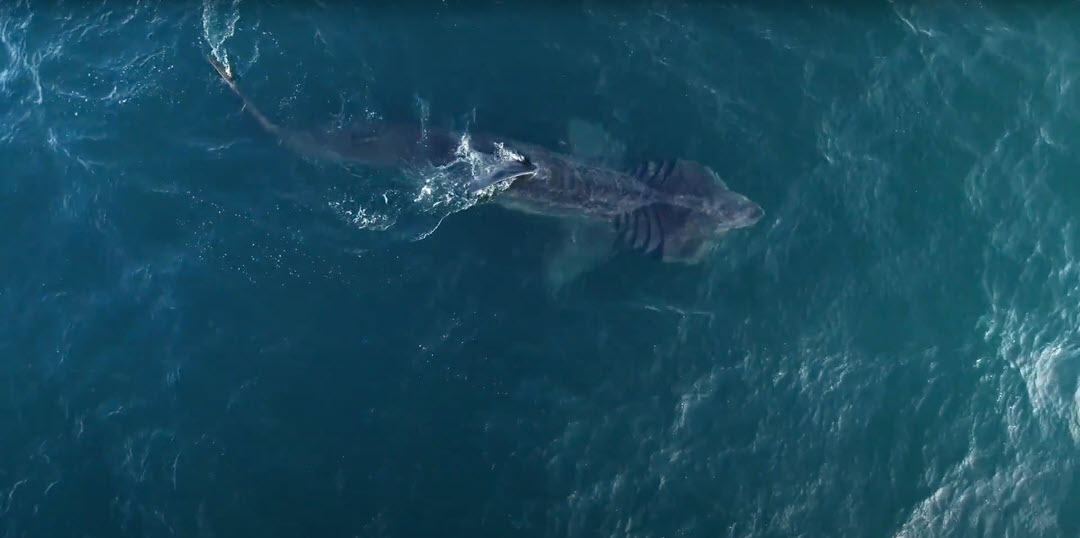
Basking Sharks live in oceans around the world, but they are far less common than they used to be. Hunting for their liver oil and fins caused huge population drops in the past. Today the species is protected in many places. Scientists still study these giants to learn more about their migrations, how they breed, and how to help protect them.
What Is a Basking Shark?
The Basking Shark (Cetorhinus maximus) is the only living member of the family Cetorhinidae. It belongs to the order Lamniformes, the same group as Great White Sharks, Mako Sharks, and Thresher Sharks. Those relatives are active hunters, but the Basking Shark evolved a completely different lifestyle as a filter feeder.
Instead of chasing prey, the Basking Shark feeds almost entirely on tiny drifting organisms called plankton, including microscopic animals called zooplankton. It swims slowly through plankton-rich water with its mouth open, filtering huge amounts of seawater through structures called gill rakers.
The Basking Shark proves that not every shark is a predator. It fills a role in the ocean similar to the Whale Shark and the Giant Manta Ray. All three feed on some of the smallest living things in the sea.
Physical Appearance
The Basking Shark has one of the most unusual looks of any shark. Its massive, torpedo-shaped body has a broad head. Its enormous mouth stretches almost all the way around the front of its face. When feeding, the mouth stays wide open — one of the most recognizable sights in the ocean.
Adults typically measure between 20 and 30 feet (6 to 9 meters) long. The largest ever recorded passed 40 feet (12 meters). They usually weigh several tons, making them some of the heaviest fish alive.
Their coloring is usually grayish brown, slate gray, or bluish gray on top, fading to a lighter color underneath. The skin feels rough because it’s covered in tiny tooth-like scales called dermal denticles.
Despite its huge size, the Basking Shark has small teeth — hundreds of tiny, hooked teeth arranged in rows across the jaws.
A large, crescent-shaped tail keeps the shark moving steadily. Its tall, triangular dorsal fin often pokes above the water’s surface, making the shark easy to spot from a boat or the shore.
Where Basking Sharks Live
Basking Sharks live in temperate oceans around the world, in both the Northern and Southern Hemispheres. They’re found across the Atlantic and Pacific Oceans and in parts of the Indian Ocean and Mediterranean Sea. They’re most common in cool to warm waters and rarely seen near the equator.
People often connect Basking Sharks with coastlines, but they aren’t strictly coastal animals. They swim over continental and island shelves, cross the open ocean, and sometimes enter bays. When plankton is plentiful, they may gather in productive coastal areas and swim near the surface. Their tall dorsal fins can sometimes be spotted above the water.
Basking Sharks travel long distances, often thousands of miles, following wherever zooplankton is concentrated. They move along continental shelves and can cross entire ocean basins. They also travel up and down through the water. They often stay near the surface during good feeding periods. But tracking studies show they also dive deep, sometimes to depths near 6,500 feet (2,000 meters).
Basking Sharks don’t stay in one place. They move between coastal waters, the open ocean, the surface, and the deep sea as conditions change. This makes them some of the ocean’s great long-distance travelers.
Social Behavior
Basking Sharks are often seen alone, but they also gather in groups when plankton is abundant. These groups can range from just a few sharks to, on rare occasions, hundreds of individuals. These gatherings usually happen around good feeding spots and seasonal movement, not because the sharks form lasting social groups.
Scientists have also seen Basking Sharks swim together in pairs and small groups. During breeding season, they sometimes follow each other nose-to-tail, a behavior linked to courtship. Groups sometimes include sharks of similar size or sex, suggesting their interactions may be more structured than random gathering around food.
Basking Sharks don’t appear to form permanent social groups the way some mammals do, and much about their behavior is still unknown. Because they spend so much time offshore and can dive deep, researchers only see a small part of their lives. Tagging studies and observations at seasonal gathering spots are helping scientists learn more about when and why Basking Sharks come together.
What Basking Sharks Eat
Basking Sharks feed almost entirely on plankton — tiny drifting organisms carried by ocean currents. Most of their diet is zooplankton, especially small crustaceans called copepods, along with fish eggs and other microscopic sea life. Instead of chasing prey, the shark simply swims through dense patches of plankton with its mouth open.
Water flows into the mouth and out through the gill openings, while the gill rakers trap the food. The shark swallows the trapped plankton every so often as it keeps feeding.
Finding enough food depends on locating areas where plankton is especially thick. That’s why Basking Sharks are often seen in temperate coastal waters during spring and summer, when seasonal plankton blooms happen. Even though these are enormous animals, their diet is made up almost entirely of some of the smallest creatures in the ocean.
How Basking Sharks Feed
Watching a Basking Shark feed is one of the most impressive sights in the ocean. Most sharks use speed or stealth to catch prey. The Basking Shark does something different — it simply glides through the water with its huge mouth held wide open.
As seawater flows in, it passes over rows of gill rakers. These comb-like structures trap tiny plankton while letting the water flow back out through the gill openings. After filtering thousands of gallons of seawater, the shark closes its mouth, swallows the plankton it caught, and starts again.
This feeding method lets the Basking Shark eat huge numbers of tiny organisms while using very little energy. Because plankton levels change throughout the year, Basking Sharks often travel long distances to find good feeding spots. In spring and summer, they’re often seen near the surface where plankton blooms are strongest. At other times, they may dive hundreds or even thousands of feet down to find food.
Reproduction and Life Cycle
Much about Basking Shark reproduction is still a mystery, because mating, pregnancy, and birth are rarely seen in the wild. Basking Sharks give birth to live young through a process called aplacental viviparity. The developing pups aren’t connected to the mother by a placenta. After using up their yolk supply, they’re thought to feed on unfertilized eggs the mother produces — a process called oophagy.
Scientists estimate that pregnancy lasts a long time, possibly several years, making it one of the longest known pregnancies of any shark. Because pregnant females are so rarely seen, the exact length is still uncertain.
Basking Shark pups are already large when they’re born — around 5 to 6.5 feet (1.5 to 2 meters) long. Very little is known about where females give birth or where young sharks spend their earliest days.
Basking Sharks grow slowly, mature late, and don’t reproduce often. This makes their populations especially easy to harm through fishing and other human threats. It can take many years to replace sharks that are lost.
Evolution & Adaptations
Basking Sharks belong to the order Lamniformes, the same group as Great White Sharks, Mako Sharks, and Thresher Sharks. But somewhere in their history, the Basking Shark’s ancestors took a very different path. Instead of hunting large prey, they became highly specialized filter feeders built to collect enormous amounts of tiny plankton.
Fossils show the Basking Shark family, Cetorhinidae, has a long history. Early fossils identified as members of this group date back at least to the Eocene Epoch, more than 30 million years ago. Fossilized gill rakers are especially important clues, since these structures are tied directly to the filter-feeding system Basking Sharks still use today.
Over millions of years, natural selection favored sharks with an enormous mouth, larger gill openings, and specialized gill rakers. It also favored a huge body — the same combination of traits seen in Basking Sharks today. These changes are called adaptations. An adaptation is a feature that develops over many generations because it helps a species survive.
Filter feeding also evolved separately in other giant sharks, including the Whale Shark and Megamouth Shark. These sharks come from completely different branches of the shark family tree, so their similar feeding strategies developed independently. Scientists call this convergent evolution. It happens when unrelated groups evolve similar features because they live similar lifestyles, not because they share a close ancestor.
Several specific adaptations make this filter-feeding lifestyle possible. The mouth and gill rakers work together as a sieve, trapping plankton while letting water flow through. Like other sharks, the Basking Shark also has a large, oil-rich liver. Sharks don’t have a gas-filled swim bladder like most bony fish, so this oily liver is what keeps them buoyant. Its streamlined body and powerful tail support long-distance migrations. Its lateral line and Ampullae of Lorenzini help it sense movement and weak electrical signals in the water around it.
Together, these adaptations let the Basking Shark live as one of the largest filter-feeding animals in the sea. But that same size and slow, surface-swimming habit have made it easy prey for hunters. They also make it easy to catch by accident in fishing boats’ nets.
Why Basking Sharks Are Important
Basking Sharks play an important role in healthy ocean ecosystems. As giant filter feeders, they connect some of the ocean’s smallest organisms with one of its largest animals. Their feeding and movement help cycle nutrients through the ocean, and their long migrations connect different ocean regions.
Basking Sharks are also valuable to scientists. Changes in where and when they show up can reveal a lot. Scientists use these changes to learn about plankton levels, ocean conditions, and how the ocean is shifting over time.
Conservation
The Basking Shark is classified as Endangered by the International Union for Conservation of Nature (IUCN). Commercial hunting has dropped a lot, but many populations still haven’t fully recovered, since the species grows slowly and has very few young.
In the past, the biggest threat was targeted fishing for the shark’s valuable liver oil, fins, meat, and cartilage. Today, getting accidentally caught in fishing gear is one of the most serious dangers.
Other major threats include:
- Getting tangled in commercial fishing nets
- Being struck by boats and ships
- Ocean pollution, including plastic debris
- Climate change affecting where plankton is found
- Disturbance from increasing boat traffic in feeding areas
Many countries now ban hunting Basking Sharks, and the species is protected under several international agreements. Marine protected areas and satellite tracking are helping too. Research teams from different countries are working together to understand migration routes and find habitats that need extra protection.
You can help by supporting sustainable fishing practices, reducing plastic pollution, following responsible wildlife-viewing guidelines, and learning more about protecting large ocean animals.
Research & Quotes
Modern research has changed how scientists understand Basking Sharks. Satellite tags have shown that these giant fish travel thousands of miles across entire ocean basins. They also dive regularly to depths of more than 4,000 feet (1,200 meters). These discoveries overturned the old belief that Basking Sharks stayed only in shallow coastal waters.
Researchers are also studying how ocean temperature, plankton blooms, and climate change affect the sharks’ seasonal migrations. Finding important feeding grounds and migration routes has become a major focus of conservation efforts worldwide.
Marine biologist Dr. David Sims has spent years studying Basking Shark movement and behavior, and his research has greatly expanded what scientists know about this species. Each new study helps researchers build better strategies to protect one of the ocean’s most extraordinary gentle giants.
Basking Sharks in Culture
Because of their huge size and strange appearance, Basking Sharks have caught people’s attention for centuries. Early sailors often reported seeing giant fins and dark shapes moving slowly through the water, which led to stories about sea monsters.
Sometimes, decaying Basking Shark bodies washed ashore missing parts of the head and tail. The strange-looking skeletons that remained helped fuel legends about giant sea serpents.
In the past, Basking Sharks were hunted in several countries for their large, oil-rich livers. Before modern petroleum products existed, shark liver oil was commonly used for lamp fuel, lubricants, and other industrial purposes. Their fins and meat were sold in some places too.
Today, the Basking Shark has become a symbol of ocean conservation and responsible wildlife tourism. In places like Scotland, Ireland, and parts of Canada, people travel from around the world for a chance to see these gentle giants. They hope to spot one feeding near the surface. Strict wildlife-viewing rules help make sure boats can watch the sharks without disturbing their natural behavior.
The Basking Shark is a reminder of something surprising. Even the largest animals in the ocean can survive peacefully by eating some of its smallest creatures.
| Common Name | Basking Shark |
| Other Common Names | Giant Basking Shark, Sailfish (historical), Bone Shark (regional) |
| Scientific Name | Cetorhinus maximus |
| Family | Cetorhinidae |
| Order | Lamniformes |
| Conservation Status | Endangered (IUCN) |
SHARK PAGES
Interesting Basking Shark Facts
- The Basking Shark is the second-largest fish on Earth.
- It can grow longer than a school bus.
- Despite its huge mouth, it feeds almost entirely on microscopic plankton.
- A single shark can filter thousands of gallons of seawater every hour while feeding.
- Its mouth can open more than three feet (one meter) wide.
- Tiny gill rakers trap food while water flows out through the gills.
- Basking Sharks are slow swimmers, usually traveling only 2 to 4 miles (3 to 6 kilometers) per hour.
- They often swim near the surface during spring and summer when plankton blooms are abundant.
- Individuals have been recorded diving more than 4,000 feet (1,200 meters) below the surface.
- They undertake long-distance seasonal migrations across entire ocean basins.
- Their liver can make up nearly one-quarter of their body weight.
- They are generally considered harmless to swimmers and divers.
SPECIES PAGES