
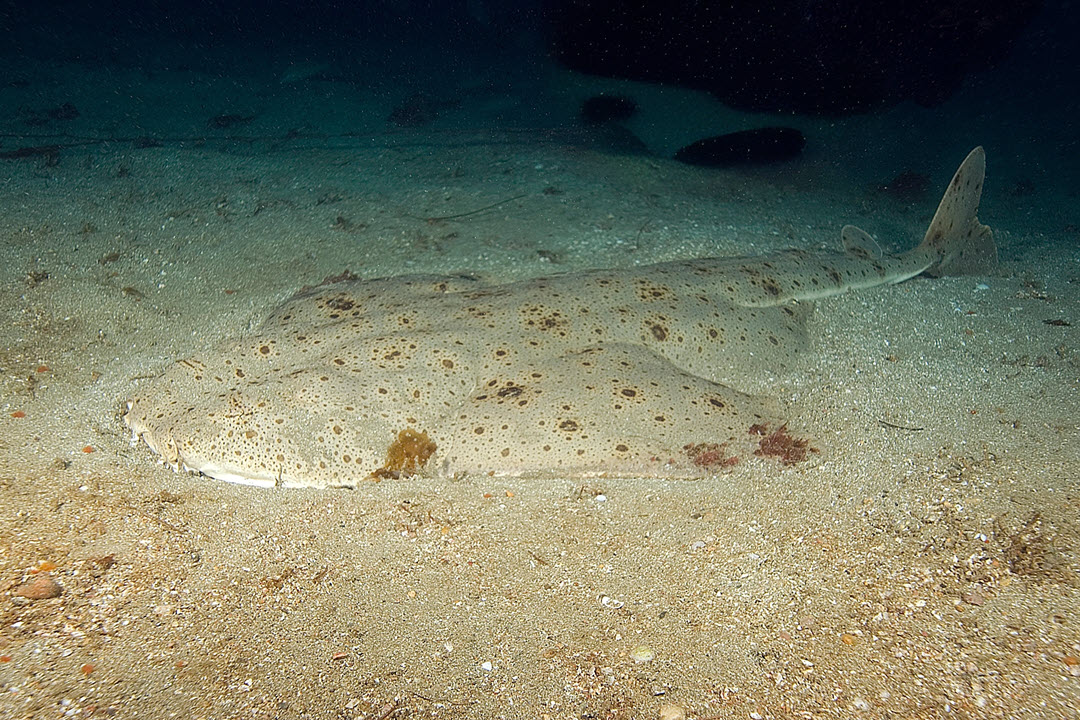
The Angel Shark looks nothing like most other sharks. Its body is broad and flat, so it looks a lot like a ray. But it’s a true shark, belonging to its own group called Squatiniformes. Most sharks swim all the time to search for food. Angel Sharks do something different. They rest on the seafloor and hide under sand or gravel, waiting for prey to swim by.
Interesting Angel Shark Facts
- Angel Sharks are some of the flattest sharks in the world.
- People often mistake them for rays because of their broad, wing-like fins.
- Unlike rays, Angel Sharks have gill slits on the sides of the head.
- They spend most of the day buried in sand or sediment.
- Their eyes sit on top of the head, so they can watch for prey while staying hidden.
- Angel Sharks can shoot upward from the sea floor in a split second to catch prey.
- They become more active at night.
- Their spotted brown coloring gives them excellent camouflage on sandy sea floors.
- Fossils show Angel Sharks have kept nearly the same body shape for millions of years.
- Most Angel Shark populations have disappeared from large parts of their old range.
- The Canary Islands are one of the last strongholds for the species.
- Because they rest on the bottom so often, Angel Sharks are especially vulnerable to bottom-trawl fishing.
| Common Name | Angel Shark, Angelshark |
| Other Common Names | European Angel Shark, Monkfish (historical name in parts of Europe and the United Kingdom) |
| Scientific Name | Squatina squatina (representative species) |
| Family | Squatinidae |
| Order | Squatiniformes |
| Conservation Status | Critically Endangered (IUCN Red List) |
Overview
Angel Shark isn’t just one species. It’s the common name for an entire family of sharks, made up of about 22 species found in coastal waters around the world. This page focuses on the original Angel Shark (Squatina squatina), the species first described by Linnaeus in 1758 and the one most associated with the common name.
Angel Sharks used to be common in the northeastern Atlantic Ocean and the Mediterranean Sea. Today they’re in serious trouble. Heavy fishing and accidental catches in fishing nets have wiped out many populations. The species is now listed as Critically Endangered. Protecting Angel Sharks is one of the top ocean conservation goals in Europe.
Angel Sharks aren’t dangerous to people. They’re experts at hiding. Instead of chasing their food, they wait patiently for fish, crabs, and other small animals to come close. Their strange shape, clever hunting style, and urgent conservation story make them one of the most interesting sharks in the ocean.
What Is an Angel Shark?
Angel Sharks belong to the family Squatinidae, within the order Squatiniformes. Every species in this family shares the same flattened, ray-like body plan. Most sharks have sleek bodies built for constant swimming. Angel Sharks are different — their flat body lets them lie still on the seafloor.
Angel Sharks look like rays, but a few key features set them apart. Their gill slits sit on the sides of the head, not underneath the body like a ray’s. Their tail still looks and works like a shark’s tail. And their pectoral fins aren’t attached to their head the way a ray’s fins are. These features show that Angel Sharks are true sharks, even though they look unusual.
Angel Sharks are ambush predators. This means they wait and surprise their prey instead of chasing it. They bury themselves in the sand until only their eyes and breathing holes show. Then they stay almost invisible until prey swims close enough to catch. The species profiled on the rest of this page, Squatina squatina, is the largest and best-known member of the family.
The Angel Shark Family
All Angel Shark species share the same flattened body and ambush hunting style, but each one lives in a different part of the world, and several have their own conservation concerns. Here are the species currently recognized in the family:
- Sawback Angelshark — Squatina aculeata
- African Angelshark — Squatina africana
- Eastern Australian Angelshark — Squatina albipunctata
- Argentine Angelshark — Squatina argentina
- Chilean Angelshark — Squatina armata
- Australian Angelshark — Squatina australis
- Philippine Angelshark — Squatina caillieti
- Pacific Angelshark — Squatina californica
- David’s Angelshark — Squatina david
- Atlantic Angelshark (Sand Devil) — Squatina dumeril
- Taiwan Angelshark — Squatina formosa
- Angular Angelshark — Squatina guggenheim
- Japanese Angelshark — Squatina japonica
- Lea’s Angelshark — Squatina leae
- Indonesian Angelshark — Squatina legnota
- Small-crested Angelshark — Squatina mapama
- Clouded Angelshark — Squatina nebulosa
- Hidden Angelshark — Squatina occulta
- Smoothback Angelshark — Squatina oculata
- Angelshark — Squatina squatina
- Ornate Angelshark — Squatina tergocellata
- Ocellated Angelshark — Squatina tergocellatoides
New Angel Shark species are still being formally described. Squatina leae was only identified in 2023, and scientists suspect a few more undescribed species may still exist in poorly studied waters off southern Australia.
Physical Appearance
The Angel Shark has one of the strangest shapes of any shark. Most adults grow to about 1.5 meters (5 feet) long. The largest females can reach 2.4 meters (8 feet).
Their body is wide and flat, so from above they look a lot like a ray. Their large pectoral fins spread out like wings. Their pelvic fins form a wide base that helps them balance on the seafloor. Unlike a ray, though, the Angel Shark’s tail stays thick and muscular. It ends in a strong tail fin the shark uses for short, quick bursts of swimming.
The head is wide and round, with small eyes on top of the head. Just behind each eye is a small opening called a spiracle.
Its skin color ranges from sandy tan to grayish brown, usually with dark spots and blotchy patterns. This coloring blends in perfectly with the seafloor and hides the shark from both prey and predators.
The Angel Shark’s most surprising feature might be its mouth. It stays hidden under the head most of the time. But when prey gets close, the jaws shoot forward in a flash, snapping shut before the prey can escape.
Where Do Angel Sharks Live?
Angel Sharks used to live across the northeastern Atlantic Ocean, from southern Norway and the British Isles down to northwestern Africa. They were also common throughout the Mediterranean Sea.
Today, their range is much smaller because so many populations have disappeared. The Canary Islands are now one of the last strongholds for this species. In most of its old range across Europe, the Angel Shark has become rare or vanished completely.
Angel Sharks like shallow water with sandy or muddy bottoms, where they can bury themselves for camouflage. You can commonly find them in:
- Sandy bays
- Coastal shelves
- Seagrass meadows
- Estuaries
- Muddy seafloors
- Areas with mixed sand and gravel
Most Angel Sharks live at depths between 5 and 150 meters (16 to 490 feet), though some go deeper. These places give them plenty of prey and the soft sand they need to hide. Unfortunately, these same coastal waters are heavily used by commercial fishing boats, which keeps putting Angel Sharks at risk.
Shark Behavior
Angel Sharks are largely solitary animals. They spend most of their time alone, resting motionless on the seafloor rather than interacting with other sharks.
They’re mostly inactive during the day, remaining buried or partly buried in sand. As night falls, they become more active and begin searching for food.
In places with especially good habitat, several Angel Sharks may be found resting near one another, though this isn’t true social grouping so much as multiple individuals independently choosing the same favorable spot. Because they rely so heavily on camouflage and stillness, Angel Sharks are generally passive and avoid confrontation unless disturbed.
What Do Angel Sharks Eat?
Angel Sharks are meat-eaters that hunt animals living near the seafloor. Instead of constantly searching for food, they save energy by staying hidden until prey comes close.
Their diet changes based on where they live and how old they are, but commonly includes:
- Small bony fish
- Flatfish
- Skates and small rays
- Squid
- Crabs
- Shrimp
- Other crustaceans
Young Angel Sharks usually eat smaller prey like shrimp and small fish. As they grow, they move on to larger fish and squid. By eating bottom-dwelling animals, Angel Sharks help keep those populations in balance.
How Do Angel Sharks Hunt?
Unlike fast-swimming sharks that chase prey across open water, Angel Sharks rely on patience and surprise. They’re true ambush predators. Most of the day, they lie partly buried in sand, with only their eyes and spiracles showing above the surface. Their spotted coloring blends in so well that passing fish rarely notice them.
Angel Sharks usually become more active at night, when many bottom-dwelling fish come out to feed. Instead of searching for food, they wait until prey swims within reach. Then the shark shoots upward in a flash. Its jaws snap forward, creating powerful suction that pulls the prey straight into its mouth. The whole attack can be over in less than a second.
This hunting style saves energy while still letting the shark catch fast-moving prey. Because Angel Sharks depend on camouflage instead of speed, they can be successful hunters even though they spend most of their time resting.
Reproduction and Life Cycle
Angel Sharks reproduce through a process called ovoviviparity. This means the babies grow inside the mother’s body, feeding on a yolk sac instead of a placenta.
Pregnancy length varies by location. In some areas it lasts about 8 to 10 months. In the Canary Islands, it’s closer to 6 months. Females give birth to live pups, usually between 7 and 25 at a time.
Newborn Angel Sharks are about 24 to 30 centimeters (9 to 12 inches) long. They’re able to survive completely on their own right after birth.
Angel Sharks grow slowly and take several years to reach adulthood. This means their populations recover slowly after a decline. Even if fewer adults are being caught or killed, it can still take decades to rebuild their numbers, because so few young sharks survive to adulthood.
Evolution & Adaptations
Angel Sharks come from an old and unusual branch of the shark family tree. Millions of years ago, their ancestors split off from other sharks and slowly became specialized for life on the seafloor.
Most sharks evolved sleek bodies built for fast swimming. Angel Sharks took a different path. Sharks that could hide well and ambush prey survived better than sharks that had to chase their food. This process is called natural selection. Over time, their bodies became flatter, their fins grew larger, and their camouflage improved. These changes are called adaptations — features that develop over many generations because they help a species survive.
Angel Sharks and rays look alike, but they didn’t evolve from a shared flat-bodied ancestor. Instead, each group developed a flat body on its own, because both needed to survive in a similar way. Scientists call this convergent evolution — when two unrelated groups evolve similar features because they live similar lifestyles, not because they’re closely related.
Several key adaptations came out of this long process. The spiracle behind each eye lets water flow over the gills, so the shark can breathe even while fully buried in sand without pulling sediment into its gills. Like other sharks, Angel Sharks also have a lateral line — a row of sensors that detects small vibrations in the water, helping them find nearby animals even in murky water or darkness. They also have the ampullae of Lorenzini, small organs that sense the weak electric signals every living animal gives off, which lets an Angel Shark find prey hiding under the sand or approaching in the dark. Strong jaw muscles and fast-moving jaws finish the job — once prey swims close enough, the strike is sudden and accurate.
Fossils show that Angel Sharks have kept this same basic body plan for millions of years, making them one of the best examples of a body shape built for one very specific job. But the same stillness and camouflage that make Angel Sharks such effective hunters also make them easy to catch by accident. Because they spend so much time lying motionless on the seafloor, they’re especially likely to end up in bottom-trawl nets meant for other fish — a major reason the species is now Critically Endangered.
Why Angel Sharks Are Important
Angel Sharks are part of the ocean’s food chains and food webs. A food chain shows how one animal becomes food for another. A food web is many food chains linked together.
Angel Sharks eat fish, rays, and crustaceans. At the same time, young Angel Sharks can become food for larger predators. This makes the Angel Shark one of many important links connecting animals throughout the ocean.
Conservation
The International Union for Conservation of Nature (IUCN) lists the Angel Shark as Critically Endangered. That makes it one of the most threatened sharks in the world.
Its biggest threat is getting accidentally caught in fishing gear, especially bottom-trawl nets that drag across the seafloor. Because Angel Sharks spend so much time resting on the bottom, they’re especially likely to get caught this way.
Other major threats include:
- Habitat loss from coastal development
- Disturbed nursery areas where young sharks grow up
- Pollution in coastal waters
- Slow population recovery, since Angel Sharks mature late and don’t have many pups
Even with these challenges, conservation work is starting to help. Several countries now have laws against intentionally catching Angel Sharks. Marine protected areas help keep important habitats safe. Scientists track surviving populations using underwater surveys, tagging, and photo identification.
The Canary Islands have become a key center for Angel Shark conservation. Researchers, conservation groups, government agencies, divers, and local communities all work together there to protect one of the last strong populations of this species.
You can help too — by choosing sustainably caught seafood, respecting marine protected areas, reporting Angel Shark sightings, and learning more about threatened ocean animals.
Angel Sharks in Culture
Angel Sharks aren’t as famous in stories and legends as great white sharks or hammerheads. But coastal communities across Europe and North Africa have known them for a long time.
In the past, people in parts of the United Kingdom and Europe called them monkfish because of their broad, flat shape. This name can cause confusion today, because the fish now sold as monkfish is actually a completely different animal — an anglerfish.
In recent years, the Angel Shark has become an important symbol for ocean conservation in the Canary Islands, home to one of the last healthy populations. Education programs, research projects, and citizen science efforts are helping more people learn about this species and its uncertain future.
Angel Shark Research & Quotes
Scientists have learned a lot about Angel Sharks in recent years. Researchers now use acoustic tags and satellite tracking to follow the sharks’ movements. Underwater photography lets them identify individual sharks by their unique spot patterns, without disturbing them.
Genetic studies are helping scientists understand how separated populations connect to each other, which helps guide future conservation plans. Other research focuses on finding nursery areas where young Angel Sharks grow up, so those places can get extra protection.
The Angel Shark reminds us that even animals that have survived for millions of years can disappear quickly without real conservation efforts.
Near disappearance of the Angelshark Squatina squatina over half a century of observations.
This 2019 study examines the dramatic decline of the Angelshark (Squatina...
The distribution, ecology and predicted habitat use of the Critically Endangered angelshark (Squatina squatina) in coastal waters of Wales and the central Irish Sea
This 2022 study investigates the distribution, ecology, and habitat use of the...
Common Angelshark (Squatina squatina) 5-Year Review: Summary and Evaluation
The Common Angelshark (Squatina squatina) 5-Year Review: Summary and...
Single Species Action Plan for the Angelshark (Squatina squatina) in the Mediterranean Sea
The Single Species Action Plan for the Angelshark (Squatina squatina) in the...