
Wobbegong Shark
The Wobbegong Shark is one of the ocean’s most remarkable masters of disguise. With its flattened body, mottled skin, and fringe of skin flaps around its mouth, a resting Wobbegong is hard to spot. It can look almost exactly like the rocky or coral seafloor around it. This incredible camouflage lets it wait patiently for prey to wander within striking distance.
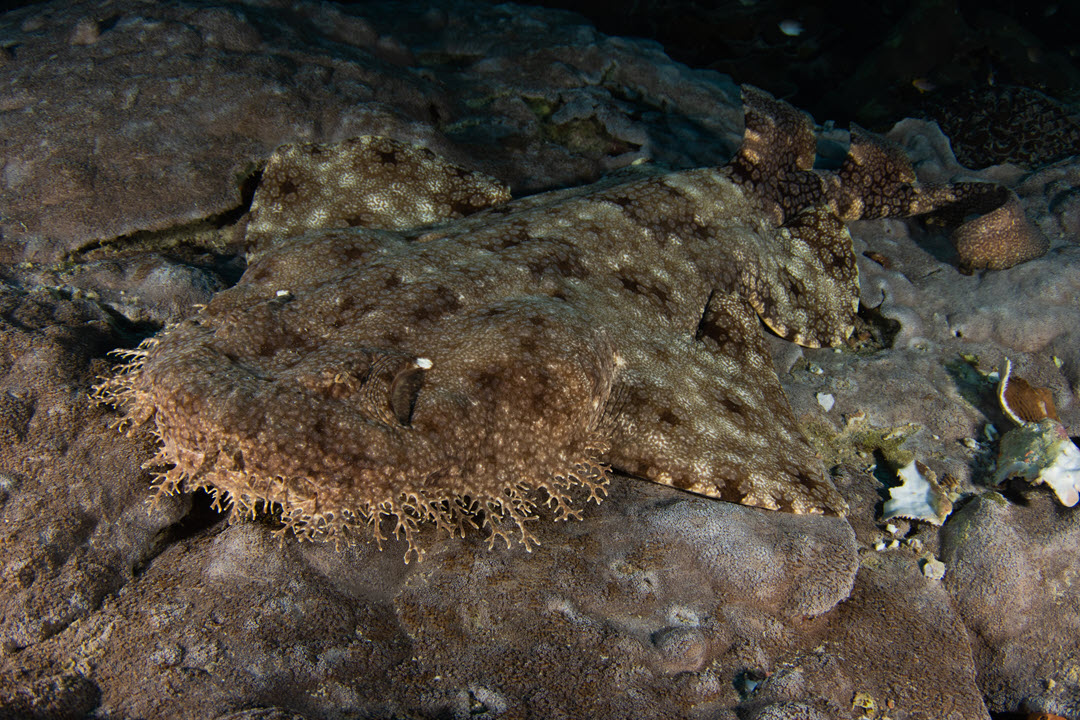
Wobbegong isn’t just one species. It’s the common name for an entire family of carpet sharks, made up of 12 different species. They’re found mainly in shallow tropical and temperate waters around Australia and Indonesia, with one species reaching as far north as Japan.
Unlike fast-swimming open-ocean sharks, Wobbegongs spend most of their time resting motionless on the seafloor. Their body shape and coloring have evolved specifically to help them disappear against reefs, rocks, and sand.
Although generally passive toward humans, Wobbegongs have powerful jaws and should never be disturbed, since they can deliver a serious bite if stepped on or provoked.
What Is a Wobbegong Shark?
Wobbegong Sharks belong to the family Orectolobidae, within the order Orectolobiformes, or carpet sharks. There are 12 living Wobbegong species, grouped into three genera: Orectolobus, Eucrossorhinus, and Sutorectus.
One of the most familiar species is the Spotted Wobbegong (Orectolobus maculatus), found only in Australian waters. Its genus name comes from Greek words meaning “stretch out” and “lobe,” referring to the fleshy lobes around its mouth. Its species name, maculatus, is Latin for “spotted.”
The name “wobbegong” itself is believed to come from an Australian Aboriginal language, possibly referring to the shark’s shaggy, bearded appearance.
The Wobbegong Family
All 12 Wobbegong species share the same flattened body, mottled skin, and dermal lobes described above, but each one has its own size, range, and small differences in appearance. Most are found only around Australia, though a few range farther into Southeast Asia and the western Pacific.
- Tasselled Wobbegong (Eucrossorhinus dasypogon): Found around northern Australia, Indonesia, and Papua New Guinea. It has the thickest, most elaborate fringe of skin flaps of any Wobbegong, giving it an especially bushy, bearded look.
- Spotted Wobbegong (Orectolobus maculatus): The most widely known species, found only in southern Australian waters. It has a golden to greenish body marked with dark saddles and pale ring-shaped spots.
- Banded Wobbegong (Orectolobus halei), also called Gulf Wobbegong: Found in south-eastern Australia. It’s one of the largest Wobbegong species, reaching about 10 feet (3 meters) long.
- Ornate Wobbegong (Orectolobus ornatus): Found from northern New South Wales to Queensland, Australia. It has an intricate, highly patterned skin that gives the species its name.
- Western Wobbegong (Orectolobus hutchinsi): Found off south-western Australia. It was only formally recognized as its own species in 2008, after being separated from similar-looking relatives.
- Floral Banded Wobbegong (Orectolobus floridus): Found off southern Australia. Its name refers to the flower-like pattern across its skin.
- Northern Wobbegong (Orectolobus wardi): Found in tropical waters of northern Australia. It’s one of the smaller Wobbegong species.
- Japanese Wobbegong (Orectolobus japonicus): The only Wobbegong species found as far north as Japan, extending the family’s range well beyond Australia and Indonesia.
- Indonesian Wobbegong (Orectolobus leptolineatus): Found around Indonesia. It was formally described as its own species in 2010, after being confused with similar Wobbegongs for years.
- Network Wobbegong (Orectolobus reticulatus): One of the newest described Wobbegong species, formally recognized in 2025. It was previously mistaken for the Northern Wobbegong until a distinctive net-like skin pattern set it apart.
- Dwarf Spotted Wobbegong (Orectolobus parvimaculatus): Found off south-western Australia, often in deeper water than other Wobbegongs. It’s the smallest species in the family, reaching only about 2.3 feet (70 centimeters) long.
- Cobbler Wobbegong (Sutorectus tentaculatus): The only species in the genus Sutorectus, found in Australian waters. It’s a smaller, less commonly seen Wobbegong species.
Physical Appearance
Wobbegong Sharks have broad, flattened bodies built for lying motionless on the seafloor. Their coloring is usually a mix of yellow, green, gray, and brown, patterned with spots, blotches, or saddle-like markings that break up their outline.
Around their mouths, Wobbegongs have branching skin flaps called dermal lobes, sometimes called a “beard.” These flaps help disguise the outline of the shark’s head. That makes it even harder to spot against the seafloor.
Species size varies quite a bit across the family. The Spotted Wobbegong commonly reaches 5 to 6 feet (1.5 to 1.8 meters) long, with a maximum recorded length of about 10.5 feet (3.2 meters). Some other Wobbegong species stay considerably smaller.
Their eyes are often surrounded by markings that help disguise them, making the shark’s face even harder to distinguish from its surroundings.
Where Do Wobbegong Sharks Live?
Wobbegong Sharks live in shallow, warm temperate and tropical waters of the western Pacific and eastern Indian Oceans, especially around Australia and Indonesia. One species, the Japanese Wobbegong, ranges as far north as Japan.
They’re commonly found on coral reefs, rocky reefs, and sandy areas close to shore, often resting in caves, crevices, or beneath ledges during the day.
Most Wobbegong species stay in relatively shallow water. Some, like the Dwarf Spotted Wobbegong, have been recorded at depths of up to about 440 feet (135 meters), though.
Social Behavior
Wobbegong Sharks are mostly solitary, though several individuals are sometimes found resting near one another in the same sheltered spot during the day.
They’re largely inactive during daylight hours, remaining still on the seafloor for long periods. As night falls, they become more active and begin searching for food.
Because they rely so heavily on camouflage and remaining still, Wobbegongs generally avoid confrontation and won’t attack unless they feel threatened or are accidentally disturbed.
What Do Wobbegong Sharks Eat?
Wobbegong Sharks are nocturnal predators that feed on bottom-dwelling fish, cephalopods, and crustaceans. Common prey includes small fish, octopus, squid, crabs, and lobsters, along with smaller sharks and rays.
Their varied diet lets them take advantage of whatever suitable prey passes close enough to strike.
How Do Wobbegong Sharks Hunt?
Wobbegong Sharks are ambush predators. Rather than chasing prey, they rely on remaining completely still and blending into their surroundings, waiting for an unsuspecting animal to come within range.
When prey approaches closely enough, the Wobbegong strikes with a sudden, rapid lunge, using its protruding jaws and numerous sharp, needle-like teeth to seize its target.
This hunting strategy uses very little energy, letting the shark remain motionless for extended periods until a hunting opportunity arises.
Reproduction and Life Cycle
Wobbegong Sharks reproduce through aplacental viviparity, with pups developing inside the mother’s body and nourished by yolk and uterine secretions rather than a placenta.
Litter sizes vary by species but often include 20 or more pups. In the Tasselled Wobbegong, for example, litters can include 20 or more pups, each measuring about 8 inches (20 centimeters) at birth.
Newborn Wobbegongs receive no parental care and must fend for themselves immediately after birth, relying on camouflage from a very young age to avoid predators.
Evolution & Adaptations
Wobbegong Sharks belong to the carpet shark order, Orectolobiformes, a diverse group that also includes Nurse Sharks and the giant Whale Shark. Within this order, Wobbegongs evolved specifically for a life of camouflage and ambush hunting on the seafloor.
Their flattened bodies reduce their profile against the bottom. Their mottled, irregular coloring breaks up their outline in a way that confuses the eye, a strategy called disruptive camouflage.
The dermal lobes around their mouths may serve a dual purpose, both disguising the shark’s outline and possibly attracting curious prey close enough to strike.
Like all sharks, Wobbegongs have a lateral line, which detects vibrations in the water. They also have the ampullae of Lorenzini, which sense weak electrical signals produced by nearby animals. These senses help them detect prey even while remaining perfectly still.
Together, these adaptations make Wobbegongs some of the most effective ambush predators among all sharks.
Why Wobbegong Sharks Are Important
As ambush predators, Wobbegong Sharks help control populations of bottom-dwelling fish, crustaceans, and cephalopods on the reefs and rocky habitats where they live.
Their remarkable camouflage has also made them valuable subjects for researchers studying disruptive coloration and ambush predation strategies across the animal kingdom.
Different Wobbegong species occupy similar habitats across a wide region. Because of this, they’re also useful indicators of the health of coastal reef ecosystems in Australia and Southeast Asia.
Conservation
Conservation status varies across the 12 Wobbegong species. Most, including the Tasselled Wobbegong, are currently classified as Least Concern by the International Union for Conservation of Nature (IUCN). A few species face greater pressure, though, and are listed as Near Threatened.
Wobbegongs have historically been targeted by commercial and recreational fisheries in parts of their range. They’ve been valued for their meat and, in the past, their tough, patterned skin. Habitat degradation on coral and rocky reefs is another ongoing concern.
Fishing regulations in parts of Australia now help manage Wobbegong populations more sustainably.
Research & Quotes
Researchers studying Wobbegong Sharks have focused heavily on their reproductive biology, camouflage, and the relationships between the many closely related species in the family.
Genetic and physical studies have helped scientists distinguish between similar-looking Wobbegong species that were once confused with one another. This work is refining our understanding of exactly how many distinct species exist.
Wobbegongs have also been studied for what their camouflage strategies can reveal about disruptive coloration more broadly. This same pattern is also seen in many other camouflaged animals throughout the natural world.
Wobbegong Sharks in Culture
Wobbegong Sharks are popular among divers, particularly in Australia, where their striking camouflage and unusual appearance make them a favorite subject for underwater photography.
Their name has become well known partly because of how unusual it sounds, and it’s often one of the first shark names people remember after learning it.
Because they rest quietly on the seafloor, Wobbegongs are also popular exhibits in public aquariums, where visitors can study their remarkable camouflage up close.
Today, Wobbegong Sharks are frequently used in marine education to illustrate how camouflage and patience can be just as effective a hunting strategy as speed and power.
| Common Name | Wobbegong Shark |
| Other Common Names | Carpet Shark (general), Spotted Wobbegong (representative species) |
| Scientific Name | Orectolobus maculatus (representative species) |
| Family | Orectolobidae |
| Order | Orectolobiformes |
| Conservation Status | Varies by species; most Least Concern (IUCN) |
Interesting Wobbegong Shark Facts
- “Wobbegong” is a common name for 12 different carpet shark species.
- Their mottled skin helps them blend in almost perfectly with the seafloor.
- Branching skin flaps around their mouths act like a natural beard.
- They’re ambush predators that wait motionless for prey to come close.
- They’re most active at night.
- They rest in caves, crevices, and under ledges during the day.
- The Spotted Wobbegong commonly reaches 5 to 6 feet (1.5 to 1.8 meters) long.
- The largest recorded individuals have reached about 10.5 feet (3.2 meters).
- They’re found mainly around Australia and Indonesia.
- One species, the Japanese Wobbegong, ranges as far north as Japan.
- They’re generally passive but can deliver a serious bite if disturbed.
- They give birth to live young, sometimes 20 or more pups at once.
- Newborn pups receive no parental care.
- Their camouflage is studied as an example of disruptive coloration.
- Most Wobbegong species are currently classified as Least Concern by the IUCN.
SHARK PAGES
SPECIES PAGES