
Blue Shark
The Blue Shark is one of the most recognizable sharks in the open ocean. Its long, slender body, bright blue color, and unusually long pectoral fins give it a graceful appearance as it moves through the water. Blue Sharks are found in oceans around the world and may travel thousands of miles during their lives.
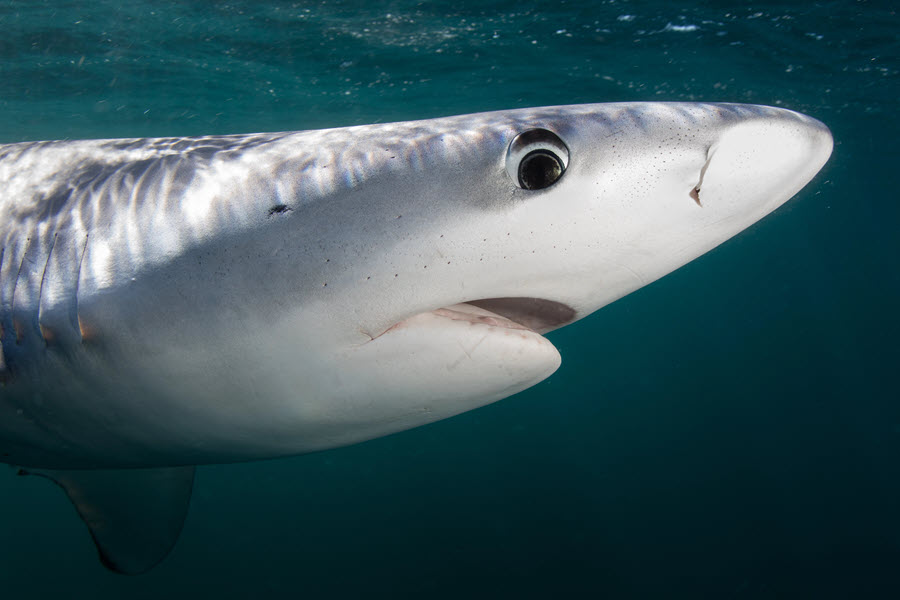
Unlike sharks that spend much of their time around reefs or coastlines, Blue Sharks are built for life in the open sea. They travel across huge areas searching for food, suitable water temperatures, and places to reproduce. Their long journeys can take them through the waters of many countries and across international waters.
What Is a Blue Shark?
The Blue Shark (Prionace glauca) belongs to the family Carcharhinidae, known as the requiem sharks, and the order Carcharhiniformes, or ground sharks. It is the only living species in the genus Prionace.
Blue Sharks are open-ocean sharks. They spend most of their lives far from shore, although they sometimes move closer to land where deep ocean water comes near the coast.
They are also highly migratory. Individual sharks may travel across large parts of an ocean as they search for food and move between areas used at different stages of their lives.
Physical Appearance
Blue Sharks have long, slender bodies with pointed snouts and large eyes. Their pectoral fins are especially noticeable because they are very long and narrow. These fins can give the shark an almost winged appearance as it swims.
Their color gives the species its name. The back is dark blue, the sides can be a brilliant blue, and the underside is white. From above, the dark back is harder to see against deeper water. From below, the pale belly is less noticeable against light coming through the surface.
Blue Sharks have triangular upper teeth with curved, serrated edges. These teeth help them grasp and cut slippery prey such as fish and squid.
Blue Sharks can reach about 13 feet (4 meters) in length, although most are smaller. The largest recorded individuals have weighed more than 450 pounds (200 kilograms).
Where Do Blue Sharks Live?
Blue Sharks are found in temperate and tropical oceans around the world. They live in the Atlantic, Pacific, and Indian Oceans and are also found in the Mediterranean Sea.
They spend most of their lives in the open ocean, although they sometimes come closer to shore. This is especially likely in places where deep water is close to the coastline.
Blue Sharks usually spend much of their time in the upper 720 feet (220 meters) of the ocean, but they can dive much deeper. They have been recorded at depths of more than 3,500 feet (1,000 meters).
These sharks can travel enormous distances. Their movements often change with the seasons, water temperature, food supply, age, and sex. Young sharks may also use certain areas as nurseries where they spend part of their early lives before beginning longer journeys.
Social Behavior
Blue Sharks sometimes travel alone, but they also gather in groups. Whether they spend time with other Blue Sharks can depend on their age, size, sex, location, and the time of year.
Scientists have found that males and females don’t always use the same parts of the ocean. Sharks of different ages and sizes may also live in different areas.
Blue Sharks may also gather where food is plentiful. However, sharks feeding in the same place aren’t necessarily working together. Each shark may simply be taking advantage of the same food source.
Scientists are still learning about the social lives of Blue Sharks. We know they sometimes gather in large numbers, but there isn’t enough evidence to say that they normally form long-lasting social groups.
What Do Blue Sharks Eat?
Blue Sharks eat many kinds of marine animals, but fish and squid make up much of their diet. They eat fish such as herring, mackerel, cod, hake, and other species they encounter as they travel. They also eat crustaceans, smaller sharks, and occasionally seabirds. Blue Sharks are also scavengers and may feed on the remains of dead whales and other marine animals.
Their diet changes depending on where they are and what food is available. This flexibility is useful for a shark that travels through huge areas of ocean, where the type and amount of prey can change from place to place.
How Do Blue Sharks Hunt?
Blue Sharks are active hunters that travel through the ocean searching for prey. They hunt at different depths and may move between surface waters and deeper parts of the ocean to follow fish and squid.
Their senses help them locate prey in a habitat where food can be widely scattered. Smell and vision help them find animals, while their lateral line detects movements in the surrounding water. At close range, their ability to detect weak electrical signals can also help them find living prey.
Blue Sharks can make deep dives while searching for food. Research in the North Atlantic has found sharks diving hundreds of meters during the day and returning to shallower water at night. Scientists believe they may be following squid and fish that also move up and down through the water each day.
Once a Blue Shark catches up with its prey, its curved, serrated teeth help it grip and cut the animal. Several sharks may feed in the same area when food is plentiful, but there’s no good evidence that they regularly work together to hunt.
Reproduction and Life Cycle
Blue Sharks give birth to live young. While the pups are developing inside the mother, they receive nutrients through a connection that works much like a placenta in mammals. Pregnancy lasts about 9 to 12 months.
Blue Sharks can have unusually large litters for sharks. A female may carry anywhere from 4 to 135 pups, although litters of about 15 to 30 are more common. Newborn pups are about 14 to 17 inches (35 to 44 centimeters) long.
Mating can be rough. Male Blue Sharks bite females during mating. Mature females have much thicker skin than males, which helps protect them from these bites.
After the pups are born, they receive no care from their parents. The young must find food and avoid predators on their own. Research has found important nursery areas where young Blue Sharks spend part of their early lives.
Blue Sharks can live for about 20 years. They grow slowly compared with many bony fish and take several years to reach adulthood.
Evolution & Adaptations
Blue Sharks belong to Carcharhinidae, the requiem shark family. This large family also includes Bull Sharks, Blacktip Sharks, Spinner Sharks, and many other species.
The history of the Blue Shark can be traced partly through fossil teeth. Shark skeletons are made mostly of cartilage, which usually breaks down before it can become fossilized. Teeth are much harder and are often the best evidence scientists have for studying ancient sharks. Fossil teeth from Blue Sharks and their close relatives show that this lineage has been living in the world’s oceans for millions of years.
Today, scientists also study shark DNA. By comparing the DNA of Blue Sharks with other requiem sharks, researchers can learn more about where the species belongs on the shark family tree and how it’s related to other sharks.
Over its evolutionary history, the Blue Shark developed several traits that help it survive in the open ocean. Its long, streamlined body moves efficiently through the water, while its unusually long pectoral fins provide lift and stability during long periods of swimming.
Its blue and white coloring is a specific adaptation called countershading. The shark’s dark upper body is harder to see against deeper water, while its light underside blends with the brighter water above. This camouflage works whether a predator is looking down from above or up from below.
Blue Sharks also have several highly developed senses that evolved for life in the open ocean, where prey can be scattered far apart. Their sense of smell helps them locate food from a distance. A sensory system called the lateral line detects movement and vibrations in the water. Small organs called ampullae of Lorenzini let them detect weak electrical signals produced by other animals at close range.
Female Blue Sharks have one more unusual adaptation: as they mature, their skin becomes much thicker than the skin of males. This thicker skin helps protect females from the biting that happens during mating.
Why Blue Sharks Are Important
As active hunters that range across entire oceans, Blue Sharks help keep populations of fish, squid, and other prey in balance across huge stretches of open water. Because they travel so widely, their role in the food web reaches far beyond any single coastline or country.
Blue Sharks are also scavengers, feeding on the remains of dead whales and other large animals. This scavenging role helps recycle nutrients back into the ocean ecosystem.
Their long migrations also make them valuable to scientists studying the health of the open ocean. Blue Sharks cross so many international boundaries that tracking a single country’s waters isn’t enough. Tracking their movements and population trends across many countries gives researchers a fuller picture of ocean conditions.
Conservation
Blue Sharks are caught in large numbers by fisheries around the world. Many are caught on long fishing lines set for tuna, swordfish, and other large ocean fish. Some Blue Sharks are caught accidentally, while others are kept and sold. Their meat is used for food, and their fins are part of the international shark-fin trade.
Because Blue Sharks travel such great distances, a single shark may pass through the waters of several countries as well as international waters during its life. This makes protecting them difficult. Rules in one country cannot protect a shark after it swims into another country’s waters or into areas of the ocean that don’t belong to any one nation.
Protecting Blue Sharks therefore requires countries to work together. Scientists and fisheries managers also need accurate information about how many sharks are being caught, where important nursery and feeding areas are located, and which migration routes the sharks use.
Research & Quotes
Blue Sharks are important animals for scientists studying how sharks use the open ocean. Because they travel such long distances, researchers can use them to learn how ocean temperature, currents, food, and seasons affect the movements of large marine animals.
Tagging has greatly changed what scientists know about Blue Sharks. Modern electronic tags can record a shark’s location, depth, and the temperature of the water around it. Some studies have followed individual Blue Sharks for months or even years. This research has shown that Blue Sharks can cross large parts of an ocean and make repeated dives between shallow and deep water.
Studies of young sharks have also helped scientists identify areas that may serve as nurseries during the first part of their lives.
Scientists also study Blue Shark DNA. By comparing sharks from different parts of the world, researchers can learn how populations are connected and whether sharks from distant regions regularly mix with one another.
Blue Sharks in Culture
Blue Sharks have long been familiar to sailors and offshore fishermen because they live across such a large part of the world’s oceans. Most people on shore rarely see them, but people who travel far offshore may encounter them around boats and fishing grounds.
Their unusual color has also made them popular subjects for underwater photographers and wildlife filmmakers. A living Blue Shark can have remarkably bright blue sides, making it look very different from many of the gray and brown sharks people are more familiar with.
Blue Sharks also have a long connection with commercial fishing. They have been caught for their meat, skin, and fins and continue to be caught in large numbers today.
Because Blue Sharks cross oceans and international borders, they have also become an important example of the challenges involved in protecting highly migratory wildlife. Following the travels of a single Blue Shark can show just how connected the world’s oceans really are.
| Common Name | Blue Shark |
| Other Common Names | Blue Whaler, Great Blue Shark |
| Scientific Name | Prionace glauca |
| Family | Carcharhinidae |
| Order | Carcharhiniformes |
| Conservation Status | Near Threatened (IUCN) |
Interesting Blue Shark Facts
- Blue Sharks are among the most widely distributed sharks in the world.
- They regularly migrate thousands of miles across entire oceans.
- Their brilliant blue coloration helps camouflage them in open water.
- Their long pectoral fins improve swimming efficiency.
- They spend most of their lives far from shore.
- Squid make up a large portion of their diet.
- Blue Sharks often gather where food is especially abundant.
- Females are usually larger than males.
- They are capable of diving to depths greater than 3,000 feet (900 meters).
- They can give birth to more than 100 pups in a single litter.
- Their streamlined bodies are built for endurance rather than short bursts of speed.
- Scientists use satellite tags to study their global migrations.
SHARK PAGES
SPECIES PAGES