
Nurse Shark
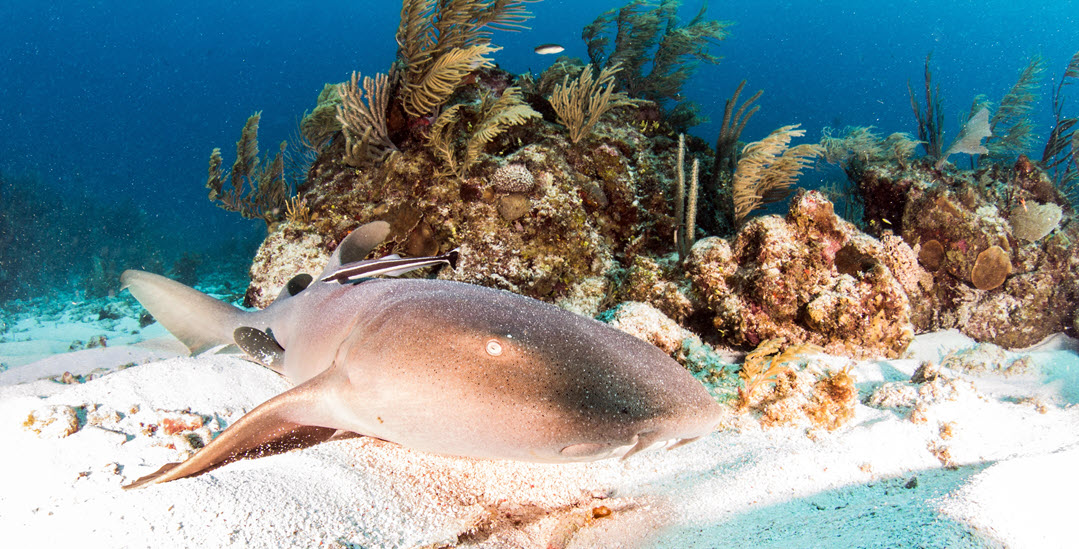
Nurse Sharks are especially well suited to life near the bottom. They can breathe while lying still and use whisker-like barbels to help locate food. They also create powerful suction to pull prey from cracks, sand, and rocky crevices.
They’re also unusually social for sharks in some situations. Several Nurse Sharks may rest together during the day, sometimes returning to the same resting areas again and again. Their predictable behavior and shallow-water habitat have made them one of the most familiar sharks to divers and marine researchers.
What Is a Nurse Shark?
The Nurse Shark (Ginglymostoma cirratum) belongs to the family Ginglymostomatidae and the order Orectolobiformes, or carpet sharks.
It’s a large bottom-associated shark found in tropical and subtropical waters of the Atlantic Ocean. Its range includes the Caribbean Sea, Gulf of Mexico, western Atlantic coastlines, and parts of the eastern Atlantic near West Africa.
Nurse Sharks are closely related to other carpet sharks, a group that includes wobbegongs, zebra sharks, and whale sharks.
One of their most recognizable features is a pair of short, fleshy structures called barbels beside the nostrils. These help the shark investigate the seafloor and locate prey.
Physical Appearance
Nurse Sharks have broad, rounded heads, small eyes, thick bodies, and long tails.
Their color usually ranges from yellowish-brown to gray-brown. Young sharks may have small dark spots that become less noticeable as they grow.
Two rounded dorsal fins sit toward the rear half of the body. The first dorsal fin is larger than the second. The tail is long and makes up a noticeable part of the shark’s total length.
The mouth sits well forward on the underside of the head. Short barbels hang near the nostrils and are one of the easiest features to use when identifying the species.
Nurse Sharks have many small teeth arranged in rows. Species such as Great Whites have large cutting teeth. Nurse Sharks are different — their teeth are suited to gripping and crushing smaller prey.
Most Nurse Sharks are considerably smaller than the largest recorded individuals, but FishBase reports a maximum length of about 14 feet (4.3 meters).
Where Do Nurse Sharks Live?
Nurse Sharks live in tropical and subtropical waters of the western and eastern Atlantic Ocean.
In the western Atlantic, they occur from the northeastern United States south through Florida and the Gulf of Mexico. Their range continues through the Caribbean, Central America, and northern South America to Brazil. They’re also found around Bermuda.
In the eastern Atlantic, Nurse Sharks occur around the Cape Verde Islands and along parts of the West African coast.
They use coral reefs, rocky areas, mangroves, seagrass habitats, sandy bottoms, lagoons, and other shallow coastal environments.
FishBase records the species from the surface to about 426 feet (130 meters). Nurse Sharks are usually found in much shallower water, though.
Young Nurse Sharks commonly use shallow protected habitats, while adults may occupy reefs and deeper coastal areas.
Social Behavior
Nurse Sharks are often seen resting together during the day. Several sharks may lie close beside one another, or even partly on top of each other. This often happens beneath ledges, inside caves, or on sheltered parts of the seafloor.
These daytime groups can form repeatedly in the same resting areas. Individual Nurse Sharks may return to familiar sites, especially when those places provide protection and suitable conditions.
At night, the sharks become more active. They usually spread out to search for food rather than hunting as an organized group.
Nurse Sharks also interact during courtship and mating. FishBase describes males and females swimming together in synchronized movements during courtship, and several adults may sometimes be involved in the same mating interaction.
Their social behavior changes with activity. Resting groups are common, while feeding is usually more independent.
What Do Nurse Sharks Eat?
Nurse Sharks feed mainly on animals that live on or near the seafloor. FishBase diet data show that bottom-dwelling crustaceans are especially important. Bony fish and cephalopods such as squid also make up significant parts of the diet.
Nurse Sharks may eat crabs, shrimp, lobsters, fish, squid, octopuses, mollusks, and other bottom-dwelling animals depending on what’s available. Their diet can change with location, age, and habitat. Young Nurse Sharks take smaller prey, while larger sharks can handle larger animals.
Nurse Sharks can pull prey from cracks and sand. This lets them feed on animals that are difficult for many other predators to reach.
How Do Nurse Sharks Hunt?
Nurse Sharks are most active at night, when they move across reefs, sandy bottoms, and other coastal habitats searching for food. They use smell, touch, their barbels, the lateral line, and electrical senses to help locate animals hidden among rocks or beneath sand.
When a Nurse Shark finds prey, it can rapidly expand its mouth and throat to create powerful suction. Water and the prey are pulled into the mouth in a sudden burst. This feeding method is especially useful around reefs, where crabs, fish, octopuses, and other animals may hide deep inside cracks and crevices.
Nurse Sharks don’t need to chase prey over long distances. Their hunting style depends more on careful searching, sensory information, and a fast suction strike at close range.
Reproduction and Life Cycle
Nurse Sharks give birth to live young. They’re aplacental viviparous sharks, meaning the embryos develop inside the mother and are nourished mainly by yolk rather than through a placental connection.
FishBase reports litters of about 21 to 28 pups. Other studies report a similar range of roughly 20 to 30. Pregnancy lasts about five to six months. In waters around Florida, females give birth in late spring and summer.
Newborn Nurse Sharks measure about 11 to 12 inches (27 to 30 centimeters) long. The pups receive no direct parental care after birth and begin life in shallow nursery habitats.
Males may take roughly 10 to 15 years to mature, while females may take about 15 to 20 years. Females generally reproduce only every other year, which limits how quickly populations can replace lost adults.
FishBase reports a maximum recorded age of 25 years.
Evolution & Adaptations
Nurse Sharks belong to the carpet shark order, Orectolobiformes. This group includes sharks with a wide variety of body shapes and feeding styles, from bottom-dwelling wobbegongs to the enormous filter-feeding Whale Shark.
Within this order, Nurse Sharks developed a body and feeding system well suited to shallow coastal habitats and life close to the seafloor.
The Nurse Shark was once thought to occur in both the Atlantic and eastern Pacific oceans. Modern taxonomic research now recognizes the eastern Pacific nurse shark as a separate species, Ginglymostoma unami. The species Ginglymostoma cirratum is therefore considered an Atlantic shark.
Several specific adaptations make Nurse Sharks well suited to resting and feeding near the ocean floor. Most sharks depend mainly on swimming to move water across their gills. Nurse Sharks are different — they can actively pump water through their mouths and over their gills. This lets them breathe while lying still on the bottom.
Their barbels help them investigate sand, rocks, and reef surfaces while searching for food. One of their most important adaptations is suction feeding. By rapidly expanding the mouth and throat, the shark creates a strong flow of water that pulls prey into its mouth. This can help Nurse Sharks capture animals hidden in narrow cracks or beneath sand where other predators may have difficulty reaching them.
Like other sharks, they also have a lateral line that detects movement and vibrations in the water. They also have ampullae of Lorenzini, which detect weak electrical signals produced by living animals.
Together, barbels, a forward-positioned mouth, strong throat muscles, and suction feeding let Nurse Sharks locate and capture prey without relying on high-speed pursuit.
Why Nurse Sharks Are Important
Nurse Sharks are part of the food webs of coral reefs, mangroves, seagrass habitats, and other coastal ecosystems. By feeding on crabs, other crustaceans, fish, squid, octopuses, and similar animals, they help shape communities of bottom-dwelling marine life.
Their specialized feeding method also gives them access to prey hidden inside reefs and beneath sand. This means they use parts of the coastal food web differently from faster sharks that hunt mainly in open water.
Nurse Sharks can often be observed in shallow habitats and may repeatedly use the same resting areas. Because of this, they’re also valuable to scientists. Researchers can study their movements, feeding, mating, habitat use, and social behavior more easily than those of many deep-water sharks.
They’re important for public education as well. Seeing groups of large sharks resting quietly on the seafloor helps people understand that shark species have many different behaviors and ways of life.
Conservation
The Nurse Shark is currently classified as Vulnerable by the International Union for Conservation of Nature (IUCN).
Fishing is an important threat in parts of its range. Nurse Sharks may be caught intentionally or accidentally in commercial and recreational fisheries.
The species also depends heavily on shallow coastal habitats that are vulnerable to human activity. Coral reef decline, mangrove loss, coastal development, pollution, and damage to nursery areas can reduce the habitats Nurse Sharks need.
Their slow growth and reproductive cycle make recovery difficult when populations decline. Females mature late and generally reproduce only every other year.
Protecting coral reefs, mangroves, seagrass beds, nursery habitats, and important resting areas can benefit Nurse Shark populations as well as many other coastal species.
Research & Quotes
Nurse Sharks have been studied for decades because many of their behaviors can be observed in shallow coastal water. Researchers have examined their movement patterns, resting behavior, feeding, reproduction, sensory biology, and use of reef habitats.
Detailed observations of mating have revealed complex courtship behavior. FishBase records synchronized swimming between males and females, along with males grasping females by the pectoral fin. Females may also use several different behaviors to accept or avoid mating attempts.
Research has also shown that litters can have more than one father. This gives scientists information about mating systems and reproduction in sharks.
Tracking studies continue to examine how Nurse Sharks use familiar areas and how far they travel. They also look at whether particular resting or nursery habitats are especially important to local populations.
Nurse Sharks in Culture
Nurse Sharks are among the most familiar large sharks in the Caribbean, Bahamas, Florida, and other tropical Atlantic destinations. Divers and snorkelers frequently encounter them resting beneath coral ledges or swimming slowly over reefs and sandy bottoms.
Their calm daytime behavior has made them popular subjects for underwater photography and marine tourism. However, Nurse Sharks are still powerful wild animals and shouldn’t be touched, fed, handled, or disturbed.
Nurse Sharks are also common subjects in aquariums and marine education. Their distinctive barbels, resting behavior, and suction feeding provide opportunities to explain how different shark species are adapted to very different lifestyles.
For many people, seeing a Nurse Shark resting peacefully on the seafloor is memorable. It’s a striking contrast to the fast, aggressive shark image often presented in popular culture.
| Common Name | Nurse Shark |
| Other Common Names | Atlantic Nurse Shark, Common Nurse Shark |
| Scientific Name | Ginglymostoma cirratum |
| Family | Ginglymostomatidae |
| Order | Orectolobiformes |
| Conservation Status | Vulnerable (IUCN) |
Interesting Nurse Shark Facts
- Nurse Sharks often spend daylight hours resting on the seafloor.
- Several Nurse Sharks may rest together in the same sheltered area.
- They can actively pump water over their gills while remaining still.
- Short whisker-like barbels beside the nostrils help them investigate the seafloor.
- Nurse Sharks capture much of their prey using powerful suction.
- They become more active after dark.
- Bottom-dwelling crustaceans make up an important part of their diet.
- They also eat fish, squid, octopuses, and other marine animals.
- Most Nurse Sharks are smaller than the largest recorded individuals, but they can reach about 14 feet (4.3 meters) long.
- They live mainly in warm Atlantic coastal waters.
- The species can live in both marine and brackish water.
- Nurse Sharks have been recorded from the surface to about 426 feet (130 meters) deep.
- Females give birth to live young.
- Litters usually contain about 21 to 28 pups.
- Females generally reproduce only every other year.
- FishBase reports a maximum recorded age of 25 years.
- The eastern Pacific nurse shark is now considered a separate species, Ginglymostoma unami.
- The Nurse Shark is currently classified as Vulnerable by the IUCN.
SHARK PAGES
SPECIES PAGES