
Oceanic Whitetip Shark
The Oceanic Whitetip Shark was once one of the most abundant large predators in the open ocean. For centuries, these powerful sharks cruised warm tropical seas. They traveled enormous distances across stretches of water where land was often hundreds of miles away. Today, they have experienced one of the steepest population declines of any shark species.
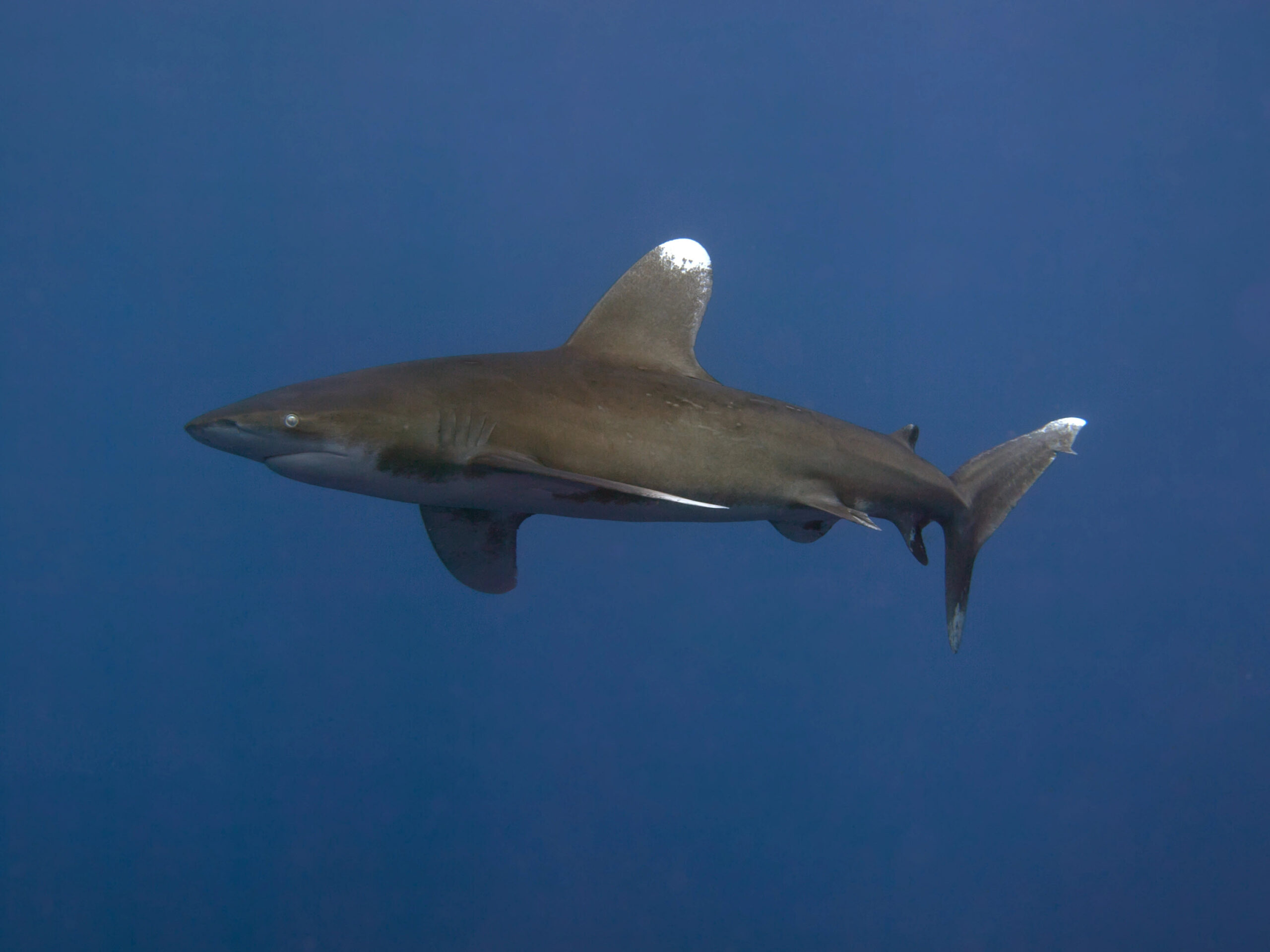
Unlike reef sharks or coastal sharks, Oceanic Whitetips spend nearly their entire lives in the open ocean. Their broad, rounded fins let them glide effortlessly through the water while searching for fish, squid, sea turtles, and other prey. They’re curious animals and have been known to investigate floating objects, seabirds, and boats that drift through their remote habitat.
Oceanic Whitetip Sharks are built for endurance rather than speed. They patrol the upper layers of the open ocean, where food can be unpredictable, making every feeding opportunity important. Today, conservation efforts focus on protecting this iconic ocean wanderer. Its dramatic decline serves as a reminder of how quickly even once-common marine species can become threatened.
What Is an Oceanic Whitetip Shark?
The Oceanic Whitetip Shark (Carcharhinus longimanus) is a member of the requiem shark family, Carcharhinidae. It’s one of the few large sharks specially adapted for life in the open ocean, far from coastlines and coral reefs.
Its long, paddle-shaped fins, tipped with bright white markings, make it easy to recognize. These oversized fins help the shark glide efficiently through open water while conserving energy during long journeys.
The genus name Carcharhinus comes from Greek words meaning “sharp” or “jagged.” This was an old way of describing a shark’s rough, rasp-like skin. The species name longimanus comes from Latin words meaning “long hand,” referring to its unusually long pectoral fins.
The Oceanic Whitetip Shark is one of the ocean’s true long-distance travelers and an important apex predator of the pelagic ecosystem.
Physical Appearance
Oceanic Whitetip Sharks have sturdy, streamlined bodies with broad, rounded snouts and large eyes. Adults commonly measure around 8 to 9 feet (2.4 to 2.7 meters) long. FishBase reports a maximum length of about 13 feet (4 meters).
Their most recognizable feature is their exceptionally long, rounded pectoral fins. The tips of these fins are marked with bright white patches, along with the first dorsal fin and upper tail lobe. This is what inspired the shark’s common name.
Their bodies are usually bronze, gray, or brownish-gray on top, fading to a white underside that provides countershading.
Their broad, serrated teeth are well suited for capturing slippery fish and tearing larger prey.
Overall, Oceanic Whitetips are built for steady, energy-efficient swimming across enormous distances.
Where Do Oceanic Whitetip Sharks Live?
Oceanic Whitetip Sharks live in tropical and subtropical oceans around the world. They’re commonly found in the Atlantic, Pacific, and Indian Oceans wherever warm water is present.
Unlike many sharks that remain close to shore, they spend most of their lives in the pelagic zone, far from land. FishBase records the species from the surface to depths of about 3,550 feet (1,082 meters). They’re usually found much shallower, though, generally within about 500 feet (152 meters) of the surface.
Because they roam such vast areas, protecting this highly migratory species takes cooperation between many countries.
Social Behavior
Oceanic Whitetip Sharks are often seen alone, but they aren’t always solitary. They’re frequently accompanied by remoras, pilotfish, and other hitchhiking fish that travel alongside them. They sometimes follow schools of tuna or pods of dolphins where feeding opportunities are more likely.
They’re also known for their bold, curious behavior. Oceanic Whitetips will investigate floating debris, boats, and other unfamiliar objects. They sometimes gather in numbers wherever prey becomes concentrated, such as around a whale carcass or beneath drifting seaweed.
What Do Oceanic Whitetip Sharks Eat?
Oceanic Whitetip Sharks are opportunistic predators that eat a wide variety of open-ocean animals. Common foods include tuna, mackerel, flying fish, squid, octopus, sea turtles, rays, seabirds, and dead whales and other carrion.
They often feed wherever prey becomes concentrated, including beneath floating seaweed, around drifting debris, or near schools of fish. Their willingness to eat many different kinds of prey helps them survive in an environment where food can be difficult to find.
How Do Oceanic Whitetip Sharks Hunt?
Oceanic Whitetip Sharks rely on endurance and opportunity rather than bursts of speed. They patrol the open ocean using their excellent sense of smell and sharp vision. They also use the lateral line and the ampullae of Lorenzini to locate prey.
When food is discovered, they may circle schools of fish before making quick attacks. They also investigate floating objects where fish and other marine animals often gather.
Unlike ambush predators, Oceanic Whitetips succeed by constantly searching large areas of ocean until opportunities arise. Their broad fins help them glide efficiently while conserving energy between feeding events.
Reproduction and Life Cycle
Oceanic Whitetip Sharks reproduce through placental viviparity. Developing embryos receive nutrients through a yolk-sac placental connection inside the mother’s body.
After a gestation period of about 10 to 12 months, females give birth to between 1 and 15 pups. Many studies report an average closer to 6 to 9. The reproductive cycle is thought to be biennial in many populations. This means females give birth every other year rather than annually.
Newborn pups measure about 2 feet (60 to 65 centimeters) long and immediately begin hunting small fish and squid.
Like many large sharks, Oceanic Whitetips grow slowly, mature late, and produce relatively few offspring. This makes population recovery difficult after heavy fishing pressure. Estimates of maximum age vary by study. Many researchers report lifespans of 20 years or more, with some estimates reaching into the 30s.
Evolution & Adaptations
Oceanic Whitetip Sharks evolved within the requiem shark family. They followed a different evolutionary path from many of their coastal relatives. Rather than specializing for reefs or shallow waters, they adapted to the open ocean, where food is scattered across immense distances.
Natural selection favored sharks with broad fins that reduced energy use during long swims. It also favored senses capable of detecting prey over large areas. Their long, rounded pectoral fins generate lift and reduce the amount of energy needed for continuous swimming over great distances. Their streamlined bodies also minimize drag.
Like all sharks, they have a lateral line, which detects vibrations. They also have the ampullae of Lorenzini, which detect weak electrical fields produced by living animals. These senses help them locate prey across enormous areas of seemingly empty ocean.
Their curious behavior may also be an adaptation to their environment. In a place where every potential food source is worth investigating, this trait can matter a lot. A willingness to check out unfamiliar objects can mean the difference between finding a meal and going hungry.
These adaptations allowed Oceanic Whitetips to become one of the dominant predators of the tropical pelagic zone.
Why Oceanic Whitetip Sharks Are Important
As apex predators of the open ocean, Oceanic Whitetip Sharks help keep pelagic food webs in balance. They feed on a wide variety of fish, squid, and other animals. This influences the populations and behavior of the species below them in the food chain.
Their steep population decline has also made them an important symbol for people working to protect sharks. Oceanic Whitetips were once so abundant and are now Critically Endangered. Their story shows just how quickly heavy fishing pressure can devastate even a widespread, adaptable species.
Studying their long-distance migrations has also helped scientists understand how pelagic ecosystems are connected across entire ocean basins. This informs protection efforts that go far beyond the waters of any single country.
Conservation
The Oceanic Whitetip Shark is currently classified as Critically Endangered by the International Union for Conservation of Nature (IUCN).
Populations have declined dramatically because this species is highly vulnerable to commercial longline fishing and the shark fin trade. Major threats include commercial longline fishing, the shark fin trade, bycatch, slow reproduction, climate change, and marine pollution.
Many countries and international organizations now regulate or prohibit the harvest of Oceanic Whitetip Sharks. Working together across borders remains essential for their recovery.
Research & Quotes
Oceanic Whitetip Sharks have become an important focus of shark conservation research around the world. Scientists use satellite tags to study their migrations, habitat use, and responses to changing ocean conditions. These studies help identify important feeding areas and migration routes that may benefit from additional protection.
Marine biologist Dr. Demian Chapman has contributed significantly to shark conservation. He’s emphasized that protecting highly migratory sharks requires cooperation across borders, since these animals routinely cross the waters of many different nations.
Oceanic Whitetip Sharks in Culture
For much of the twentieth century, Oceanic Whitetip Sharks were known mainly to sailors, commercial fishermen, and marine biologists. This is because they lived so far from shore.
Today, they’ve become important symbols of open-ocean conservation. Their dramatic population declines have drawn worldwide attention to the effects of overfishing on pelagic ecosystems.
Divers who encounter Oceanic Whitetips often describe them as bold, confident, and inquisitive rather than aggressive. Their graceful appearance and distinctive white-tipped fins have made them one of the most recognizable sharks of the open sea.
| Common Name | Oceanic Whitetip Shark |
| Other Common Names | Whitetip Shark, Brown Shark (historical) |
| Scientific Name | Carcharhinus longimanus |
| Family | Carcharhinidae |
| Order | Carcharhiniformes |
| Conservation Status | Critically Endangered (IUCN) |
Interesting Oceanic Whitetip Shark Facts
- Oceanic Whitetip Sharks are named for the bright white markings on their fin tips.
- They spend nearly their entire lives in the open ocean, far from land.
- They’re naturally curious and often investigate unfamiliar objects, boats, and even divers.
- They feed on fish, squid, sea turtles, seabirds, and carrion.
- They often follow schools of tuna or pods of dolphins.
- They’re frequently accompanied by remoras and pilotfish.
- Adults commonly measure around 8 to 9 feet (2.4 to 2.7 meters) long.
- FishBase reports a maximum length of about 13 feet (4 meters).
- They were once among the most abundant large sharks in tropical oceans.
- Their populations have declined dramatically over the past several decades.
- Females give birth to live young after a gestation period of about 10 to 12 months.
- Litters typically contain between 1 and 15 pups.
- Many populations appear to reproduce every other year rather than annually.
- They play an important role in maintaining healthy pelagic ecosystems.
- The Oceanic Whitetip Shark is currently classified as Critically Endangered by the IUCN.
SHARK PAGES
SPECIES PAGES