
Blacktip Shark
Albert KokAlbert Kok at Dutch Wikipedia, Public domain, via Wikimedia Commons

The Blacktip Shark is a fast-moving coastal shark found in warm waters around much of the world. It gets its name from the dark markings on many of its fins. You can often spot it in bays, estuaries, lagoons, near beaches, and along continental and island shelves. Blacktip Sharks are powerful swimmers known for their dramatic leaps out of the water while chasing schools of fish.
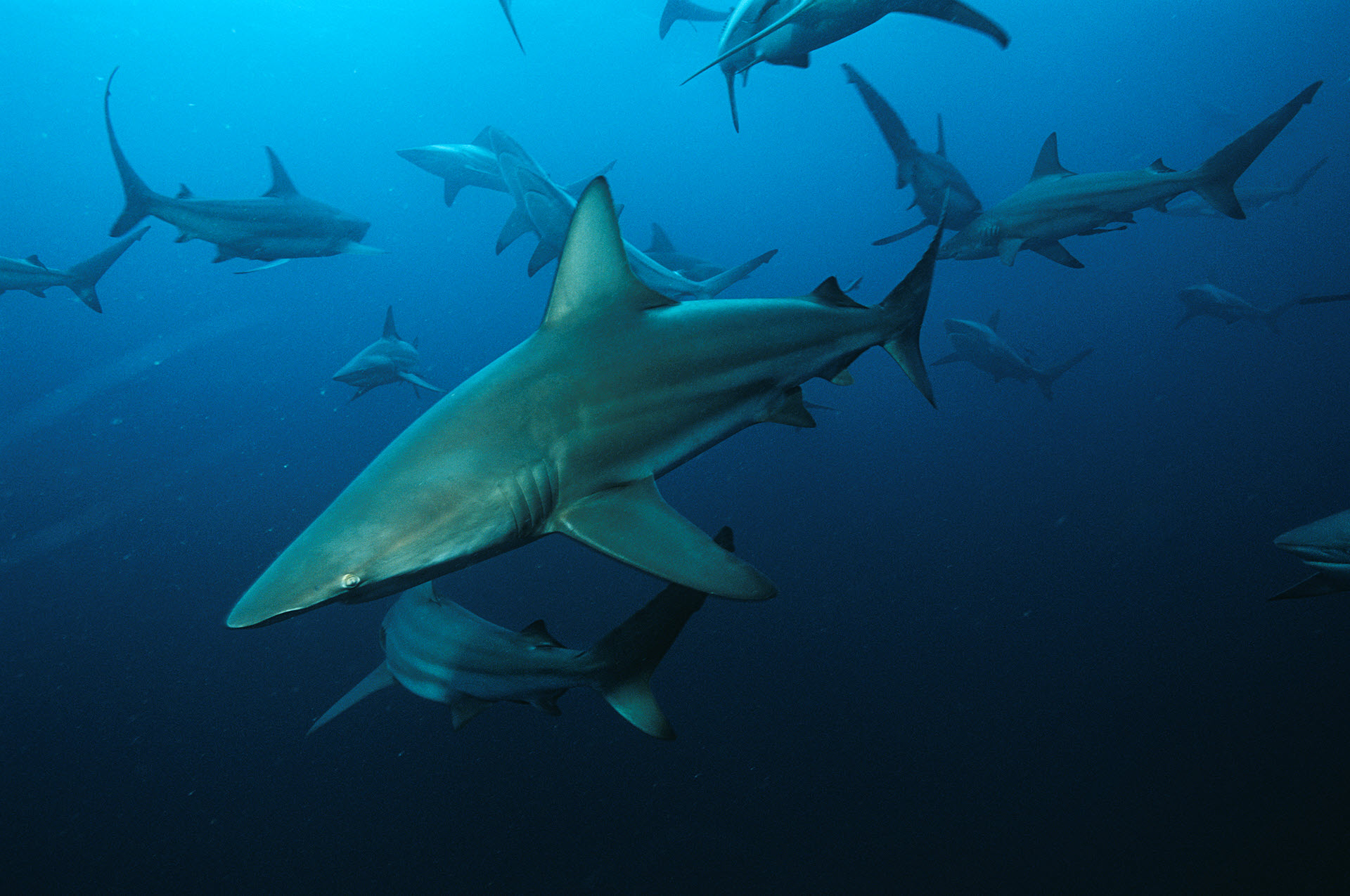
Blacktip Sharks spend much of their lives in busy coastal waters, but they can also travel long distances. In some regions they migrate with the seasons. Young sharks often stay in shallow nursery areas for months, and some return to the same nursery in later years. These sharks live so close to shore that their lives are closely tied to coastal habitats — the same places most affected by fishing and coastal development.
What Is a Blacktip Shark?
The Blacktip Shark (Carcharhinus limbatus) belongs to the family Carcharhinidae, commonly known as the requiem sharks. It’s part of the order Carcharhiniformes, the ground sharks. It’s a medium-sized shark with a streamlined body, a pointed snout, and dark markings on its fins.
Despite the similar name, the Blacktip Shark and the Blacktip Reef Shark (Carcharhinus melanopterus) are two different species. Blacktip Sharks have a much wider range and live in many kinds of coastal and offshore waters, not just shallow tropical reefs.
The Blacktip Shark is also easy to confuse with the Spinner Shark (Carcharhinus brevipinna). Both species leap and spin out of the water while feeding. One easy way to tell them apart is the anal fin. A Blacktip Shark’s anal fin is usually plain, while an adult Spinner Shark’s anal fin usually has a black tip.
Physical Appearance
Blacktip Sharks have strong, streamlined bodies built for fast swimming. Their backs are usually gray, gray-brown, or bronze, while their bellies are much lighter. A dark band sometimes runs along each side of the body.
The dark markings on the fins give this shark its name. Black or dusky tips usually show on the pectoral fins, dorsal fins, pelvic fins, and the lower part of the tail. These marks can fade a bit as the shark gets older. Unlike the similar Spinner Shark, the Blacktip Shark’s anal fin usually has no dark tip.
The head ends in a fairly long, pointed snout. The first dorsal fin is tall, and there’s no ridge between the two dorsal fins. Its teeth are narrow and sharp, built for grabbing and cutting the fish that make up most of its diet.
Blacktip Sharks usually grow to about 5 to 6 feet (1.5 to 1.8 meters) long, though larger ones do turn up. The largest ever recorded reached about 9.4 feet (2.86 meters), and the heaviest weighed about 271 pounds (123 kilograms).
Where Blacktip Sharks Live
Blacktip Sharks live across warm and warm-temperate waters worldwide. They’re found in the Atlantic, Indian, and Pacific Oceans, along continental and island coasts in many parts of the world. They mostly stay over continental and island shelves rather than heading into the open ocean far from land.
They live both close to shore and farther out, showing up near river mouths, estuaries, muddy bays, mangrove areas, lagoons, beaches, and coral reef edges. They’ve been recorded from the surface down to about 460 feet (140 meters) deep.
Young Blacktip Sharks especially rely on shallow coastal nursery areas. Bays and estuaries give them plenty of food and fewer large shark predators to worry about. Juveniles often stay in the same nursery area for a long stretch, and some return to it again in later years.
Some populations migrate strongly with the seasons. Along the southeastern United States, for example, large numbers move down the coast each winter, gathering in huge numbers off southeastern Florida.
Social Behavior
Blacktip Sharks aren’t simply “social” or “solitary” — it depends on their age, sex, location, and the time of year. They can be found alone, in small groups, or in massive seasonal gatherings.
One of the most dramatic examples happens off southeastern Florida, where migrating Blacktip Sharks gather by the thousands every winter. Aerial surveys have spotted sharks swimming alone, in organized schools, and in huge loose groups that aren’t all heading the same direction.
These gatherings don’t necessarily mean the sharks form lasting friendships. Many groups seem to form around migration routes, ocean conditions, or shared food sources. Recent research has found that some large winter groups are strongly split by sex and size. One Florida study found a gathering made up almost entirely of similarly sized adult males.
Young Blacktip Sharks may also share shallow nursery areas with many other juveniles. Where they settle depends heavily on habitat, food, temperature, and safety from bigger predators. Scientists are still working out how much of this grouping is truly social behavior, and how much is just many sharks separately choosing the same good spot.
What Do Blacktip Sharks Eat?
Blacktip Sharks eat a wide variety of marine animals, but fish make up most of their diet. They hunt fish that swim in open water as well as ones that stay closer to the seafloor. Depending on the region, their prey can include schooling fish like sardines, herring, anchovies, mullet, and menhaden.
They also eat squid, octopuses, crustaceans, and occasionally smaller sharks and rays. Diet changes based on location, what’s available, and the shark’s age. Young Blacktip Sharks in coastal nurseries eat smaller prey suited to those shallow habitats, while larger sharks can take on a wider range of food. This flexibility is part of why Blacktip Sharks thrive in so many different coastal environments around the world.
How Do Blacktip Sharks Hunt?
Blacktip Sharks are active hunters that often search for prey in open water rather than along the bottom. Schooling fish are especially important prey, and the sharks can move fast through a school to grab individual fish.
Their most famous move happens near the surface. A Blacktip Shark chasing fish may burst straight up and out of the water completely, twisting or spinning in the air before splashing back down. Spinner Sharks perform similar leaps, which is part of why the two species get confused.
Blacktip Sharks rely on several senses while hunting. Vision and smell work at longer range. The lateral line picks up movement and vibration in the water, and electroreception lets the shark detect very weak electrical signals at close range. Many Blacktip Sharks may feed in the same spot when food is abundant, but there isn’t strong evidence that they hunt as an organized team. They’re mainly skilled individual hunters that often cross paths around a good food source.
Reproduction and Life Cycle
Blacktip Sharks give birth to live young through a process called placental viviparity. Early on, a developing pup is nourished by its yolk sac. Once that yolk is used up, the sac forms a placental connection to the mother, which then delivers nutrients as the pup keeps growing.
Pregnancy lasts about 10 to 12 months. Litters usually range from 1 to 10 pups, though the exact number varies by female and population. Some females appear to give birth about every two years.
Pregnant females move into shallow inshore waters to give birth, and these nursery areas matter a lot during the pups’ earliest days. Newborns typically measure about 15 to 28 inches (38 to 72 centimeters) long, though this range narrows within specific populations.
Pups get no care from their parents after birth. Instead, they stay in productive shallow habitats where they feed and grow on their own. Juveniles often show strong loyalty to their nursery area, and some return to it after moving away for a season. Growth rate, age at maturity, and lifespan all vary depending on where in the world a population lives. There’s no single age that fits every Blacktip Shark.
Evolution & Adaptations
Blacktip Sharks belong to Carcharhinidae, a large family of ground sharks that also includes Bull Sharks, Spinner Sharks, reef sharks, and many other familiar coastal species. They’re part of Carcharhiniformes, the largest living order of sharks.
The relationships between species within the genus Carcharhinus are complicated, and scientists still use both genetics and anatomy to sort out how they’re related. The Blacktip Shark shares many traits with other requiem sharks: a streamlined body, five gill slits, two dorsal fins, an uneven tail shape, and highly developed senses.
Over its evolutionary history, the Blacktip Shark lineage developed a combination of traits well suited to life in busy coastal waters. Its body shape allows for fast, efficient swimming, while its senses and jaws let it track down and capture many different kinds of prey.
A few specific adaptations stand out. Its muscular tail provides speed, while its fins give it control and stability while chasing fast-moving fish. Like other sharks, it has a lateral line that detects movement and vibration in the water. It also has ampullae of Lorenzini, which sense the weak electrical fields living animals give off. Together with smell, vision, and hearing, these senses give the shark a detailed picture of its surroundings.
One especially interesting adaptation shows up in young sharks: navigation. Juveniles can form a strong attachment to a specific nursery area and find their way back even after being moved away in experiments. Scientists think smell plays a big role in helping them recognize home, though other cues may help too.
Modern populations also carry evidence of more recent evolutionary history. Genetic studies have found real differences between some Blacktip Shark populations around the world. This suggests that migration patterns — and females returning to the same nursery regions — have shaped genetic differences within this widely spread species.
Why Blacktip Sharks Are Important
Blacktip Sharks play an important role as mid-level predators in coastal food webs. By hunting schooling fish, squid, and other prey, they help keep those populations in balance. Without predators like the Blacktip Shark, prey species can become overly abundant, which can throw off the balance of an entire coastal ecosystem.
Blacktip Sharks depend heavily on healthy nursery habitats — bays, estuaries, and mangroves. Because of this, their presence is also a good sign of how healthy those coastal environments are. When Blacktip Shark populations decline, it often points to bigger problems in the coastal habitats many other species depend on too.
Blacktip Sharks are also valuable to scientists. They migrate long distances, return to the same nursery areas, and gather in large, trackable groups. This makes them one of the most useful species for studying how coastal shark populations move, grow, and respond to changes in their environment.
Conservation
The Blacktip Shark is currently listed as Vulnerable on the IUCN Red List, based on a global assessment completed in 2020.
Fishing is one of the biggest pressures on this species. Blacktip Sharks are caught in both commercial and recreational fisheries, and they’re sometimes caught unintentionally as bycatch. Their meat is used for food, and their fins, skin, and liver oil have historically been used too.
Their dependence on coastal habitats adds another layer of risk. Important nursery grounds sit in bays, estuaries, mangroves, and other nearshore areas — places affected by coastal development, pollution, fishing activity, and changing water quality.
Protecting Blacktip Sharks takes more than just managing how many adult sharks are caught. It also means identifying and protecting nursery habitats, understanding migration routes, monitoring fisheries, and figuring out how different populations around the world are connected.
Research & Quotes
Blacktip Sharks have become valuable subjects for research. Their lives touch several major areas of shark science: migration, nursery habitat, navigation, population genetics, and large group behavior.
Tagging studies have shown that young sharks stay strongly connected to specific nursery areas. Experiments in Florida found that young Blacktip Sharks moved away from their home range could find their way back. This gave scientists evidence that smell helps them recognize home.
Aerial surveys have revealed just how large adult seasonal migrations can be. Researchers off southeastern Florida have documented thousands of Blacktip Sharks gathering in nearshore waters every winter. More recent studies have shown these groups can be strongly separated by sex and size. This raises new questions about why different groups migrate and gather the way they do.
Genetic research has also uncovered distinct population structure across the Blacktip Shark’s range. That matters for conservation. A species found around much of the world isn’t necessarily one single, freely mixing population — different regional groups may need to be managed and protected separately.
Taken together, this research tells a detailed story. Blacktip Sharks remember and return to important places, travel long distances, and organize their lives around coastal habitats in ways scientists are still working to fully understand.
Blacktip Sharks in Culture
Because Blacktip Sharks live so close to shore, they’re among the sharks people encounter most often in many coastal regions. Anglers, boaters, divers, surfers, photographers, and beachgoers frequently share the same waters as this species.
Their dramatic leaps have made Blacktip Sharks especially recognizable in wildlife photography and film. Large seasonal gatherings have produced striking images too. Photos taken from the air along Florida’s coast show hundreds or thousands of sharks swimming surprisingly close to beaches.
Blacktip Sharks matter to both commercial and recreational fisheries in parts of their range. At the same time, seeing so many of them near populated coastlines has made the species useful for teaching the public how sharks actually use nearshore waters.
Their presence is also a reminder of something important: coastal waters are wildlife habitat. Blacktip Sharks have used beaches, bays, estuaries, and migration routes for feeding, raising young, and traveling. They were doing this long before those same coastlines became centers of human recreation and development.
| Common Name | Blacktip Shark |
| Other Common Names | Common Blacktip Shark (Blacktip Reef Shark is sometimes confused, but is a different species) |
| Scientific Name | Carcharhinus limbatus |
| Family | Carcharhinidae |
| Order | Carcharhiniformes |
| Conservation Status | Vulnerable (IUCN) |
Interesting Blacktip Shark Facts
- Blacktip Sharks can leap completely out of the water while chasing fish.
- They often spin several times during these spectacular jumps.
- Their black fin markings give them their common name.
- They can reach speeds of more than 20 miles (32 kilometers) per hour during short bursts.
- Large schools sometimes gather during seasonal migrations.
- Young Blacktip Sharks spend their first months in shallow nursery areas that provide protection from larger predators.
- They are one of the shark species most often seen near popular beaches.
- Their excellent eyesight helps them hunt in clear coastal waters.
- They primarily hunt during daylight hours.
- They are important predators that help maintain healthy fish populations.
- They are generally cautious around humans and rarely attack people.
- Scientists use satellite tags to track their long-distance seasonal movements.
SHARK PAGES
SPECIES PAGES