
Whale Shark
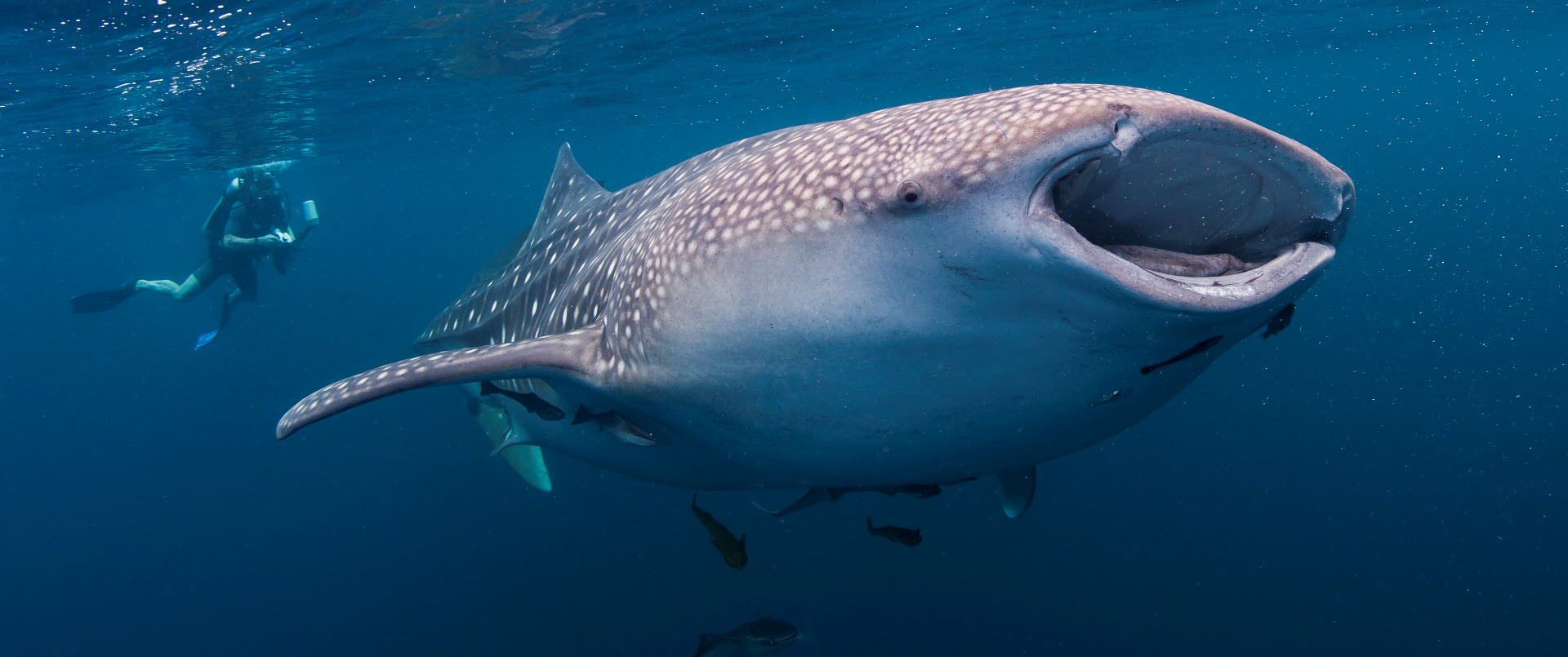
Whale Sharks live in warm tropical and subtropical waters around the world. They’re found near the surface in coastal areas rich with food, but they’re also capable of diving to extraordinary depths.
Despite its massive size, the Whale Shark poses no danger to people. It has no interest in hunting large animals and is known for being calm and curious around divers and boats.
Today, Whale Sharks face serious conservation challenges. They grow slowly, mature late, and are increasingly threatened by fishing, boat strikes, and marine pollution.
What Is a Whale Shark?
The Whale Shark (Rhincodon typus) is the only living species in the genus Rhincodon. It belongs to the family Rhincodontidae, within the order Orectolobiformes, or carpet sharks.
Despite its name, the Whale Shark isn’t related to whales at all. It’s a true shark and a fish, not a marine mammal. Its name comes from its enormous size, more typical of whales than fish.
The species was first formally described by the naturalist Andrew Smith in 1828.
Whale Sharks are one of only three known filter-feeding shark species, along with the Basking Shark and the rare Megamouth Shark.
Physical Appearance
Whale Sharks have massive, elongated bodies with a broad, flattened head and a wide mouth positioned at the front rather than underneath, like most other sharks.
Adults commonly reach 20 to 30 feet (6 to 9 meters) long. Well-documented individuals have reached about 62 feet (18.8 meters), making the Whale Shark the largest confirmed fish species alive.
Their skin is gray, brown, or bluish-gray, covered in a distinctive checkerboard pattern of white or pale yellow spots and stripes. This pattern is unique to each individual shark, similar to a human fingerprint.
Their mouths can stretch nearly 5 feet (1.5 meters) wide in the largest adults and contain thousands of tiny teeth. Oddly, these teeth aren’t used for feeding at all, since Whale Sharks are filter feeders. Scientists have even discovered tiny tooth-like structures on the shark’s eyeballs, which may help protect the eyes.
Where Do Whale Sharks Live?
Whale Sharks live in tropical and warm temperate oceans around the world, though they’re absent from the Mediterranean Sea.
They use both coastal and open-ocean habitats. Whale Sharks are often seen near the surface in areas where food is abundant. Satellite tags have also recorded dives to depths of at least 1,928 meters (about 6,325 feet), well into cold, dark water.
Many Whale Sharks travel enormous distances. Some tagged individuals have completed journeys of more than 8,000 kilometers (about 5,000 miles). Despite these long migrations, many sharks return to the same coastal feeding sites year after year.
Social Behavior
Whale Sharks are usually seen alone, but they can also form large aggregations of more than 100 individuals in places where food is especially abundant.
These gatherings often happen near coral spawning events, plankton blooms, or schools of small fish. Whale Sharks are sometimes seen alongside groups of tuna and other pelagic fish that are feeding in the same productive waters.
They’re known for being curious and generally unbothered by boats and divers. In some regions, they’ve become accustomed to swimming near people at popular feeding sites.
What Do Whale Sharks Eat?
Despite their enormous size, Whale Sharks feed mainly on some of the smallest animals in the ocean. Their diet includes zooplankton, krill, small crustaceans, squid, fish eggs, and small schooling fish such as sardines, anchovies, and mackerel.
They’re capable of filtering an extraordinary amount of water. Some estimates suggest a Whale Shark can filter more than 600,000 liters (about 158,000 gallons) of water every hour while feeding.
How Do Whale Sharks Hunt?
Whale Sharks feed using specialized filter pads inside their gills. As water passes through their huge mouths and out through five enormous gill slits, tiny prey gets trapped and swallowed.
While feeding on concentrated plankton near the surface, Whale Sharks often position themselves vertically in the water, with the head lifted partly out of the water. They open and close their mouths repeatedly, sometimes more than 20 times per minute, drawing in large gulps of food-rich water.
At other times, Whale Sharks simply swim slowly forward with their mouths open, straining prey from the water as they move.
Reproduction and Life Cycle
Whale Sharks reproduce through ovoviviparity, with pups developing inside eggs nourished by a yolk sac within the mother’s body before being born live.
Much about Whale Shark reproduction remains a mystery. No one has ever directly observed Whale Sharks mating or giving birth in the wild. Most of what scientists know comes from a single pregnant female examined in Taiwan. She was found carrying about 300 pups at different stages of development, the largest litter ever recorded for any shark.
Very young Whale Sharks are rarely seen. Almost no individuals have ever been recorded between about 3 feet (93 centimeters) and 10 feet (3 meters) long. This suggests that young sharks may spend this stage of life somewhere scientists haven’t yet studied closely.
Whale Sharks grow slowly and mature late, reaching sexual maturity at around 30 years of age. They’re also remarkably long-lived, with some individuals estimated to live 70 to 100 years.
Evolution & Adaptations
Whale Sharks belong to the carpet shark order, Orectolobiformes, a group that includes a wide range of body shapes, from bottom-dwelling wobbegongs to this enormous filter-feeding giant.
Fossil evidence shows that ancestors of the whale shark lineage stretch back tens of millions of years. The modern genus has been present since at least the Oligocene epoch.
Over time, Whale Sharks evolved a body built for filter feeding rather than hunting. Their enormous mouths, specialized gill filter pads, and reduced reliance on teeth let them thrive on tiny, abundant prey rather than competing with faster predators for larger fish.
Their massive size may also help protect adult Whale Sharks from most predators, since few animals in the ocean are large enough to threaten a fully grown individual.
Like all sharks, Whale Sharks have a lateral line, which detects vibrations in the water. They also have the ampullae of Lorenzini, which sense weak electrical signals produced by living things.
Why Whale Sharks Are Important
As filter feeders, Whale Sharks help connect different levels of the marine food web, feeding directly on plankton and small fish that support countless other ocean animals.
Their long migrations also link distant parts of the ocean together. Studying their movements helps scientists understand how far marine animals can travel and how different ecosystems are connected.
Whale Sharks are also economically valuable to coastal communities through ecotourism. In many parts of the world, responsible Whale Shark tourism provides income for local communities while encouraging protection of the species and its habitat.
Conservation
The Whale Shark is currently classified as Endangered by the International Union for Conservation of Nature (IUCN).
Populations have declined significantly in parts of their range, with some regions reporting sighting declines of more than 50 percent over recent decades. Major threats include commercial fishing, bycatch, boat strikes, habitat degradation, and marine pollution, including entanglement in and ingestion of plastic debris.
Because Whale Sharks grow slowly and mature late, their populations recover very slowly from these pressures. International protections and responsible tourism guidelines are important tools for their conservation.
Research & Quotes
Whale Sharks are studied using a unique method called photo identification. Because each shark’s spot pattern is unique, researchers can identify and track individual sharks for years by photographing their markings, without needing to physically tag them.
Satellite tagging has also revealed extraordinary migrations, with some sharks traveling thousands of miles between feeding and breeding areas. These studies have shown that Whale Sharks are capable of diving to nearly 2,000 meters, far deeper than most researchers once expected.
Whale sharks are difficult to study in open water. Because of this, much of what scientists know continues to come from long-term monitoring at predictable feeding aggregation sites around the world.
Whale Sharks in Culture
Whale Sharks are among the most beloved sharks in the world, drawing divers and snorkelers to aggregation sites across the globe.
Their massive size paired with their gentle, non-threatening behavior has helped reshape public perceptions of sharks in general.
In some coastal cultures, Whale Sharks are considered good luck or spiritually significant. In parts of East Africa, the species is known by the Swahili name “papa shillingi.”
Today, Whale Sharks are important ambassadors for shark conservation, showing the public that some of the ocean’s largest predators are also among its gentlest animals.
| Common Name | Whale Shark |
| Other Common Names | Papa Shillingi (Swahili) |
| Scientific Name | Rhincodon typus |
| Family | Rhincodontidae |
| Order | Orectolobiformes |
| Conservation Status | Endangered (IUCN) |
Interesting Whale Shark Facts
- The Whale Shark is the largest fish in the world.
- Despite its size, it feeds mainly on plankton, small fish, and fish eggs.
- It can filter more than 600,000 liters (about 158,000 gallons) of water per hour.
- Adults commonly reach 20 to 30 feet (6 to 9 meters) long.
- Well-documented individuals have reached about 62 feet (18.8 meters).
- Each shark’s spot pattern is unique, similar to a fingerprint.
- Scientists use these spot patterns to identify individual sharks over many years.
- It’s one of only three known filter-feeding shark species.
- Despite having thousands of tiny teeth, it doesn’t use them for feeding.
- It can dive to depths of nearly 2,000 meters (about 6,325 feet).
SHARK PAGES
SPECIES PAGES