
Hammerhead Shark
The Hammerhead Shark is one of the most recognizable sharks in the ocean, instantly identifiable by its wide, flattened head, called a cephalofoil. This unusual head shape isn’t just for show. It’s a powerful sensory tool that helps these sharks find prey and navigate the water with remarkable precision.
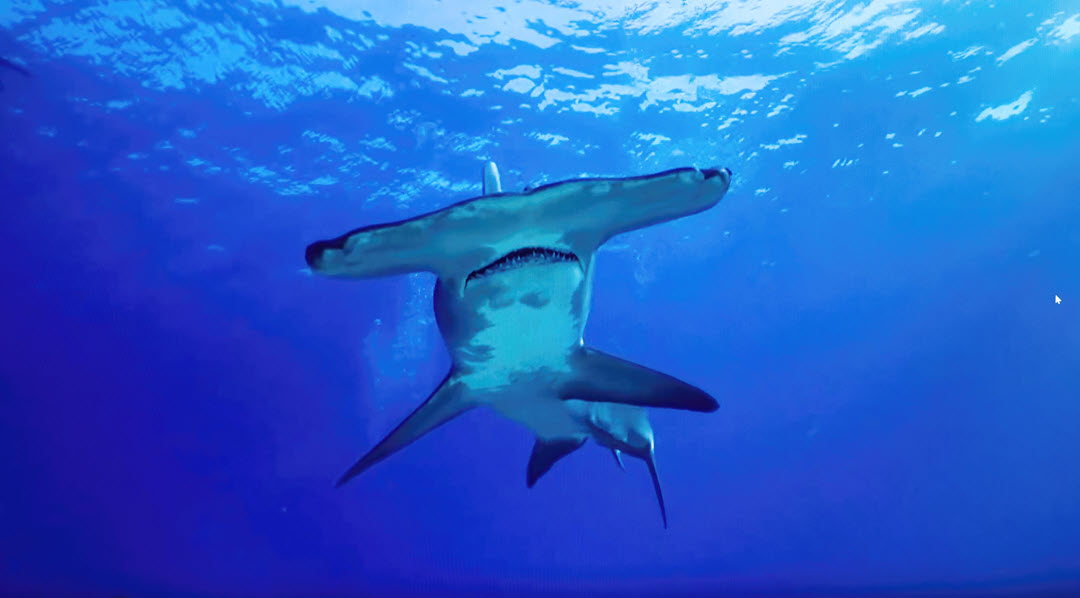
Hammerhead isn’t just one species. It’s the common name for an entire family of sharks, made up of 9 living species. They range in size from the small, shovel-headed Bonnethead to the enormous Great Hammerhead, the largest of the family and the focus of the rest of this page.
Great Hammerheads live in warm coastal and offshore waters around the world. They’re often found near coral reefs, sandy flats, and continental shelves, where they hunt for one of their favorite foods: stingrays.
These sharks are known for a striking hunting technique. A Great Hammerhead can use the underside of its head to pin a stingray against the seafloor, holding it in place before delivering a bite. Few other sharks hunt quite this way.
Today, Great Hammerhead Sharks face a serious conservation crisis. Their fins are highly valued in the fin trade, and their slow growth and infrequent reproduction make it hard for populations to recover from fishing pressure.
What Is a Hammerhead Shark?
Hammerhead Sharks belong to the family Sphyrnidae, within the order Carcharhiniformes, or ground sharks. There are 9 living hammerhead species, 8 of them in the genus Sphyrna and one, the Winghead Shark, in its own genus, Eusphyra.
The genus name Sphyrna comes from the Greek word for “hammer,” referring to the shark’s unmistakable head shape.
The largest and most recognizable member of the family is the Great Hammerhead Shark (Sphyrna mokarran). It can be told apart from other hammerhead species by its nearly straight-edged cephalofoil and its tall, sickle-shaped first dorsal fin. Both of these features are more pronounced in this species than in smaller hammerheads like the Scalloped or Smooth Hammerhead. The rest of this page focuses specifically on the Great Hammerhead.
The Hammerhead Family
All 9 hammerhead species share the same distinctive wide, flattened head, called a cephalofoil, though the exact shape and size varies quite a bit across the family. Most hammerheads live in warm coastal waters, though a few range into cooler seas.
- Great Hammerhead (Sphyrna mokarran): The largest hammerhead species, reaching up to 20 feet (6.1 meters) long. It has the widest, straightest cephalofoil in the family and is known for hunting stingrays.
- Scalloped Hammerhead (Sphyrna lewini): Named for the wavy, scalloped front edge of its cephalofoil. It’s well known for forming large daytime schools, sometimes numbering in the hundreds.
- Smooth Hammerhead (Sphyrna zygaena): The only hammerhead with a smooth, notch-free cephalofoil. It tolerates cooler water better than most other hammerheads and often stays close to the surface in bays and estuaries.
- Bonnethead (Sphyrna tiburo): The smallest hammerhead species, with a rounded, shovel-shaped head rather than a flat hammer. It’s the only shark known to eat and digest plant matter as part of its diet.
- Winghead Shark (Eusphyra blochii): The only hammerhead species outside the genus Sphyrna, placed in its own genus, Eusphyra. It has the widest cephalofoil relative to body size of any hammerhead, sometimes half as wide as its entire body length.
- Smalleye Hammerhead (Sphyrna tudes): A smaller species found along the eastern coast of South America. Its head is proportionally narrower than that of most other hammerheads.
- Scalloped Bonnethead (Sphyrna corona): A small, poorly studied species found along the coasts of California and northwestern South America. Its cephalofoil has a scalloped edge, different from the smooth-headed Bonnethead despite the similar name.
- Scoophead (Sphyrna media): A small species often confused with the Scalloped Hammerhead due to its similar head shape. It’s found along the coasts of California and northern South America, and remains one of the least studied hammerheads.
- Whitefin Hammerhead (Sphyrna couardi): Found along the coasts of West Africa and western Spain. It was once thought to be the same species as the Scalloped Hammerhead before being recognized separately.
Scientists have also identified a possible tenth species, the Carolina Hammerhead (Sphyrna gilberti), discovered through genetic testing along the southeastern United States coast. It’s nearly identical in appearance to the Scalloped Hammerhead, and not all researchers agree yet on whether it should be classified as fully distinct.
Physical Appearance
Great Hammerhead Sharks have thick, muscular bodies and light gray to grayish-brown skin, fading to a white underside for countershading.
Adults commonly reach about 13 to 15 feet (4 to 4.6 meters) long, with a maximum recorded length of about 20 feet (6.1 meters).
Their cephalofoil is wide and nearly straight along the front edge, with a small notch at the center. This sets them apart from other hammerhead species, which often have more curved or scalloped head shapes.
Their first dorsal fin is unusually tall and curved, another feature that helps distinguish this species from its relatives.
Where Do Great Hammerhead Sharks Live?
Great Hammerhead Sharks live in tropical and warm temperate waters around the world. Their range includes waters from North Carolina to Uruguay in the western Atlantic, and similar warm regions across the Pacific and Indian Oceans.
They use a wide range of habitats, including coastal reefs, lagoons, continental shelves, and island terraces. FishBase records the species from the surface to depths of about 980 feet (300 meters), though they’re often found much shallower, especially near reefs.
Many Great Hammerheads make long seasonal migrations, sometimes traveling thousands of miles between warmer and cooler waters. Some populations move toward the poles during certain seasons.
Social Behavior
Great Hammerhead Sharks are generally solitary, nomadic animals. They aren’t typically seen traveling in groups the way some other shark species do.
They’re also highly migratory, covering enormous distances during the year. Researchers have documented individuals moving between very different regions, following changes in water temperature and prey availability.
Despite their large size, divers who encounter Great Hammerheads in the wild often describe them as calm and non-aggressive. Because of their size and broad diet, though, they should still be treated with caution and respect.
What Do Great Hammerhead Sharks Eat?
Great Hammerhead Sharks are opportunistic predators with a strong preference for stingrays and other rays. Common foods also include groupers, sea catfish, other sharks, squid, crabs, and lobsters.
Their broad diet lets them take advantage of whatever prey is available in a given habitat, from bottom-dwelling rays to free-swimming fish.
How Do Great Hammerhead Sharks Hunt?
Great Hammerhead Sharks are famous for their unusual hunting method. Their wide cephalofoil is packed with the ampullae of Lorenzini, sensory organs that detect the weak electrical signals produced by living animals. Spreading these sensors across such a wide head lets the shark scan a much larger area of seafloor than a narrower-headed shark could.
This helps them find stingrays hidden beneath the sand. Once a ray is located, the shark may use the underside of its head to pin the ray against the seafloor. This keeps the ray from escaping before the shark delivers a bite.
Great Hammerheads often feed around dusk, using their combination of electrical sense, smell, and vision to track down prey in low light.
Reproduction and Life Cycle
Great Hammerhead Sharks reproduce through viviparity, with pups nourished by a yolk-sac placenta while developing inside the mother’s body.
After a gestation period of about 11 months, females give birth to litters that can range from about 13 to 42 pups. Smaller or larger litters have been recorded, though, depending on the size of the mother. Newborns measure about 20 to 28 inches (50 to 70 centimeters) long.
Females appear to reproduce on a biennial cycle, giving birth only once every two years. Great Hammerheads also grow slowly and mature late, with females reaching maturity around 15 years old.
Some individuals have been documented living 20 to 40 years, with the oldest confirmed record reaching 44 years.
Evolution & Adaptations
Great Hammerhead Sharks belong to the hammerhead family, Sphyrnidae, a group defined by its distinctive wide, flattened head. Over millions of years, the ancestors of today’s hammerhead sharks evolved this unusual shape. Different hammerhead species then developed different head proportions suited to their own hunting styles.
In Great Hammerheads, natural selection favored an especially wide, nearly straight cephalofoil. This shape spreads the ampullae of Lorenzini across a much larger surface area, giving the shark an unusually broad electrical “search image” of the seafloor below.
The cephalofoil also provides hydrodynamic lift, helping the shark make sharp, precise turns. This is useful for a predator that specializes in cornering fast-moving prey like stingrays.
Like all sharks, Great Hammerheads have a lateral line, which detects vibrations in the water. Their eyes, positioned at the outer edges of the cephalofoil, also give them a wide field of vision.
Together, these adaptations have made the Great Hammerhead one of the most specialized ray-hunters in the ocean.
Why Great Hammerhead Sharks Are Important
As apex predators, Great Hammerhead Sharks help keep populations of stingrays and other prey species in balance across coral reef and coastal ecosystems.
Because they specialize in hunting rays, their presence can shape how ray populations use their own habitat, influencing where and how those species feed and shelter.
Great Hammerheads are also important subjects for scientists studying sensory biology. Their extreme cephalofoil shape offers a natural example of how a sensory system can evolve to become unusually powerful and specialized.
Conservation
The Great Hammerhead Shark is currently classified as Critically Endangered by the International Union for Conservation of Nature (IUCN).
Great Hammerheads are heavily targeted for their large, distinctively shaped fins, which are highly valued in the international fin trade. They’re also caught as bycatch in longline and gillnet fisheries.
Because they grow slowly, mature late, and reproduce only every two years, Great Hammerhead populations recover very slowly from fishing pressure. Many countries and international agreements now restrict hammerhead fishing and the trade of their fins.
Research & Quotes
Great Hammerhead Sharks continue to be an important focus of shark research, particularly around their migrations and their unusual hunting behavior.
Researchers have used satellite tags to track individuals moving thousands of miles between coastal feeding grounds and offshore waters. This work reveals how far this species travels throughout the year.
Underwater observations have also documented the species’ distinctive stingray-pinning hunting behavior directly. This gives scientists rare, detailed insight into exactly how the cephalofoil is used during a real attack.
Great Hammerhead Sharks in Culture
Great Hammerhead Sharks are among the most recognizable sharks in the world, thanks to their unmistakable head shape.
They’re popular attractions for divers in places where the species can reliably be found, and they frequently appear in documentaries and aquariums because of their striking appearance.
Today, the Great Hammerhead’s dramatic decline has made it an important symbol in the effort to reduce the global shark fin trade and protect migratory ocean predators.
| Common Name | Hammerhead Shark |
| Other Common Names | None commonly used |
| Scientific Name | Sphyrna mokarran (representative species) |
| Family | Sphyrnidae |
| Order | Carcharhiniformes |
| Conservation Status | Critically Endangered (IUCN) |
Interesting Hammerhead Shark Facts
- Great Hammerheads are the largest of the nine living hammerhead species.
- Their wide head is called a cephalofoil.
- The cephalofoil is packed with electrical sensors that help find hidden prey.
- They favor stingrays as prey, sometimes pinning them to the seafloor before biting.
- Adults commonly reach 13 to 15 feet (4 to 4.6 meters) long.
- The largest recorded individuals have reached about 20 feet (6.1 meters).
- They’re generally solitary and highly migratory.
- Some individuals travel thousands of miles between feeding grounds.
- They often feed around dusk.
- Litters can range from about 13 to 42 pups.
- Females appear to give birth only once every two years.
- Newborn pups measure about 20 to 28 inches (50 to 70 centimeters) long.
- Some individuals have been documented living 20 to 40 years or more.
- Their fins are heavily targeted by the international fin trade.
- The Great Hammerhead Shark is currently classified as Critically Endangered by the IUCN.
SHARK PAGES
SPECIES PAGES