
Cookiecutter Shark
The Cookiecutter Shark is a small shark with one of the strangest feeding methods in the ocean. Instead of overpowering animals much larger than itself, it attaches to them and removes a round plug of flesh. The wound looks as though it was made with a cookie cutter, which is how this unusual shark got its name.
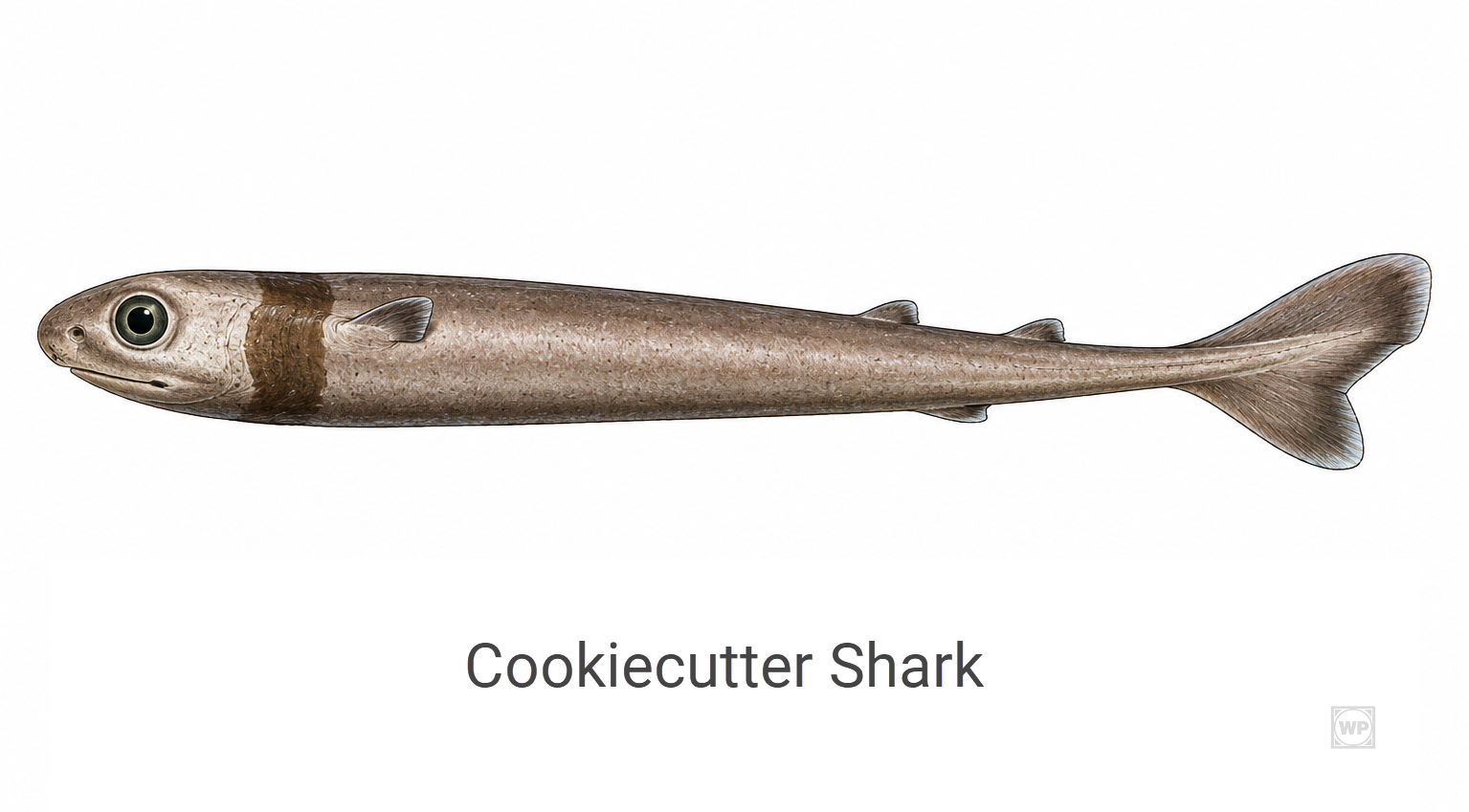
Cookiecutter Sharks spend much of their lives in the open ocean. During the day they stay in deep, dark water. At night, they move toward the surface to feed. Their bodies are built with glowing organs, powerful suction-producing lips, and unusually large lower teeth.
Females reach only about 22 inches (56 centimeters) long. Even so, Cookiecutter Sharks can take bites from tuna, billfish, whales, dolphins, and other sharks. They also eat smaller animals that they can swallow whole.
What Is a Cookiecutter Shark?
The Cookiecutter Shark (Isistius brasiliensis) belongs to the family Dalatiidae and the order Squaliformes, or dogfish sharks.
It’s a small oceanic shark found in tropical and subtropical waters around the world. Some sharks live near reefs or along the seafloor. Cookiecutter Sharks are different — they spend much of their time swimming through the open water of the deep ocean.
The species is best known for its unusual feeding method. Its lips and throat create suction, which lets it attach to a larger animal. Its large lower teeth then cut out a plug of flesh.
There’s also another species in the genus Isistius, the Largetooth Cookiecutter Shark (Isistius plutodus). The species described on this page is Isistius brasiliensis, the Cookiecutter Shark.
Physical Appearance
Cookiecutter Sharks have long, cigar-shaped bodies with short, rounded snouts. Their bodies are generally dark brown, with a darker band around the throat area.
Females can reach about 22 inches (56 centimeters) long. Males are smaller and reach about 16.5 inches (42 centimeters). Despite their small size, their mouths are highly specialized for feeding on much larger animals.
The upper teeth are small and narrow. The lower teeth are much larger and shaped like triangles. Together, the lower teeth form a cutting edge that works almost like a saw.
Much of the underside is covered with tiny light-producing organs called photophores. These produce a greenish glow.
One unusual feature is the dark band around the throat. Unlike the glowing areas around it, this collar doesn’t produce light. Scientists have proposed several possible functions for the dark patch, but exactly what it does is still being studied.
Where Do Cookiecutter Sharks Live?
Cookiecutter Sharks live in tropical and subtropical oceans around much of the world. They’ve been recorded in the Atlantic, Pacific, and Indian Oceans.
They’re open-ocean sharks that can move through an enormous range of depths. FishBase records the species from near the surface to about 12,100 feet (3,700 meters). It’s usually found within the upper 3,300 feet (1,000 meters), though.
Cookiecutter Sharks make large daily movements through the water. During the day, they may stay below about 3,300 feet (1,000 meters). At night, they move upward toward the surface.
This daily up-and-down movement is called vertical migration. Many fish, squid, crustaceans, and other ocean animals also move toward shallower water at night. This creates feeding opportunities for the sharks.
Cookiecutter Sharks spend much of their lives far offshore and at great depths. Because of this, people rarely see them alive in their natural habitat.
Social Behavior
Very little is known about the social behavior of Cookiecutter Sharks. Their deep-ocean habitat makes them extremely difficult to observe for long periods.
Scientists don’t currently have good evidence that Cookiecutter Sharks form lasting social groups or regularly hunt together. Most of what’s known about the species comes from captured specimens, bite marks found on larger animals, and occasional observations.
Like many deep-water animals, they may encounter other members of their species while feeding or reproducing. But researchers still have much to learn about how often Cookiecutter Sharks interact with one another.
For this species, the lack of information is itself important. The deep ocean remains one of the least observed habitats on Earth. Many parts of the Cookiecutter Shark’s life are still unknown.
What Do Cookiecutter Sharks Eat?
Cookiecutter Sharks have two very different ways of feeding. They eat smaller ocean animals whole, but they can also remove pieces of flesh from animals much larger than themselves. Their diet includes squid, small deep-water fish, and crustaceans. They’ve also been recorded feeding from large animals such as tuna, wahoo, billfish, whales, dolphins, and other sharks.
When feeding on a large animal, the Cookiecutter Shark usually doesn’t kill it. Instead, it removes a single plug of tissue and swims away. The larger animal is often left with a round wound that may later become a noticeable scar. This lets a shark less than two feet long get food from some of the largest animals in the ocean.
How Do Cookiecutter Sharks Hunt?
The Cookiecutter Shark’s bite is one of the most unusual feeding methods among sharks. When it reaches a large animal, the shark uses its thick lips and specialized throat to create suction. This lets it attach itself to the animal’s body. Its small upper teeth help hold its position.
The shark then drives its large lower teeth into the flesh. By twisting its body, it cuts out a cone-shaped plug of tissue. It pulls away carrying the piece of flesh in its mouth.
The shark’s glowing underside may also play a role in feeding, providing camouflage that helps it approach unnoticed. Scientists have also proposed that the dark collar near the throat could help attract or confuse other animals. This idea hasn’t been proven yet.
Cookiecutter Sharks also hunt smaller prey that can be swallowed whole. The famous circular bite is only one part of their feeding behavior.
Reproduction and Life Cycle
Cookiecutter Sharks give birth to live young, but scientists still know relatively little about their reproduction. The developing embryos grow inside the mother’s body and are nourished by yolk rather than through a placental connection.
FishBase reports litters of about 6 to 12 pups. Males mature at around 14 inches (36 centimeters), while females mature at around 15 inches (39 centimeters). Females grow larger than males.
The size of newborn pups isn’t well established. Scientists don’t yet have reliable information about how long pregnancy lasts or how long Cookiecutter Sharks live. These gaps in our knowledge reflect how difficult it is to study this species. Cookiecutter Sharks spend much of their life in deep ocean water, far from easy observation.
Evolution & Adaptations
Cookiecutter Sharks belong to the order Squaliformes, an old and diverse group that includes many sharks adapted to life in deep water. Within this order, the Cookiecutter belongs to the family Dalatiidae.
Like many deep-water sharks, Cookiecutters have features that help them survive where sunlight is weak or completely absent. Their ability to produce light is one example. Their feeding system is even more specialized. The shark’s lips, jaws, throat, and teeth work together as a team. This lets a very small animal feed from animals many times its own size. It doesn’t need to capture and kill a whale, tuna, or other large animal. Instead, the shark can remove a small amount of flesh and swim away.
One of the Cookiecutter’s most important adaptations is bioluminescence — the ability to produce its own light. Tiny photophores cover much of the shark’s underside. Their glow can help reduce the shark’s silhouette when viewed from below against faint light coming from the surface. This type of camouflage is called counterillumination.
The mouth is another remarkable adaptation. Thick lips and a specialized throat help the shark create suction and attach itself to a larger animal. Small upper teeth help hold on while the much larger lower teeth cut into the flesh.
The lower teeth are replaced differently from the teeth of many other sharks. Instead of losing them one at a time, Cookiecutter Sharks shed the lower teeth together as a connected row. Evidence suggests the shark may swallow the old row, possibly letting it reuse some of the minerals in the teeth.
Cookiecutter Sharks also have large eyes that help them see in dim ocean light. They also have sensory systems that help them detect animals around them. Scientists continue to study how these unusual features developed within the Cookiecutter lineage. They’re also studying how these features relate to adaptations found in other deep-water sharks.
Why Cookiecutter Sharks Are Important
Cookiecutter Sharks are part of the complex food web of the open ocean. They feed on small deep-water animals while also taking tissue from much larger fish, marine mammals, and sharks.
Their distinctive bite marks also provide scientists with useful evidence. Researchers can recognize Cookiecutter wounds and scars on whales, dolphins, large fish, and other sharks. These give clues about where these animals have encountered Cookiecutters.
The species is also valuable for understanding how animals survive in the deep ocean. Its bioluminescence, daily vertical movements, specialized teeth, and unusual feeding method are all remarkable adaptations. Each one developed to help this shark survive in a difficult environment. Studying Cookiecutter Sharks helps scientists learn about one unusual shark. It also teaches them about life in parts of the ocean that humans rarely see.
Conservation
The Cookiecutter Shark is currently classified as Least Concern by the International Union for Conservation of Nature (IUCN). Its wide distribution and deep-ocean habitat mean it’s not exposed to some of the fishing pressure faced by larger coastal sharks. Its small size also makes it less valuable to most fisheries.
Cookiecutter Sharks can still be caught accidentally in fishing gear, including longlines and midwater nets. However, there’s currently no evidence that fishing is causing major declines across the species as a whole.
Scientists still know relatively little about the size and structure of Cookiecutter Shark populations. Continued study of deep-ocean ecosystems will be important as fishing, climate change, pollution, and other human activities affect more parts of the ocean.
Research & Quotes
Much of what scientists know about Cookiecutter Sharks has come from studying captured sharks and the unusual wounds they leave on other animals. Their circular bite marks have been documented on many large ocean animals, including whales, dolphins, tuna, billfish, and other sharks. These wounds can show that Cookiecutter Sharks and their much larger targets have occupied the same areas of the ocean.
Researchers also study the shark’s bioluminescence. Cookiecutter Sharks have thousands of photophores on their undersides, and their light can continue to glow even after the shark dies. Scientists are interested in how this light functions as camouflage and whether it may also play a role in feeding.
Other research focuses on the shark’s extreme daily vertical movements, unusual jaws and teeth, and reproduction. Because observing living Cookiecutter Sharks in deep water is difficult, many basic questions about their behavior and life cycle remain unanswered.
Cookiecutter Sharks in Culture
For many people, the Cookiecutter Shark became famous because of its strange circular wounds. These wounds are found on whales, dolphins, large fish, and other ocean animals. The neat shape of these wounds eventually inspired the common name “Cookiecutter Shark.”
The species has also become known for biting human-made objects. Cookiecutter damage has been reported on equipment used in the ocean, including parts of submarines. These incidents helped bring attention to a shark that most people will never see alive.
Today, the Cookiecutter Shark is frequently featured in books, documentaries, and programs about deep-sea animals. Its tiny size compared with the animals it feeds from makes it an especially memorable example of how unusual deep-ocean life can be.
Rather than relying on great size or strength, the Cookiecutter Shark survives through an extraordinary collection of specialized adaptations. That has made it one of the most recognizable small sharks in the world.
| Common Name | Cookiecutter Shark |
| Other Common Names | Cigar Shark, Luminous Shark |
| Scientific Name | Isistius brasiliensis |
| Family | Dalatiidae |
| Order | Squaliformes |
| Conservation Status | Least Concern (IUCN) |
Interesting Cookiecutter Shark Facts
- Female Cookiecutter Sharks can reach about 22 inches (56 centimeters) long.
- They remove round plugs of flesh from animals much larger than themselves.
- They also eat small fish, squid, and crustaceans whole.
- Their undersides contain thousands of light-producing organs called photophores.
- The light produced by their bodies helps camouflage them in the open ocean.
- Cookiecutter Sharks may move thousands of feet upward and downward during a single day.
- They have small upper teeth but unusually large, saw-like lower teeth.
- Their thick lips and specialized throat help them attach to larger animals by suction.
- The lower teeth are shed together as an entire row rather than one tooth at a time.
- Cookiecutter Sharks may swallow their old lower teeth, possibly recycling some of the minerals.
- Their bite marks have been found on whales, dolphins, tuna, billfish, and other sharks.
- Females grow larger than males.
- They can give birth to litters of about 6 to 12 pups.
- The species has been recorded from the surface to depths of about 12,100 feet (3,700 meters).
- The Cookiecutter Shark is currently classified as Least Concern by the IUCN.
SHARK PAGES
SPECIES PAGES