
Bull Shark
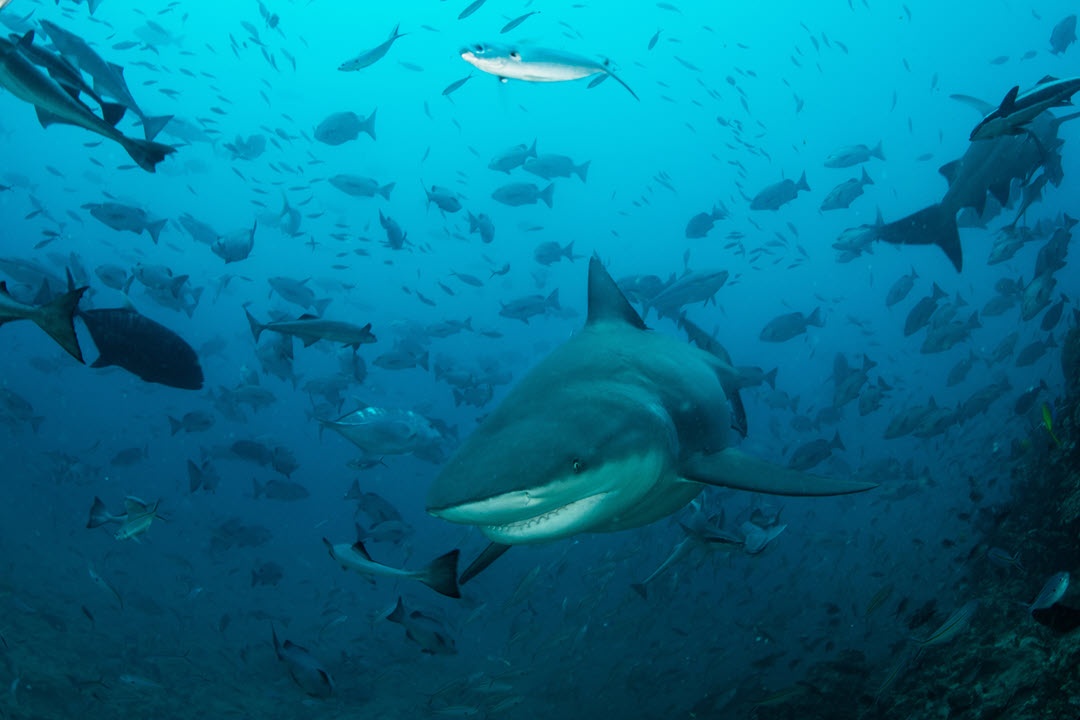
This ability makes the Bull Shark one of the most adaptable large sharks in the world. It can move between very different environments while hunting fish, rays, crustaceans, and other animals.
Bull Sharks often live in shallow coastal areas and river systems that are also heavily used by people. This has made them one of the best-known shark species. It also exposes them to fishing, pollution, habitat loss, and other human pressures.
What Is a Bull Shark?
The Bull Shark (Carcharhinus leucas) belongs to the family Carcharhinidae, known as the requiem sharks. It’s part of the order Carcharhiniformes, or ground sharks.
It’s a large, heavy-bodied shark best known for its ability to move between ocean water and freshwater. Most sharks can’t survive for long in freshwater because their bodies are built for the salt levels of the ocean. Bull Sharks have special ways of controlling the amount of salt and water inside their bodies, letting them survive in both environments.
Bull Sharks are found in warm regions around much of the world. They use oceans, bays, estuaries, rivers, lagoons, and some freshwater lakes during different parts of their lives.
Physical Appearance
Bull Sharks have thick, powerful bodies with short, broad snouts and relatively small eyes. Their heavy build gives them a very different appearance from slender open-ocean sharks such as the Blue Shark.
The upper body is usually gray, while the underside is white. This darker-above and lighter-below pattern, called countershading, helps the shark blend into the water when viewed from different directions.
The first dorsal fin is large and triangular. Bull Sharks don’t have a ridge between their two dorsal fins, which can help tell them apart from some similar-looking sharks.
Their upper teeth are broad, triangular, and heavily serrated. These strong cutting teeth let Bull Sharks feed on many different kinds of prey.
Most adult Bull Sharks are much smaller than the largest individuals ever recorded, but females can reach about 13 feet (4 meters). FishBase reports a maximum published weight of about 700 pounds (317 kilograms). Females generally grow larger than males.
Where Do Bull Sharks Live?
Bull Sharks live in tropical and subtropical waters around much of the world. They occur in the Atlantic, Pacific, and Indian Oceans and are especially associated with warm coastal waters.
They’re usually found in relatively shallow water. Common habitats include bays, river mouths, estuaries, lagoons, coastal waters, rivers, and some freshwater lakes.
Bull Sharks can travel surprisingly far inland. They’ve been recorded far upstream in major river systems including the Amazon in South America and the Mississippi in North America. They’re also famous for entering African rivers, including the Zambezi, which is why they’re sometimes called Zambezi Sharks.
Young Bull Sharks often spend important parts of their early lives in rivers, estuaries, and other protected coastal areas. These nursery habitats provide food and may reduce the number of large marine predators the young sharks encounter.
Adults often spend more time in coastal marine waters but may continue to move between saltwater, brackish water, and freshwater throughout their lives.
Social Behavior
Bull Sharks are often described as solitary hunters, and much of the time that’s true. A Bull Shark may travel alone for weeks, covering long distances through open water, rivers, or coastal areas. But new research shows their social lives are more complicated than scientists once thought.
For over a decade, researchers at the Shark Reef Marine Reserve in Fiji have studied a large group of Bull Sharks. These sharks gather at the same feeding site. By tracking dozens of individual sharks over many years, they found that some sharks kept returning to spend time near the same companions. Other pairs of sharks seemed to avoid each other. This showed that Bull Sharks don’t just gather randomly — they seem to remember and choose who they spend time with.
A newer study built on this work by watching 184 Bull Sharks at the same reef over six years. Researchers recorded when sharks swam side by side, followed one another, or joined a shark that was already there. Both male and female sharks preferred spending time near females. Male sharks, which are usually smaller than females, tended to have more social connections overall. Sharks also showed a mild preference for others close to their own size. There were early signs that some sharks may favor relatives too, though this connection was weak and still being studied.
None of this means Bull Sharks live in permanent groups the way wolves or dolphins do. Their social behavior is flexible. A shark might spend time near preferred companions at a feeding site, then travel alone for long stretches afterward. Scientists also continue to find evidence that Bull Sharks return to familiar places again and again. Female Bull Sharks often return to the same river systems to give birth. Adult sharks have also been tracked coming back to the same coastal areas year after year.
Together, these findings are changing how scientists think about Bull Sharks. Rather than being purely solitary animals, they appear to build loose but real social connections. This discovery could help researchers better protect the places where these relationships form.
What Do Bull Sharks Eat?
Bull Sharks are opportunistic predators, which means they eat many different kinds of animals depending on what’s available. Fish make up an important part of their diet. Bull Sharks also eat rays, smaller sharks, crabs, shrimp, squid, sea turtles, and other marine animals. Large individuals can take much bigger prey than young sharks.
Their diet changes depending on their size and habitat. A young Bull Shark living in a river or estuary encounters different prey from an adult swimming along a marine coastline. This flexible diet helps Bull Sharks survive as they move between freshwater, estuaries, and coastal marine habitats.
How Do Bull Sharks Hunt?
Bull Sharks are active predators that search shallow coastal waters, estuaries, rivers, and other habitats for food. They can hunt in clear water, but they’re also well equipped to find prey where the water is cloudy or visibility is poor.
They use several senses while searching for food. Smell and vision help locate animals, while the lateral line detects movements and vibrations in the surrounding water. At close range, their electrical senses can help them detect living prey even when it’s difficult to see.
When a Bull Shark reaches its prey, its heavy body and powerful jaws let it make a strong attack. Its broad, serrated teeth can grip and cut fish, rays, turtles, and other prey.
Bull Sharks don’t depend on one hunting method or one type of prey. Their ability to adjust to different foods and environments is one reason they’re successful in so many habitats.
Reproduction and Life Cycle
Bull Sharks give birth to live young. They reproduce through placental viviparity. As the embryos develop, the yolk sac forms a placental connection with the mother that supplies nutrients to the growing pups.
Pregnancy lasts about 10 to 11 months. Females give birth to between 1 and 13 pups. In some parts of the world, birth takes place mainly during spring or early summer, although the timing varies by region.
Newborn Bull Sharks are usually about 22 to 32 inches (56 to 81 centimeters) long. They receive no parental care after birth. Young Bull Sharks often spend several years using rivers, estuaries, and other shallow nursery habitats. As they grow, they begin using a wider range of coastal environments.
Bull Sharks mature slowly. They may take about 10 to 15 years to reach adulthood, and FishBase reports a maximum recorded age of 32 years.
Evolution & Adaptations
Bull Sharks belong to the requiem shark family, Carcharhinidae. This large family includes many familiar sharks, such as Blacktip Sharks, Spinner Sharks, and reef sharks.
One of the most important developments in the Bull Shark lineage was the ability to move between water with very different salt levels. Most sharks are limited mainly to saltwater, because moving into freshwater can upset the balance of water and salts inside their bodies. Bull Sharks developed an unusually flexible system for controlling this balance instead. Their kidneys, rectal gland, gills, and other organs work together as a team. This lets the body change how it handles salt and water as the shark moves between the ocean and rivers.
This process is called osmoregulation. When a Bull Shark enters freshwater, its body must prevent too much water from entering its tissues and must hold onto important salts. Its kidneys and other organs adjust the way they work to keep the shark’s internal chemistry balanced. When the shark returns to the ocean, its body adjusts again.
This ability gave Bull Sharks access to habitats that most other large sharks can’t use. Today, they can move from coastal seas into estuaries and far upstream into freshwater rivers. This makes them one of the most successful sharks at living across the boundary between marine and freshwater environments.
Bull Sharks also have powerful bodies well suited to shallow coastal waters, river mouths, and areas with strong currents. Their broad jaws and serrated teeth let them handle many different kinds of prey. Like other sharks, Bull Sharks have a lateral line that detects movement and vibrations in the water. They also have ampullae of Lorenzini, small sensory organs that detect weak electrical signals produced by other animals.
Together, these adaptations let Bull Sharks move through a wider range of aquatic habitats than almost any other large shark.
Why Bull Sharks Are Important
Bull Sharks are large predators that are part of both marine and freshwater food webs. By feeding on fish, rays, smaller sharks, crustaceans, and other animals, they help shape the animal communities in the habitats they use.
They’re especially interesting because they connect different aquatic environments. A single Bull Shark may move between the ocean, an estuary, and a freshwater river during its life. This means the species is part of several ecosystems rather than just one.
Bull Sharks are also valuable to scientists studying how animals adapt to extreme changes in their environment. Their ability to move from seawater into freshwater is a rare opportunity for study. Scientists can watch how shark kidneys, gills, and other organs control salt and water in real time.
Protecting Bull Sharks also means protecting the rivers, estuaries, wetlands, and coastal waters that many other animals depend on.
Conservation
The Bull Shark is currently classified as Vulnerable by the International Union for Conservation of Nature (IUCN). Fishing is one of the main threats to the species. Bull Sharks are caught in commercial and recreational fisheries and may also be caught accidentally as bycatch.
Their use of rivers and shallow coastal waters creates additional problems. Pollution, dams, changes to rivers, coastal development, and the loss of wetlands and estuaries can damage important nursery and feeding habitats.
Bull Sharks grow slowly, mature relatively late, and produce only a small number of young compared with many bony fish. This means populations can take a long time to recover when large numbers of sharks are removed.
Protecting the species requires both fisheries management and healthy habitat. Rivers, estuaries, wetlands, and coastal waters all form part of the Bull Shark’s life cycle.
Research & Quotes
Bull Sharks are important research animals because they move between environments that are very different from one another. Scientists study how their bodies adjust to freshwater, how young sharks use rivers and estuaries, and how adults travel between coastal areas.
Electronic tagging has revealed that some Bull Sharks travel hundreds of miles while others remain in the same general region for long periods. Individual sharks can also return to the same estuaries or coastal areas in different years. Research in Sydney Harbour found strong seasonal patterns, with Bull Sharks returning when water temperatures became warmer. Other studies have tracked sharks over much longer coastal migrations.
Scientists are also beginning to learn more about Bull Shark social behavior. Long-term research in Fiji has found that some individuals repeatedly associate with particular companions. More recent genetic research has also found evidence that females return to particular river systems to reproduce. Some mating pairs may even reproduce together in more than one breeding season.
These studies show that Bull Shark lives are more complex than simply moving between rivers and oceans. Their movements involve feeding, temperature, reproduction, familiar habitats, and interactions with other sharks.
Bull Sharks in Culture
Bull Sharks have been known to people living along tropical rivers and coastlines for centuries. Their ability to appear far inland has given them different names in different parts of the world. In Africa they’re called Zambezi Sharks, and in Central America they’re called Nicaragua Sharks.
Their unusual freshwater ability has also made them popular subjects in documentaries, books, and television programs. A large shark swimming in a river can seem surprising because sharks are usually thought of as ocean animals.
Bull Sharks are also frequently described in popular culture as especially aggressive or dangerous. They are large wild predators and should be treated with caution. But dramatic descriptions can give the wrong impression — that they actively seek people as prey. Human encounters need to be understood in the context of Bull Sharks naturally using shallow coastal waters and rivers that people use as well.
For scientists and educators, the Bull Shark provides a different story. It’s an example of extraordinary adaptability and a reminder that rivers and oceans are connected ecosystems. Protecting a Bull Shark may require protecting habitats hundreds of miles apart.
| Common Name | Bull Shark |
| Other Common Names | Zambezi Shark, Nicaragua Shark, Swan River Whaler |
| Scientific Name | Carcharhinus leucas |
| Family | Carcharhinidae |
| Order | Carcharhiniformes |
| Conservation Status | Vulnerable (IUCN) |
Interesting Bull Shark Facts
- Bull Sharks can live in both saltwater and freshwater.
- They can travel hundreds of miles inland through rivers.
- Young Bull Sharks often use rivers and estuaries as nursery habitats.
- Special changes in their kidneys and other organs help them control salt and water as they move between freshwater and the ocean.
- Females grow larger than males and can reach about 13 feet (4 meters) long.
- Bull Sharks give birth to live young after a pregnancy of about 10 to 11 months.
- A litter can contain from 1 to 13 pups.
- Bull Sharks eat many kinds of prey, including fish, rays, smaller sharks, crustaceans, and sea turtles.
- Some Bull Sharks return to the same coastal areas or river systems year after year.
- Scientists have found that some Bull Sharks repeatedly spend time with particular sharks rather than associating randomly.
- The species is also called the Zambezi Shark in parts of Africa.
- The Bull Shark is currently classified as Vulnerable by the IUCN.
SHARK PAGES
SPECIES PAGES