
Great White Shark
The Great White Shark is one of the most recognizable sharks in the world. Its large size, powerful body, and rows of serrated teeth have made it famous. But there’s much more to this shark than its reputation. Great Whites are highly mobile animals that travel across coastlines and entire ocean regions in search of food and suitable conditions.
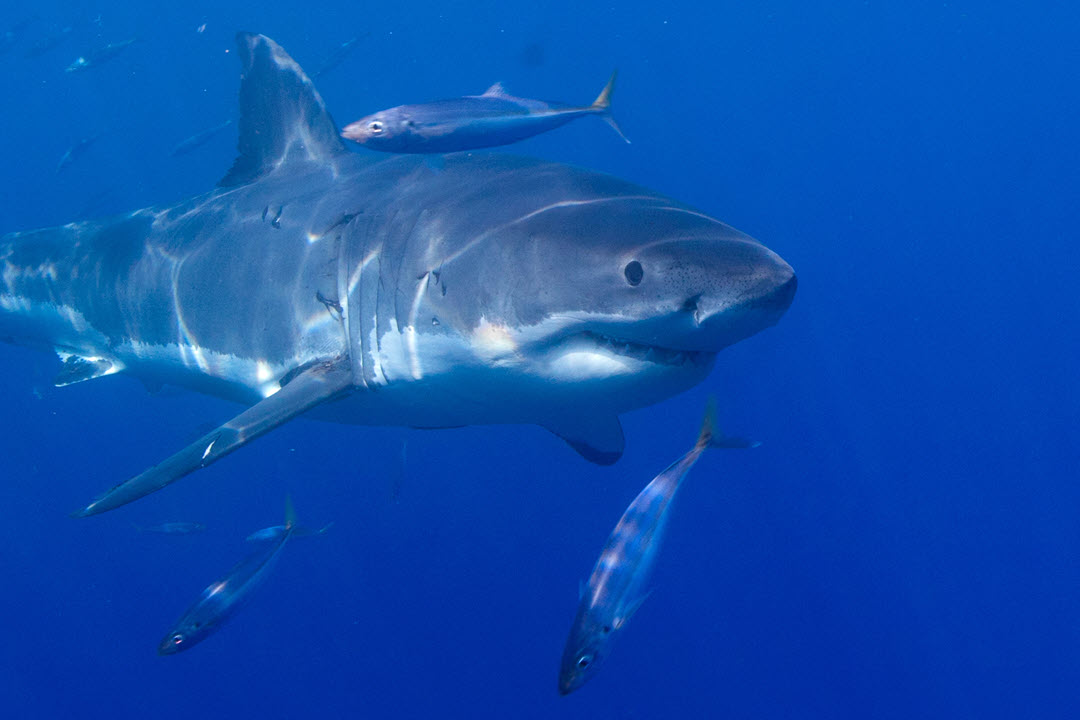
Great White Sharks live in temperate and subtropical waters around the world. They may spend part of the year near coasts and islands where seals and other prey are abundant. Then they travel far offshore for months at a time.
As large predators, Great Whites are an important part of marine ecosystems. Scientists now use satellite tags, cameras, drones, genetics, and other tools to study these sharks. This research shows where they travel, how they hunt, how they interact with one another, and how their populations are changing.
What Is a Great White Shark?
The Great White Shark (Carcharodon carcharias) belongs to the family Lamnidae, known as the mackerel sharks, and the order Lamniformes.
It’s the only living species in the genus Carcharodon. Its relatives in the mackerel shark family include mako sharks, salmon sharks, and porbeagles.
Great Whites are large, fast-swimming sharks that can live both close to shore and far out in the open ocean. They’re capable of crossing enormous distances and returning to important feeding areas year after year.
Physical Appearance
Great White Sharks have thick, streamlined bodies shaped for powerful swimming. Their snouts are blunt and cone-shaped, and their eyes are dark and noticeable.
The upper body may be gray, brownish-gray, or nearly black, while the underside is white. This sharp difference in color helps create countershading, which makes the shark harder to see from above or below.
The mouth contains several rows of large, triangular teeth with serrated edges. These teeth are built for cutting and are replaced throughout the shark’s life when older teeth are lost.
The tail is crescent-shaped and provides strong propulsion. Large pectoral fins help control lift and movement through the water.
Great White Sharks can reach more than 20 feet (6 meters) in length, although most are smaller. Females generally grow larger than males.
Where Do Great White Sharks Live?
Great White Sharks are found in many temperate and subtropical oceans around the world. Their range includes waters around North and South America, southern Africa, Australia, New Zealand, Japan, and parts of the Mediterranean.
They use both coastal and offshore habitats. Great Whites may swim close to beaches, enter shallow bays, travel along continental shelves, or move far across the open ocean.
FishBase records Great Whites from the surface to depths of more than 4,000 feet (1,280 meters). They’re often found in the upper part of the ocean, though, generally within about 800 feet (250 meters).
Some Great Whites make long seasonal migrations. Satellite-tagging studies have shown sharks traveling thousands of miles between coastal feeding areas and distant offshore regions.
Young Great Whites often use productive coastal areas as nursery habitat. As they grow, they begin using a wider range of environments and traveling much farther.
Social Behavior
Great White Sharks are often seen alone or in pairs, but they can also gather in places where food is abundant. Feeding areas around seal colonies and whale carcasses may attract several sharks at the same time.
These gatherings aren’t the same as permanent schools of fish. Great Whites don’t normally travel together in large organized groups.
Research has shown, however, that their social behavior may be more complex than scientists once thought. Some Great Whites repeatedly spend time near particular individuals, while others have fewer social contacts.
Studies using cameras and electronic tags have found something interesting. Some associations between Great Whites appear to be stronger than would be expected by chance. Scientists are studying whether sharks may benefit from being near others when searching for food.
Great Whites also appear to follow social rules around feeding. Size, sex, and individual behavior can affect which sharks approach food and how they interact with one another.
What Do Great White Sharks Eat?
The diet of a Great White Shark changes as it grows. Young Great Whites feed mainly on fish, rays, smaller sharks, squid, and other marine animals. As the sharks become larger, they’re able to take bigger prey.
Adult Great Whites may feed on seals, sea lions, dolphins, porpoises, large fish, rays, and other sharks. They also scavenge dead whales and other carrion when available. A whale carcass can attract several Great Whites and provide a large amount of food. Scavenging lets the sharks gain energy without having to chase or overpower living prey.
Because Great Whites live in many different parts of the world, their diet varies depending on what animals are available in each region.
How Do Great White Sharks Hunt?
Great White Sharks use different hunting methods depending on the prey, location, and individual shark. When hunting seals or sea lions, some Great Whites approach from deeper water and accelerate upward toward the animal. In places such as South Africa, these attacks can carry the shark partly or completely out of the water in a behavior called breaching.
Not every Great White hunts the same way. Research has shown that individual sharks may develop different hunting tactics and may use different depths and areas when searching for prey.
Great Whites rely on several senses during a hunt. Vision helps track moving prey, and the lateral line detects disturbances in the water. At close range, the ampullae of Lorenzini can detect weak electrical signals.
Their large serrated teeth let them remove large pieces of tissue from prey. In some attacks on large animals, the shark may bite and then move away before approaching again. This can reduce the chance of being injured by struggling prey.
Reproduction and Life Cycle
Great White Sharks give birth to live young. The embryos develop inside the mother’s body without a placental connection. Early in development, the embryos use their yolk supply. They later feed on unfertilized eggs produced by the mother. This form of feeding is called oophagy.
Much about Great White reproduction remains difficult to study. Mating and birth are rarely observed, and scientists still don’t know the exact length of pregnancy with certainty. Reported litters range from about 7 to 14 pups.
Newborn Great Whites are already large, measuring roughly 4 to 5 feet (1.2 to 1.5 meters) long. The young receive no parental care after birth and must find food and avoid predators on their own.
Great Whites grow slowly and take many years to mature. Their slow reproduction means that populations can’t quickly replace sharks lost to fishing and other causes.
Evolution & Adaptations
Great White Sharks belong to a long line of fast-swimming mackerel sharks. Fossil evidence shows that the modern Great White developed from sharks closely related to ancient broad-toothed mako sharks.
Scientists once debated whether Great Whites were especially close relatives of the giant extinct Megalodon. Fossil teeth and modern research now support a different history. Great Whites appear to have developed within the Carcharodon lineage, while Megalodon belonged to a separate group of giant sharks.
Fossils show a gradual change from older shark teeth with little or no serration to the fully serrated teeth seen in modern Great Whites. Fossils with a mix of older and more modern features help scientists trace this transition. Because shark skeletons are made mostly of cartilage and rarely fossilize well, teeth provide much of the evidence used to study Great White evolution.
This long evolutionary history produced several traits that help Great Whites travel long distances and hunt in different ocean environments. One of the most unusual is regional endothermy. Great Whites can keep certain parts of their bodies, including swimming muscles and some internal organs, warmer than the surrounding water. This helps their muscles work effectively even in cool seas.
Their streamlined bodies and powerful crescent-shaped tails let them swim efficiently over long distances and accelerate rapidly when needed. A large, oil-rich liver helps provide buoyancy, since sharks don’t have the gas-filled swim bladder found in many bony fish.
Great Whites also have highly developed senses. Vision, smell, hearing, the lateral line, and the ampullae of Lorenzini all provide different kinds of information about the animals and water around them.
Their continually replaced teeth are another important adaptation. Losing a tooth doesn’t leave the shark without a cutting edge, since replacement teeth move forward throughout its life.
Why Great White Sharks Are Important
Great White Sharks are large predators that help shape marine food webs. By feeding on fish, seals, rays, smaller sharks, and other animals, they influence the communities in the ecosystems they use.
Their presence can also affect how other animals behave. Prey animals may change where they feed, rest, or travel when large predators are nearby.
Great Whites are also important scavengers. Whale carcasses and other large dead animals can provide major feeding opportunities. Sharks help break down and recycle this material through the marine food web.
Because Great Whites travel between coastal and offshore environments, studying them also helps scientists understand how different parts of the ocean are connected. Protecting Great Whites means protecting not only one famous shark, but also the habitats and food webs that support large ocean predators.
Conservation
The Great White Shark is currently classified as Vulnerable by the International Union for Conservation of Nature (IUCN).
Great Whites have historically been caught in commercial and recreational fisheries, and they can still be caught accidentally as bycatch. Their jaws, teeth, fins, and other body parts have also been valuable in trade.
Because Great Whites grow slowly, mature late, and produce relatively few young, their populations can recover slowly after large numbers of sharks are lost.
Many countries now protect Great White Sharks or restrict fishing for them. Conservation efforts also include satellite tracking, fisheries monitoring, protection of important habitat, and international cooperation. Their long migrations make cooperation especially important. A Great White protected in one country’s waters may later travel into the waters of another country or into the open ocean.
Research & Quotes
Great White Sharks are among the most closely studied sharks in the world. New technology has changed what scientists know about how they move, hunt, and interact.
Satellite and electronic tags have shown that Great Whites can cross enormous distances and return to important areas year after year. Some individuals travel between coastal feeding grounds and distant offshore regions thousands of miles away.
Animal-borne cameras and sensors are also revealing details that can’t easily be seen from boats. Researchers have found that individual Great Whites use different hunting tactics and that some sharks form repeated social associations with other individuals.
Genetic research helps scientists study how populations in different parts of the world are related. Fossil research continues to improve our understanding of Great White evolution.
Scientists still know relatively little about mating, pregnancy, birth locations, and the earliest part of a Great White’s life. These remain major areas of research.
Great White Sharks in Culture
Few sharks have had a greater influence on popular culture than the Great White. Books, movies, television programs, and news reports have often portrayed Great Whites as animals that actively hunt people. This image became especially powerful after the success of the novel and film Jaws.
Real Great White behavior is much more complex. They’re wild predators, and encounters with people can be dangerous, but humans aren’t a normal part of their diet. Scientists continue studying why bites on people occur rather than assuming every encounter has the same cause.
Modern documentaries and shark research have gradually introduced the public to a different Great White. This is an animal capable of enormous migrations, different hunting strategies, repeated use of familiar places, and more complex social behavior than once believed.
Today, the Great White has become both a symbol of people’s fear of sharks and one of the most recognizable animals in shark conservation.
| Common Name | Great White Shark |
| Other Common Names | White Shark, Great White, White Pointer |
| Scientific Name | Carcharodon carcharias |
| Family | Lamnidae |
| Order | Lamniformes |
| Conservation Status | Vulnerable (IUCN) |
Interesting Great White Shark Facts
- Great White Sharks can grow to more than 20 feet (6 meters) long.
- Females generally grow larger than males.
- They can keep parts of their bodies warmer than the surrounding ocean water.
- Great Whites can travel thousands of miles during long migrations.
- They live both near coasts and far out in the open ocean, and have been recorded at depths of more than 4,000 feet (1,280 meters).
- Young Great Whites eat mainly fish and other smaller prey before taking larger animals as they grow.
- Adult Great Whites may feed on seals, sea lions, dolphins, fish, rays, and other sharks.
- They also scavenge whale carcasses.
- Great White teeth are replaced throughout the shark’s life.
- Some Great Whites leap completely out of the water while hunting seals.
- They are often solitary but can gather in groups around abundant food.
- Research shows that some Great Whites repeatedly associate with particular individuals.
- Developing pups feed on unfertilized eggs inside the mother before birth.
- Newborn Great Whites are already about 4 to 5 feet (1.2 to 1.5 meters) long.
- Great Whites are currently classified as Vulnerable by the IUCN.
SHARK PAGES
SPECIES PAGES