
Lemon Shark
The Lemon Shark is a large coastal shark. It’s known for its yellowish-brown color, broad head, and two dorsal fins that are almost the same size. It lives in warm, shallow waters where mangroves, sandy bottoms, coral areas, and sheltered bays provide food and nursery habitat.
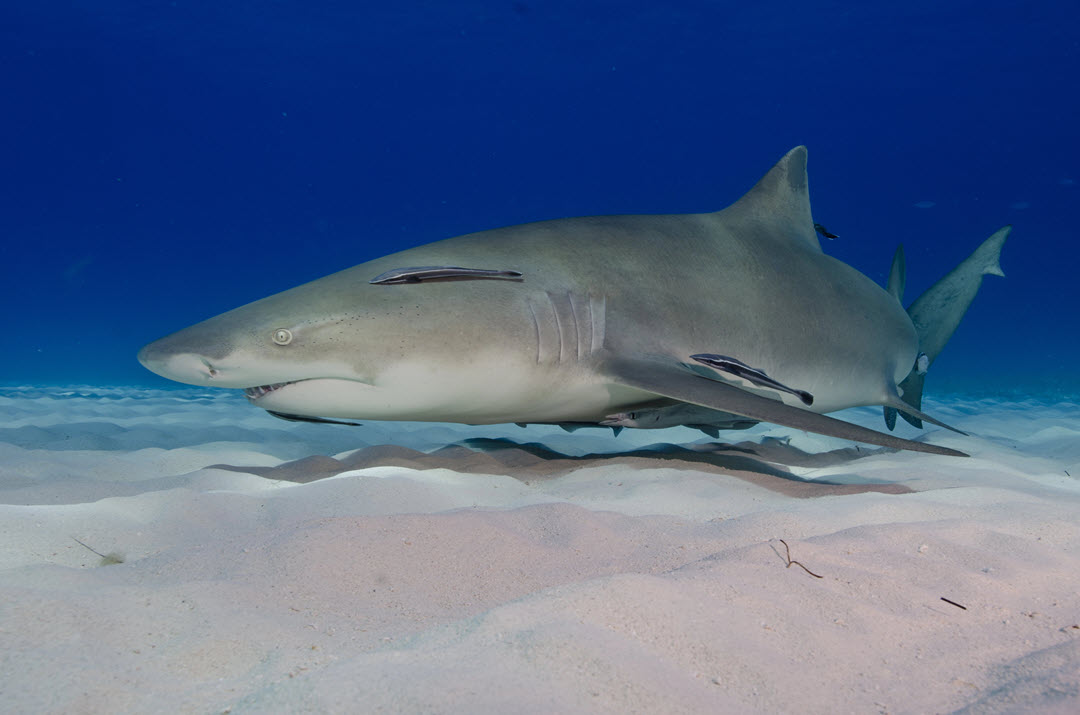
Lemon Sharks are also among the best-studied sharks in the world. Researchers have followed individuals for many years. This work reveals how they move, return to familiar places, interact with other sharks, and use coastal habitats throughout their lives.
Young Lemon Sharks often spend several years in shallow nursery areas before gradually moving into a wider range of habitats. Their strong connection to mangroves and other coastal ecosystems has made them especially important for shark research and conservation.
What Is a Lemon Shark?
The Lemon Shark (Negaprion brevirostris) belongs to the family Carcharhinidae, known as the requiem sharks. It’s part of the order Carcharhiniformes, or ground sharks.
Its common name comes from the yellowish or olive-brown color of its skin. This color can help the shark blend with sandy and muddy bottoms in shallow coastal water.
Lemon Sharks are large, strongly built sharks that spend much of their lives near coasts. They’re often associated with mangrove shorelines, bays, river mouths, coral areas, and sandy or muddy bottoms.
Physical Appearance
Lemon Sharks have thick, powerful bodies with broad, rounded snouts and relatively small eyes.
Their upper body is usually yellowish-brown, olive-brown, or gray-brown, while the underside is much lighter. This darker-above and lighter-below pattern provides camouflage in shallow water.
One of the easiest ways to recognize a Lemon Shark is by its two dorsal fins. The second dorsal fin is unusually large and nearly the same size as the first. Most other sharks have a much smaller second dorsal fin.
Their teeth are narrow and pointed, letting them grasp slippery prey such as fish.
Lemon Sharks commonly reach around 8 feet (2.4 meters) long, but large individuals can grow to about 11 feet (3.4 meters). Females generally grow larger than males.
Where Do Lemon Sharks Live?
Lemon Sharks live mainly in warm coastal waters of the western Atlantic Ocean and eastern Pacific Ocean.
In the western Atlantic, their range extends from the eastern United States through the Gulf of Mexico. It continues through the Bahamas and Caribbean, south toward Brazil. They also occur along parts of the West African coast. In the eastern Pacific, they’re found from Baja California and the Gulf of California south toward Ecuador.
Lemon Sharks use many shallow coastal habitats. These include mangrove shorelines, coral areas, enclosed bays, river mouths, sandy bottoms, muddy bottoms, and saline creeks. FishBase records them from the surface to about 300 feet (92 meters) deep.
Young Lemon Sharks often remain in protected nursery areas for several years. Mangrove-fringed bays are especially important because they provide food and shelter from larger predators.
Adults can range more widely and may make seasonal movements. Many Lemon Sharks repeatedly return to familiar areas, though.
Social Behavior
Lemon Sharks may be found alone or in small groups. Young sharks in nursery areas often spend time near other Lemon Sharks, since many individuals use the same protected habitat.
Research on juvenile Lemon Sharks has shown something interesting. Some individuals repeatedly associate with other sharks rather than simply encountering one another at random. Scientists have used special acoustic tags to record when tagged sharks come close together.
This doesn’t mean Lemon Sharks form permanent schools. Their social relationships can change as individuals grow, move, and use different habitats.
Scientists are especially interested in how age, size, habitat, and food influence these interactions. Lemon Sharks have helped researchers discover that shark social behavior can be more complex than once assumed.
What Do Lemon Sharks Eat?
Lemon Sharks feed mainly on fish, but they also eat crustaceans and mollusks.
Young Lemon Sharks eat small fish, crabs, shrimp, and other animals they can capture in shallow nursery habitats. As they grow larger, they’re able to take bigger fish, rays, and other prey.
Their diet varies depending on where they live and what food is available. This flexible feeding strategy helps Lemon Sharks survive in coastal environments. Prey communities in these places can change from place to place and season to season.
How Do Lemon Sharks Hunt?
Lemon Sharks are active predators that search shallow coastal waters for fish, rays, crustaceans, and other prey. They often move slowly through sandy areas, mangrove channels, bays, and reef habitats while using their senses to locate food.
Vision and smell help them find prey. The lateral line detects movement in the surrounding water. At close range, their electrical senses can help them detect living animals even when visibility is poor.
Once prey is located, a Lemon Shark can accelerate quickly and use its strong jaws and pointed teeth to seize it. Lemon Sharks may feed at different times of day. Their activity patterns can vary with location, tides, prey, and other environmental conditions.
Reproduction and Life Cycle
Lemon Sharks give birth to live young through placental viviparity. As the embryos develop, the yolk sac forms a placental connection with the mother and supplies nutrients to the growing pups.
FishBase reports litters of about 4 to 17 young. Newborn Lemon Sharks are about 24 to 26 inches (60 to 65 centimeters) long.
Females use shallow nursery habitats when giving birth, and some return to the same general areas used during earlier reproductive cycles. The pups receive no parental care after birth. Young sharks spend their early years in shallow habitats where they can find food and avoid some larger predators.
Lemon Sharks mature slowly. FishBase reports a maximum recorded age of 25 years, though lifespan estimates can vary among studies and populations.
Evolution & Adaptations
Lemon Sharks belong to the requiem shark family, Carcharhinidae. This large group of sharks includes bull sharks, blacktip sharks, spinner sharks, and many other coastal species.
The genus Negaprion contains the Lemon Shark and the closely related Sicklefin Lemon Shark. These sharks share several features, including strong coastal habits, similar body shapes, and large second dorsal fins.
Over evolutionary time, Lemon Sharks became well suited to warm, shallow coastal habitats. Their body shape, senses, and broad diet all help. So does their ability to use mangrove-fringed bays and other protected areas. Together, these let them survive in environments that change with tides, seasons, and water conditions.
Several specific adaptations support this coastal lifestyle. Their yellowish-brown color provides camouflage over sandy or muddy bottoms, making the shark less noticeable to both prey and other animals. Their strong bodies let them maneuver through shallow bays, mangroves, coral areas, and coastal channels. Unlike sharks built mainly for long-distance open-ocean travel, Lemon Sharks are well suited to moving through complex coastal habitats.
Like other sharks, Lemon Sharks have a lateral line that detects movement and vibrations in the water. They also have ampullae of Lorenzini, small sensory organs that detect weak electrical signals produced by living animals.
Lemon Sharks are also capable learners. Research has shown that they can learn from experience and remember information, helping scientists better understand learning and memory in sharks.
Modern genetic research also helps scientists study Lemon Shark populations in different parts of their range. This work shows how connected these populations are and how much movement occurs between regions.
Why Lemon Sharks Are Important
Lemon Sharks are part of the food webs of mangroves, bays, coral areas, and other coastal ecosystems. By feeding on fish, crustaceans, rays, and other animals, they help shape the communities that live in these habitats.
They’re also important because of their close connection to mangrove nursery areas. Protecting habitat used by young Lemon Sharks matters beyond just this one species. It also protects many other fish, crustaceans, birds, and marine animals that depend on healthy mangrove ecosystems.
Lemon Sharks have also made an enormous contribution to shark science. Individuals can be observed and followed over long periods. Because of this, researchers have used them to study learning, memory, social behavior, movement, reproduction, and habitat use. What scientists have learned from Lemon Sharks has helped change the old idea that sharks are simple animals driven only by instinct.
Conservation
The Lemon Shark is currently classified as Vulnerable by the International Union for Conservation of Nature (IUCN).
Fishing is one of the main threats to Lemon Sharks. They’re caught in commercial and recreational fisheries and may also be taken accidentally as bycatch.
Coastal habitat loss is another major concern. Mangroves, bays, estuaries, and other shallow areas used by young sharks are affected by coastal development, pollution, and changes to shorelines.
Lemon Sharks grow slowly and produce relatively small litters compared with many bony fish. Because of this, populations can take a long time to recover after heavy losses. Conservation depends on both responsible fisheries management and protection of important coastal habitats, especially nursery areas.
Research & Quotes
Lemon Sharks have been central to some of the longest-running shark research programs in the world. Scientists have tagged and followed individuals over many years, revealing strong connections between young sharks and particular nursery areas.
These studies helped establish the idea of site fidelity — the tendency of an animal to return repeatedly to the same place.
Researchers have also studied how Lemon Sharks learn and remember information. Experimental work has shown that sharks can learn from experience, while field studies have revealed repeated social associations among some individuals.
New technology continues to expand this research. Acoustic transmitters, proximity tags, genetics, and long-term identification records all help. These tools let scientists study shark movements and interactions without having to watch the animals continuously.
Lemon Shark research has helped transform the scientific picture of sharks. Instead of mostly solitary predators, sharks now look like animals capable of learning, remembering places, and forming changing social relationships.
Lemon Sharks in Culture
Lemon Sharks are especially well known in the Bahamas and Caribbean. Divers, researchers, and visitors may encounter them there in shallow coastal waters. Their relatively calm behavior and tendency to use familiar areas matter a lot. These traits have made them important animals for shark research, underwater photography, and responsible wildlife tourism.
Lemon Sharks are also closely associated with the history of modern shark science. Decades of research in places such as the Bahamas helped introduce the public to a different kind of shark. These are animals that can learn, remember, travel, and interact socially.
Today, Lemon Sharks are often used in education and conservation to show that understanding sharks requires more than focusing on teeth and hunting. Their lives include nursery habitats, long-term movements, social relationships, learning, and strong connections to coastal ecosystems.
| Common Name | Lemon Shark |
| Other Common Names | Yellow Shark |
| Scientific Name | Negaprion brevirostris |
| Family | Carcharhinidae |
| Order | Carcharhiniformes |
| Conservation Status | Vulnerable (IUCN) |
Interesting Lemon Shark Facts
- Lemon Sharks get their name from their yellowish or olive-brown coloring.
- Their two dorsal fins are almost the same size, which helps distinguish them from many other sharks.
- Large Lemon Sharks can reach about 11 feet (3.4 meters) long.
- Young Lemon Sharks often spend several years in shallow nursery habitats.
- Mangrove-fringed bays are especially important habitats for young Lemon Sharks.
- Lemon Sharks may be found alone or in small groups.
- Researchers have found repeated social associations among some juvenile Lemon Sharks.
- They can learn from experience and remember information.
- Some Lemon Sharks repeatedly return to familiar habitats.
- Fish make up much of their diet, but they also eat crustaceans and mollusks.
- Females give birth to live young through placental viviparity.
- Litters can contain about 4 to 17 pups.
- Newborn Lemon Sharks are about 24 to 26 inches (60 to 65 centimeters) long.
- Lemon Sharks have been important subjects in decades of shark research.
- The species is currently classified as Vulnerable by the IUCN.
SHARK PAGES
SPECIES PAGES