
Leopard Shark
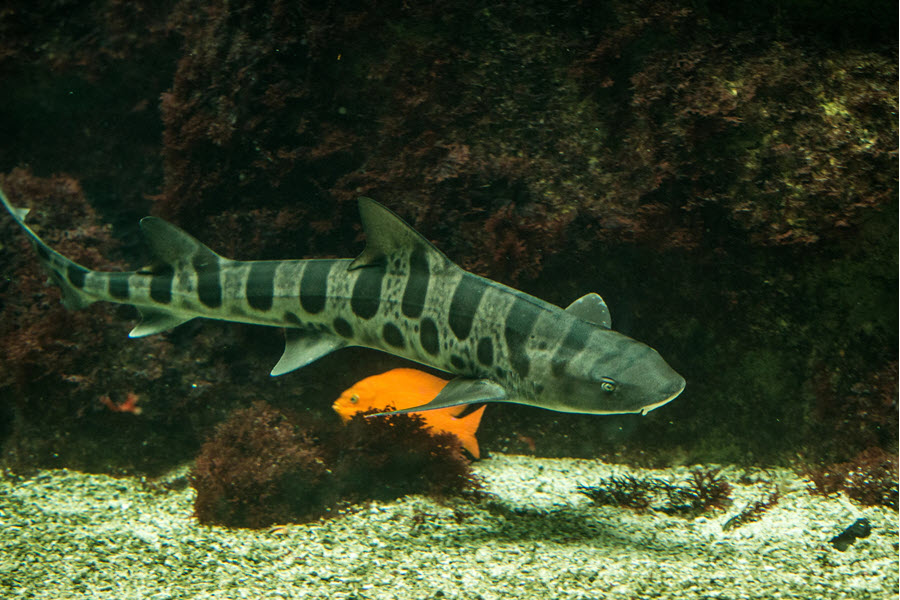
Leopard Sharks spend much of their lives in shallow water. They can be found in bays, estuaries, lagoons, sandy areas, mudflats, and near rocky reefs and kelp beds. They’re especially well known along the California coast, where large groups can sometimes be seen swimming through clear, shallow water.
These sharks spend much of their time near the seafloor searching for crabs, shrimp, fish, worms, and other small animals. Their shallow coastal habitat also makes them easier to observe than many sharks. This gives scientists valuable opportunities to study their movements, feeding, reproduction, and social behavior.
What Is a Leopard Shark?
The Leopard Shark (Triakis semifasciata) belongs to the family Triakidae, known as the houndsharks, and the order Carcharhiniformes, or ground sharks.
It’s a bottom-associated coastal shark found in the eastern Pacific Ocean. Unlike sharks that spend most of their lives crossing the open ocean, Leopard Sharks are strongly connected to shallow coastal habitats.
The scientific name semifasciata means “partly banded,” referring to the dark saddle markings that cross the upper part of the shark’s body.
Leopard Sharks are generally considered harmless to people. Their striking appearance and tendency to swim in shallow water matter too. These traits have made them familiar sharks to divers and snorkelers along the Pacific coast.
Physical Appearance
Leopard Sharks have long, slender bodies with rounded snouts and relatively large eyes.
Their most recognizable feature is their pattern. Dark saddle-shaped markings cross the back, with additional dark spots along the body and fins. The background color may be silver-gray, gray-brown, or bronze, while the underside is much lighter.
This pattern can help break up the outline of the shark as it swims. Sand, mud, rocks, and other features of the seafloor all blend with the pattern.
Leopard Sharks have many small teeth. Each tooth has a central point with smaller points beside it. This forms a surface suited to gripping the fish and bottom-dwelling animals they eat.
Adults are commonly around 4 to 5 feet (1.2 to 1.5 meters) long. The maximum length reported by FishBase is about 6.5 feet (1.98 meters).
Where Do Leopard Sharks Live?
Leopard Sharks live in the eastern Pacific Ocean along the west coast of North America. Their range extends from Oregon south to the Gulf of California in Mexico.
They’re especially associated with shallow coastal habitats. Leopard Sharks use enclosed bays, estuaries, lagoons, sandy areas, mudflats, and rocky areas near reefs and kelp beds.
FishBase records them from the surface to depths of about 512 feet (156 meters). They’re most commonly associated with much shallower water, though.
Some Leopard Sharks make seasonal movements between different coastal areas. Others repeatedly use familiar bays and feeding grounds.
Shallow bays and estuaries are also important habitats for young sharks. These productive waters provide small prey and places where young Leopard Sharks can grow.
Social Behavior
Leopard Sharks can be found alone, but they’re also well known for gathering in groups. FishBase reports that they form mixed schools, and large seasonal gatherings occur in some coastal areas.
These groups may contain sharks of different sizes. Leopard Sharks can also swim with other shark species.
Some of the best-known gatherings occur along the California coast during warmer months. In shallow areas, dozens or even hundreds of Leopard Sharks may sometimes occupy the same general habitat.
These gatherings don’t mean that Leopard Sharks live permanently in organized schools. Group size and location can change with season, water temperature, reproduction, food, and other environmental conditions.
The sharks can be observed in shallow water. Because of this, researchers can study these gatherings and learn more about how Leopard Sharks use coastal habitats.
What Do Leopard Sharks Eat?
Leopard Sharks eat a wide variety of animals that live on or near the seafloor.
FishBase records crabs, shrimp, bony fish, fish eggs, clam siphons, and innkeeper worms among their main foods. Other small bottom-dwelling animals may also be eaten when available.
The exact diet changes with the shark’s size, location, and available prey. Young sharks feed on smaller animals, while larger sharks can capture larger fish and invertebrates. This flexible diet lets Leopard Sharks take advantage of the many kinds of prey found in productive bays and estuaries.
How Do Leopard Sharks Hunt?
Leopard Sharks usually search for food close to the seafloor. They swim over sand, mud, eelgrass, and rocky areas while using smell, vision, the lateral line, and their electrical senses to locate prey.
Many of the animals they eat live partly hidden in or on the bottom. The shark’s sensory systems can help it locate prey even when it’s difficult to see.
Once prey is located, the shark moves in and captures it with its mouth. Its numerous small teeth are suited to holding fish and handling crustaceans and other bottom-dwelling animals.
Tides can also affect feeding opportunities. As water moves into shallow coastal areas, fish and invertebrates become available in new places. These spots may have been too shallow for the sharks at low tide.
Reproduction and Life Cycle
Leopard Sharks give birth to live young. They’re aplacental viviparous sharks, meaning the embryos develop inside the mother without a placental connection and are nourished mainly by yolk.
FishBase reports litters ranging from 4 to 29 pups, although another reproductive record reports 6 to 24 young. Newborn Leopard Sharks are small, measuring about 8 to 9 inches (20 to 23 centimeters) long.
Young sharks use shallow coastal habitats where they can find abundant small prey. As they grow, they gradually begin using a wider range of coastal areas.
Leopard Sharks grow slowly. FishBase reports a maximum recorded age of 30 years. Their slow growth and relatively long life mean that maintaining healthy adult populations is important for continued reproduction.
Evolution & Adaptations
Leopard Sharks belong to the houndshark family, Triakidae. This family includes a variety of sharks that live mainly in coastal waters and feed on fish and animals found near the seafloor.
The Leopard Shark belongs to the genus Triakis, which also contains several other houndshark species. Members of this group share features such as elongated bodies and teeth adapted for catching relatively small prey.
Over evolutionary time, Leopard Sharks developed features that work particularly well in shallow coastal environments. Their body shape lets them move easily over the seafloor. Their senses help them locate animals in sand, mud, eelgrass, and rocky habitats.
Like other living sharks, Leopard Sharks are part of an ancient branch of vertebrate evolution. But the modern Leopard Shark is the result of its own long evolutionary history. It shouldn’t be thought of as an unchanged animal from prehistoric seas.
Several specific adaptations support this coastal lifestyle. Their dark saddles and spots provide camouflage against the changing patterns of the seafloor. Their long bodies let them swim efficiently through bays, channels, eelgrass areas, and other shallow habitats.
Like other sharks, Leopard Sharks have a lateral line that detects movement and vibrations in the surrounding water. They also have ampullae of Lorenzini, sensory organs that detect weak electrical signals produced by living animals. These senses are especially useful when prey is difficult to see. A fish, crab, or worm partly hidden in sand or mud can still produce movements and electrical signals that reveal its location.
Leopard Sharks can also live in both marine and brackish water. This lets them use estuaries and other coastal areas where the amount of salt in the water can change.
Why Leopard Sharks Are Important
Leopard Sharks are part of the food webs of bays, estuaries, kelp areas, and other coastal habitats. They feed on fish, crabs, shrimp, worms, and other animals living near the seafloor.
They’re also useful to scientists studying coastal ecosystems. Leopard Sharks spend much of their lives in relatively accessible shallow water. Because of this, researchers can study their movements, feeding, reproduction, habitat use, and seasonal gatherings.
Their dependence on bays and estuaries also shows why healthy coastal habitats matter. These environments support not only Leopard Sharks but also fish, birds, marine mammals, crustaceans, and many other animals.
Leopard Sharks have another important role in public education. Seeing large groups of these patterned sharks swimming peacefully in shallow water changes how people see sharks. It’s a very different view from the image often presented in movies and popular culture.
Conservation
The Leopard Shark is currently classified as Least Concern by the International Union for Conservation of Nature (IUCN).
Leopard Sharks are caught in commercial and recreational fisheries, but fishing regulations have helped protect the species in important parts of its range.
Their strong connection to shallow coastal environments creates another concern. Bays, estuaries, lagoons, and other nearshore habitats can be affected by coastal development, pollution, habitat alteration, and declining water quality.
Many Leopard Sharks repeatedly use particular coastal areas. Because of this, local habitat damage can affect sharks that depend on those places for feeding, reproduction, or growth. Protecting healthy bays, estuaries, eelgrass habitats, wetlands, and other coastal ecosystems remains an important part of Leopard Shark conservation.
Research & Quotes
Leopard Sharks have been studied for decades. Many of their activities take place in shallow coastal water, where scientists can observe and track them.
Researchers have studied their seasonal movements, feeding, reproduction, growth, habitat use, and population structure. Tagging studies can reveal where individual sharks travel and whether they return to the same areas.
Scientists are also interested in the large seasonal gatherings that occur in some parts of California. Studying these groups can help researchers understand how water temperature, reproduction, food, and habitat affect shark movements.
Research on Leopard Sharks also provides information about the health and importance of bays and estuaries. Following the sharks can reveal how mobile marine animals connect different parts of a coastal ecosystem.
Leopard Sharks are more accessible than many deep-water and open-ocean sharks. This makes them valuable animals for studying the biology and ecology of coastal sharks.
Leopard Sharks in Culture
Leopard Sharks are among the most familiar sharks along parts of the California coast. Their striking pattern and seasonal gatherings make them popular with divers, snorkelers, underwater photographers, and wildlife watchers.
In some shallow coastal areas, people can observe the sharks without traveling far offshore. These encounters have helped make the Leopard Shark an effective animal for shark education. People who expect sharks to be constantly aggressive may instead see groups of Leopard Sharks quietly swimming through shallow water.
Leopard Sharks also appear in public aquariums and marine education programs, where their distinctive markings make them easy for visitors to recognize.
Its unusual appearance, visible coastal behavior, and close connection to California’s marine habitats all play a part. Together, they’ve made the Leopard Shark one of the best-known sharks of the eastern Pacific.
| Common Name | Leopard Shark |
| Other Common Names | None commonly used |
| Scientific Name | Triakis semifasciata |
| Family | Triakidae |
| Order | Carcharhiniformes |
| Conservation Status | Least Concern (IUCN) |
Interesting Leopard Shark Facts
- Leopard Sharks are named for the dark saddles and spots covering their bodies.
- They live only in the eastern Pacific Ocean, from Oregon to the Gulf of California.
- They are especially common in shallow bays and estuaries.
- Leopard Sharks can form large seasonal groups.
- They spend much of their time swimming close to the seafloor.
- They can live in both salt water and brackish water.
- Their diet includes crabs, shrimp, fish, fish eggs, clam siphons, and marine worms.
- They use electrical senses to help locate animals around them.
- Adults are commonly around 4 to 5 feet (1.2 to 1.5 meters) long.
- The largest length reported by FishBase is about 6.5 feet (1.98 meters).
- Females give birth to live young.
- Litters can contain more than 20 pups.
- Newborn Leopard Sharks are only about 8 to 9 inches (20 to 23 centimeters) long.
- The maximum reported age is 30 years.
- The species is currently classified as Least Concern by the IUCN.
SHARK PAGES
SPECIES PAGES