
Sand Tiger Shark
The Sand Tiger Shark is one of the most misunderstood sharks in the ocean. With its mouth permanently open, rows of long needle-like teeth, and slow, deliberate swimming style, it looks fierce and intimidating. In reality, this large coastal shark is generally calm and poses little danger to humans.
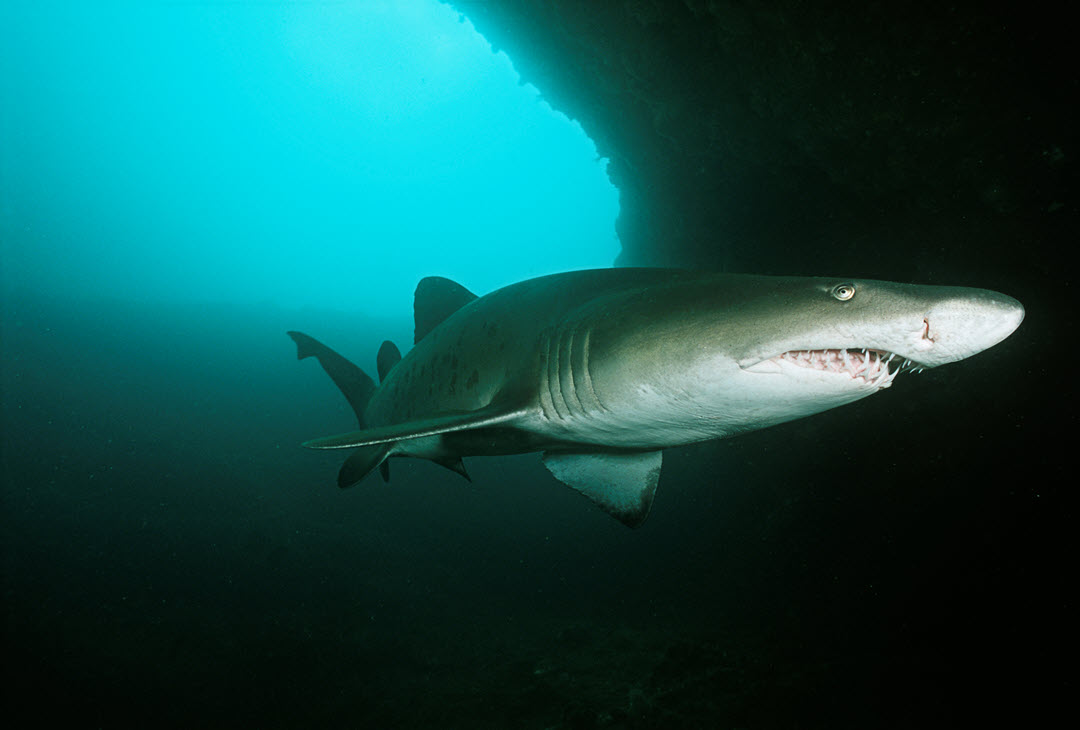
Sand Tiger Sharks live in temperate and subtropical coastal waters around the world. They’re often found near rocky reefs, shipwrecks, sandy bottoms, and underwater caves, where they slowly patrol in search of fish and other prey. Their relaxed behavior makes them a favorite among scuba divers and underwater photographers.
One of the Sand Tiger Shark’s most remarkable features is its unusual reproductive strategy. Before birth, the largest developing embryo consumes its smaller siblings inside the mother’s body. This ensures that only the strongest pups survive. It may seem surprising, but it’s a natural adaptation that produces large, well-developed young capable of surviving immediately after birth.
Today, Sand Tiger Sharks face serious conservation challenges. They reproduce slowly and have experienced significant population declines in many parts of the world.
What Is a Sand Tiger Shark?
The Sand Tiger Shark (Carcharias taurus) is a member of the mackerel shark order, Lamniformes, in the family Carchariidae. Despite its name, it’s not closely related to Tiger Sharks or true requiem sharks.
Sand Tiger Sharks are best known for their long, pointed teeth that remain visible even when the mouth is closed. Their appearance often causes people to think they’re dangerous. Decades of research have shown that they’re generally slow-moving, curious, and non-aggressive toward humans.
The genus name Carcharias comes from an ancient Greek word for shark. That word was itself based on a term meaning “sharp” or “jagged,” likely referring to the shark’s teeth. The species name taurus is Latin for “bull.” It comes from Pesce Tauro, a local Italian name for the shark used near Sicily. That’s the region where the species was first formally described.
The Sand Tiger Shark is an excellent example of why appearance alone should never determine how we judge an animal.
Physical Appearance
Sand Tiger Sharks have thick, muscular bodies with pointed snouts and relatively small eyes. Adults typically measure between 7 and 10 feet (2.1 to 3 meters) long, with a maximum recorded length of about 10.5 feet (3.2 meters).
Their most distinctive feature is their mouth. It contains several rows of long, slender, needle-like teeth that project outward even when the jaws are closed. These teeth are designed for gripping slippery fish rather than cutting large pieces of flesh.
Their bodies are light brown to gray with darker reddish-brown spots scattered across the back and sides, especially in younger sharks. The underside is pale white.
Unlike fast-swimming sharks, Sand Tigers have relatively large fins and a thick body built for slow, steady movement through coastal waters.
Where Do Sand Tiger Sharks Live?
Sand Tiger Sharks live in temperate and subtropical coastal waters around the world. This includes the Atlantic coast of North and South America, the Mediterranean Sea, southern Africa, Japan, and Australia.
They’re commonly found near coral reefs, rocky reefs, shipwrecks, sandy bottoms, underwater caves, and coastal drop-offs. FishBase records the species from the surface to about 630 feet (191 meters). They’re usually found in shallower water, though, generally around 50 to 80 feet (15 to 25 meters).
Unlike highly migratory oceanic sharks, Sand Tigers usually remain relatively close to continental coastlines. Many populations make seasonal migrations between warmer and cooler waters while returning to familiar breeding and feeding sites each year. Healthy coastal habitats are essential throughout every stage of their lives.
What Do Sand Tiger Sharks Eat?
Sand Tiger Sharks are opportunistic predators that feed mainly on medium-sized marine animals. Common foods include fish, rays, squid, small sharks, skates, crabs, lobsters, and octopus.
They usually hunt at night, moving slowly through reefs and along the seafloor before making quick strikes with their long, grasping teeth. Because they swallow prey whole or in large pieces, their teeth are designed primarily for gripping rather than slicing.
How Do Sand Tiger Sharks Hunt?
Sand Tiger Sharks are patient ambush predators. Rather than chasing prey over long distances, they move slowly through reefs and coastal habitats. They use their excellent vision, sense of smell, lateral line, and ampullae of Lorenzini to detect nearby animals.
When prey approaches, they accelerate quickly and seize it with their long, needle-like teeth.
One unusual adaptation lets Sand Tiger Sharks swallow air at the surface and store it in their stomach. This extra buoyancy helps them hover almost motionless in the water while conserving energy during hunting. This slow, deliberate hunting strategy is highly effective in complex reef habitats.
Reproduction and Life Cycle
Sand Tiger Sharks reproduce through aplacental viviparity, with embryos developing inside eggs that remain within the mother’s body.
They’re famous for an extraordinary reproductive behavior called adelphophagy, or embryo cannibalism. The largest embryo in each uterus consumes its smaller developing siblings, as well as unfertilized eggs produced by the mother. As a result, females almost always give birth to only two pups, one from each uterus.
Producing so few offspring may seem unusual, but each pup is born large and strong. Newborns measure roughly 3 feet (85 to 105 centimeters) long and are well prepared to survive independently right away.
This reproductive strategy has been successful for millions of years. It also makes the species especially vulnerable to overfishing, since populations recover very slowly. Researchers have validated ages of at least 40 years in some Sand Tiger Sharks, making them one of the longer-lived sharks studied.
Evolution & Adaptations
Sand Tiger Sharks belong to Lamniformes, an ancient order that includes Great White Sharks, Mako Sharks, and Goblin Sharks. Although they share ancestry with some of the ocean’s fastest predators, Sand Tigers followed a different evolutionary path. Rather than evolving for speed, they became slow-moving ambush predators capable of hovering quietly near reefs and rocky ledges.
Their remarkable reproductive strategy also evolved over millions of years. By producing only a couple of exceptionally large pups, Sand Tiger Sharks greatly increase the survival chances of their offspring. It’s a trade-off between quantity and quality that has kept the species successful despite its very low birth rate.
Their air-gulping behavior is one of their most unusual adaptations, letting them achieve nearly neutral buoyancy and hover with very little effort. Their long, outward-pointing teeth are ideal for gripping slippery fish, while their powerful jaws prevent prey from escaping.
Like all sharks, they have the lateral line, which detects vibrations. They also have the ampullae of Lorenzini, which sense weak electrical fields produced by nearby animals.
This combination of efficient hunting and unique reproduction has allowed the species to survive for millions of years despite producing relatively few young.
Why Sand Tiger Sharks Are Important
Sand Tiger Sharks are part of the food webs of coral reefs, rocky reefs, and other coastal ecosystems. They feed on fish, rays, squid, and other marine animals while patrolling their territory at night.
Because they frequently return to predictable coastal habitats, they’ve also become valuable to scientists studying migration, breeding behavior, nursery areas, and shark reproductive biology. Their unusual embryo development remains one of the most striking examples of reproductive adaptation among vertebrates.
Sand Tiger Sharks are also important public ambassadors for sharks in general. Their calm behavior around divers and popularity in public aquariums have helped many people rethink assumptions about sharks based on appearance alone.
Conservation
The Sand Tiger Shark is currently classified as Critically Endangered by the International Union for Conservation of Nature (IUCN).
Because females produce only two pups during each reproductive cycle, populations recover very slowly after declines. Major threats include commercial fishing, recreational fishing, bycatch, habitat degradation, coastal development, and marine pollution.
Many countries now protect Sand Tiger Sharks, and marine protected areas are helping conserve important breeding and nursery habitats.
Research & Quotes
Sand Tiger Sharks have become valuable research animals because they frequently return to predictable coastal habitats. Scientists continue studying their migrations, breeding behavior, nursery areas, and unique reproductive biology. Their extraordinary embryo development remains one of the most remarkable examples of reproductive adaptation among vertebrates.
Marine biologists have used Sand Tiger Sharks to better understand how slow reproductive rates affect the recovery of threatened shark populations. This work also shows why protecting mature females is especially important for long-term conservation.
Sand Tiger Sharks in Culture
Sand Tiger Sharks are among the most recognizable sharks in public aquariums because of their dramatic appearance and calm behavior.
Divers often describe encounters with Sand Tigers as peaceful and unforgettable. Their slow swimming style lets photographers observe them closely without disturbing the animals.
For many people, seeing a Sand Tiger Shark in person changes long-held misconceptions about sharks. It reveals that even large, intimidating-looking species are often cautious and non-aggressive.
Today, Sand Tiger Sharks have become important ambassadors for shark conservation around the world.
| Common Name | Sand Tiger Shark |
| Other Common Names | Ragged-Tooth Shark, Grey Nurse Shark (Australia), Spotted Ragged-Tooth Shark |
| Scientific Name | Carcharias taurus |
| Family | Carchariidae |
| Order | Lamniformes |
| Conservation Status | Critically Endangered (IUCN) |
Interesting Sand Tiger Shark Facts
- Their long teeth remain visible even when the mouth is closed.
- They can gulp air at the surface to help control their buoyancy.
- They often hover almost motionless in the water.
- They’re usually active at night.
- They commonly gather around reefs and shipwrecks.
- Their embryos practice adelphophagy, consuming their developing siblings before birth.
- They’re popular attractions in public aquariums because of their calm behavior.
- Adults commonly reach 7 to 10 feet (2.1 to 3 meters) long.
- They feed mainly on fish, rays, and squid.
- They’re generally not aggressive toward humans.
- They often return to the same coastal habitats year after year.
- Females usually produce only two pups at a time, one from each uterus.
- Newborn pups measure roughly 3 feet (85 to 105 centimeters) long.
- Some individuals have been validated at 40 years old or more.
- The Sand Tiger Shark is currently classified as Critically Endangered by the IUCN.
SHARK PAGES
SPECIES PAGES